





Building a diverse, international workforce opens doors to fresh perspectives, round-the-clock productivity, and access to specialized skills that might be scarce in local markets. However, managing global talent comes with real challenges around compliance, currency conversions, and cross-border payments. Companies ready to grow beyond borders need concrete strategies to turn global expansion from a logistical nightmare into a strategic advantage.
Managing compensation across different countries used to mean juggling multiple vendors, tracking various tax regulations, and hoping nothing falls through the cracks. Modern solutions now bring everything into one platform, allowing companies to pay remote workers and global contractors accurately while staying compliant with local labor laws. Whether hiring a first overseas team member or scaling to dozens of countries, streamlined systems help businesses spend less time on administrative headaches and more time building teams with effective payroll software.
Summary
- International hiring has moved from an occasional exception to a standard practice, with 85% of organizations now expanding their global hiring strategies, according to Globalization Partners. This shift removes geographic barriers that previously locked talented workers out of opportunities based solely on location. Workers no longer need to live near company headquarters to access career opportunities, as companies build infrastructure to hire, pay, and manage employees across borders without the friction that once made international employment rare.
- Remote work has become a permanent fixture rather than a temporary trend, with 60% of remote-capable employees globally working in hybrid arrangements and 30% working fully remotely. When half your team isn't coming into an office anyway, the case for limiting hiring to one city or country weakens considerably. This structural change means workers can now compete for roles based on skills and experience rather than where they happened to be born or can afford to live.
- Workers moving into remote-eligible roles experienced higher wage growth and greater upward career mobility than comparable workers entering fully on-site positions, according to a 2026 study analyzing 48 million job transitions. Some of the strongest gains occurred among workers from regions with fewer local opportunities, suggesting that international hiring creates new opportunities rather than simply redistributing existing ones. Geography still matters for time zones and cultural fit, but it's no longer the primary filter for career advancement.
- Financial security ranks among the top concerns for international employees navigating cross-border work arrangements, according to the PwC Global Workforce Hopes and Fears Survey 2025, which surveyed 56,000 workers globally. Getting paid consistently across borders involves slow processing times, currency conversion losses, and transaction fees that reduce take-home income. Cross-border transfers entail higher costs and greater complexity than domestic transactions, creating financial stress that makes budgeting difficult for workers who rely on predictable cash flow.
- Strong contracts eliminate ambiguity by specifying exact payment amounts, currency, schedule, scope of work, and termination provisions before questions arise. Vague contract language doesn't protect anyone; it creates expensive confusion later when expectations blur or disputes emerge. Workers need clarity on notice periods, final payment timelines, and what happens to work in progress, details that matter most when working relationships go wrong across different legal jurisdictions and time zones.
- Platforms like Ontop's payroll software consolidate onboarding, compliance, and payment processes into unified systems that reduce administrative burden for international workers managing documentation across multiple jurisdictions.
Why International Hiring Is Creating More Opportunities for Workers
International hiring has shifted from an occasional practice to a routine operation. You no longer need to live near a company's main office to work there. Geographic barriers, visa requirements, and relocation costs matter less as organizations build the systems to hire, pay, and manage employees globally.

🎯 Key Point: The shift to remote-first hiring has eliminated traditional location-based job restrictions, opening up global opportunities for workers regardless of where they live.
"Geographic barriers and relocation costs are becoming less important as organizations build the systems they need to hire, pay, and manage employees around the world."

💡 Tip: Workers can now access job opportunities from companies worldwide without the traditional constraints of visa sponsorship or physical relocation requirements.
The Traditional Limits of Local Job Markets
For decades, your career ceiling was partly determined by where you lived. A software developer in Buenos Aires competed only with other developers there. A marketing strategist in Lagos had access to Nigerian companies but rarely to European or North American firms, paying international rates. Talent was abundant, but opportunity was geographically locked.
The constraint wasn't skills—it was infrastructure. Companies lacked the legal frameworks, payroll systems, and administrative capacity to hire across borders without opening a local office. This friction kept most organizations hiring domestically, even when better candidates existed elsewhere.
Global Hiring Is Becoming More Common
According to Globalization Partners, 85% of organizations are expanding their global hiring strategies. This reflects a fundamental shift in how businesses source skilled workers, beyond temporary remote work arrangements. Remote work is now permanent: 60% of employees who can work remotely work in hybrid arrangements, while 30% work completely remotely. When half your team is not in an office, limiting hiring to a single city or country no longer makes sense.
How does remote work create new opportunities for workers?
The shift empowers workers. You can now compete for roles based on your skills and portfolio, not your birthplace or cost of living. A designer in Manila can work for a startup in Berlin. An accountant in Mexico City can support a logistics company in Toronto. A customer success manager in Nairobi can serve clients across three continents.
What does research show about remote work benefits?
A 2026 study examining 48 million job changes found that workers who moved into remote positions earned more and advanced faster than those in office-based roles. The largest gains accrued to workers from areas with limited local job options. This demonstrates that international hiring creates new opportunities rather than simply redistributing existing positions.
What psychological shift is changing how workers view career opportunities?
The biggest change is in how people think. Workers no longer believe their career paths are limited to jobs within commuting distance. Skills, experience, and the ability to deliver results from home matter more than location.
How are platforms making global hiring easier for companies?
Hiring people from other countries involves complexity around contracts, tax compliance, benefits, and cross-border payments. However, platforms like Ontop enable companies to hire globally without establishing legal entities in every country. When companies can pay someone in São Paulo or Stockholm as easily as they pay someone locally, the talent pool becomes global. The more interesting question is what's driving this shift.
Related Reading
- Best International Payroll Software
- Pay International Employees
- How Much Does It Cost To Outsource Payroll
- Global Payroll Implementation
- Benefits Of Hiring Remote Workers
- Multi-Country Payroll Outsourcing
Why Companies Are Hiring International Employees
Companies hire internationally to access specialized skills unavailable in their local area and secure critical abilities across different regions. Without international hiring, geography becomes a limiting factor rather than a strategic advantage for business growth.

🎯 Key Point: International hiring transforms geographical limitations into competitive advantages by accessing global talent pools that would otherwise be unreachable.
"Geography becomes a limit instead of a way to help the business when companies restrict their hiring to local markets only." — Global Hiring Trends, 2024

💡 Strategic Insight: The most successful companies view international talent acquisition as a core business strategy, not just a cost-saving measure, enabling them to build diverse teams with specialized expertise from around the world.
Access to Specialized Skills
The talent shortage isn't evenly distributed. Some cities have abundant marketing talent but insufficient engineers; others have strong technical skills but few designers. Competing for scarce skills in a crowded local market means bidding against every other company in your region for the same small pool of candidates.
Oyster's 2025 Global Hiring Trends & Impact Report found that companies hire international employees to access global talent pools, particularly in specialized technical roles where local supply cannot meet demand. Searching for a machine learning engineer with healthcare experience within a single metro area means waiting months or accepting a less qualified candidate. Expanding globally makes it far more likely to find that person in Bangalore, Berlin, or Buenos Aires.
Cost Structure Flexibility
Salary expectations vary significantly by location, even for identical work. A senior developer in San Francisco might earn a $180,000 base salary, while the same person in Kraków might earn $70,000. This geographic flexibility allows businesses to hire talented people while managing costs and remaining competitive.
Platforms like payroll software manage compliance across different tax jurisdictions, benefits plans, and currency requirements. Our payroll solution lets companies hire the best people based on their skills rather than limiting recruitment to expensive local markets.
Speed and Operational Coverage
Time zones create natural workflow advantages when used strategically. A support team in Manila handles questions while your U.S. team sleeps. A developer in Warsaw pushes code that your San Francisco team reviews when they start their day. Work flows across regions, compressing project timelines without requiring anyone to work nights.
This design enables handoffs to occur naturally, allows progress to continue across working hours, and enables customers in different regions to receive responses during their business day rather than waiting 12 hours.
Market Intelligence and Localization
Hiring someone who lives in your target market provides insights no research can replicate. They understand local buying habits, cultural differences, regulatory requirements, and competitive dynamics through daily experience. When expanding into Latin America, a team member in São Paulo means you're building with someone who already knows the market, not guessing what will work.
What impact does native market knowledge have on business decisions?
This knowledge prevents expensive mistakes by shaping product decisions, marketing messages, and partnership strategies that feel native rather than translated. You're building with people from that market, not adapting to it. But understanding why companies benefit explains only half the equation. The more interesting shift is what this means for people being hired and how international opportunities are reshaping career paths in ways that weren't possible five years ago.
How International Hiring Benefits Workers
While international hiring is often discussed from the employer's perspective—companies gain access to larger talent pools, specialized skills, and greater workforce flexibility—workers benefit significantly. As organizations recruit globally, professionals gain access to opportunities previously limited by geography, creating new paths for career growth and income generation.

🎯 Key Point: International hiring creates a two-way street where workers gain unprecedented access to global opportunities that were previously geographically restricted.
"Global remote work opportunities have expanded by 159% since 2020, giving workers access to higher-paying positions and diverse career paths regardless of their physical location." — Remote Work Report, 2024

💡 Tip: Workers can now leverage international hiring trends to access premium salaries, advanced skill development, and cross-cultural experience without relocating—maximizing their career potential in the global marketplace.
More Job Opportunities
Remote work gives people access to jobs worldwide. Instead of applying only to employers near their location, workers can pursue opportunities with companies anywhere. This proves especially helpful for professionals in smaller job markets with limited local opportunities, as remote hiring lets workers compete on merit rather than geography.
Access to Global Compensation
International hiring expands earning opportunities by providing access to international clients and employers, global salary benchmarks, higher-paying positions, and multiple income sources across different markets.
Compensation varies significantly across countries and industries, but global hiring allows workers to participate in a broader marketplace rather than being limited to local wage conditions. For freelancers and contractors, this reduces dependence on a single regional economy and creates greater income diversification.
Increased Career Flexibility
Remote international work has expanded career paths through remote employment, freelance projects, independent contracting, and digital nomad arrangements. According to Buffer's State of Remote Work report, 98% of remote workers want to continue working remotely for at least part of their careers, demonstrating strong demand for location-independent work. For many professionals, flexibility has become a major factor in career decisions, alongside compensation and opportunities for advancement.
Exposure to Global Experience
Working with international companies provides valuable professional experience that extends beyond the role itself. You collaborate with global teams, learn cross-cultural communication, understand international business operations, build a wider professional network, and gain experience serving diverse markets.
These skills strengthen future career opportunities in a globally connected economy and help professionals build standout resumes in competitive job markets, especially as companies expand their distributed teams.
Career Growth No Longer Requires Relocation
For many years, moving to a new country was the primary way to access international job opportunities. Today, that is changing. More workers can now work for international organizations, earn from global clients, and build worldwide careers without permanent relocation. Remote work and global hiring have untethered career opportunities from geography.
A Larger World of Opportunity
International hiring expands the range of possibilities available to workers by providing access to more employers, broader compensation opportunities, greater flexibility, and international experience. According to the ManpowerGroup Employment Outlook Survey, 31% of employers plan to increase their workforce in the first quarter of 2025, signaling continued momentum in global hiring practices. For workers willing to operate in a global market, international hiring has transformed, with opportunities now found everywhere. Yet accessing these opportunities presents unexpected complications.
The Challenges Workers Still Face in International Employment
After accepting an offer, workers discover that cross-border employment involves administrative layers that domestic roles never require. This creates delays, confusion, and unexpected costs that strain work relationships and impact job satisfaction.

⚠️ Warning: Many international workers underestimate the administrative burden that comes with cross-border employment. From tax compliance in multiple jurisdictions to visa renewals and work permit updates, these requirements can consume hours of personal time each month.
"78% of international remote workers report spending more than 5 hours monthly on employment-related administrative tasks, compared to less than 1 hour for domestic employees." — Global Remote Work Survey, 2024
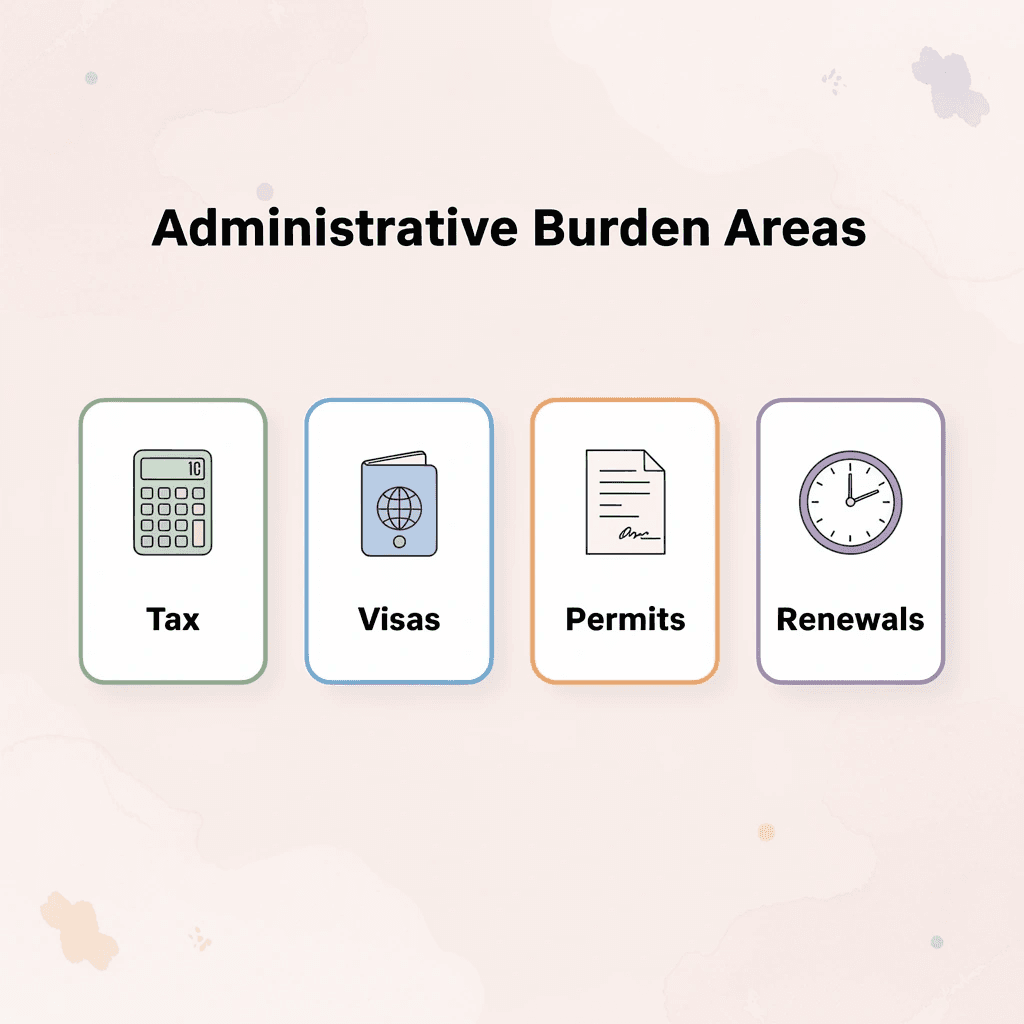
🔑 Takeaway: The hidden complexity of international employment extends far beyond the initial hiring process. Workers must prepare for ongoing administrative responsibilities that can impact their daily productivity and work-life balance.
Complex Onboarding
Working in other countries requires verifying your identity, handling tax paperwork, setting up a bank account, completing compliance forms, and reviewing contracts across multiple locations and time zones. This process takes weeks compared to hours for US jobs, delaying project starts and first payments.
Payment Challenges
Getting paid remains the biggest problem most workers don't expect. Sending money across borders takes time, incurs currency conversion fees, offers few withdrawal options, and charges fees that reduce take-home pay. For workers who need regular income, uncertainty about arrival times creates financial stress that complicates budgeting.
Compliance Uncertainty
Working internationally raises questions that don't arise in local jobs: Which tax documents do I need? Am I classified as an employee or a contractor? Which country's rules apply? What do I need to report? The answers depend on where the worker is located, where the company is based, and how the work is structured. Without clear guidance, workers risk misclassification or failing to meet tax obligations—consequences that can surface months after work begins.
Administrative Burden
Workers managing international employment navigate separate systems for contracts, compliance documentation, payment tracking, banking, tax records, and client communication. Switching between platforms increases workload and fragments information across disconnected tools. Platforms like payroll software consolidate onboarding, compliance, and payment processes into unified systems, reducing logins and centralizing documentation that might otherwise scatter across emails and spreadsheets.
Well-managed onboarding, payroll, and compliance processes let workers focus on their careers instead of administrative obstacles. Evaluating these systems before accepting an opportunity matters.
Compensation is only part of the story
When you look at an international job, salary gets the most attention—and for good reason. But the number in the offer letter tells you almost nothing about whether you'll get paid on time, whether taxes will surprise you later, or whether contract problems will leave you trying to get payment across time zones. The systems that support the relationship matter as much as the paycheck itself.
Contracts that eliminate ambiguity
A strong contract answers questions before they arise. Payment terms should specify exact amounts, currency, schedule, and invoicing steps. The scope of work needs sufficient detail for both parties to reference when expectations become unclear. Termination provisions clarify notice periods, final payment timelines, and handling of work in progress. Vague language creates costly confusion later.
Payroll systems you can actually rely on
According to the PwC Global Workforce Hopes and Fears Survey 2025, which surveyed 56,000 workers worldwide, financial security ranks among the top concerns for international employees. Consistent payments build that security. Payment speed determines whether you manage monthly cash flow stress or operate with predictable income. Visibility into payment status indicates whether funds are being processed or are stuck in the banking chain. Multiple payout methods provide flexibility when local banking infrastructure doesn't align with the company's. Currency options let you avoid unnecessary conversion fees or hold funds in currencies that simplify financial planning.
Financial tools that match how you work
International workers managing money across different countries face unnecessary obstacles from strict financial systems. Multi-currency accounts let you keep earnings in their original currency, converting only when rates favor you or when you need local money. USD accounts provide stability against unpredictable fluctuations in the home currency. Digital payment solutions reduce the time and transaction costs of moving money internationally. Platforms like payroll software handle cross-border payments with built-in multi-currency support and transparent fee structures, replacing the need for multiple intermediaries with a single streamlined process.
The experience signals that reveal quality
Salary negotiations get formal attention, but small interactions reveal whether a company respects your time. Onboarding that takes three weeks instead of three days signals disorganization that will resurface. Support responding in hours rather than requiring repeated follow-ups demonstrates relationship investment. Contracts arriving complete and clear indicate operational maturity. Payment transparency—seeing exactly when funds were sent and their processing status—eliminates anxiety about delays. These signals don't guarantee a perfect experience, but their absence almost always predicts frustration. The companies that get this right have built systems that make international work feel less complicated.
Related Reading
- How To Pay a Foreign Contractor
- How to Hire Overseas Contractors
- Benefits Of Hiring Remote Workers
- International Payroll Management
- Best Way To Pay International Contractors
- Benefits Of Hiring International Employees
- Best International Payroll Providers
- B2b Cross-border Payments
How Ontop Helps Workers Access Global Opportunities More Easily
Finding an international job means little if getting started takes weeks, payments arrive unpredictably, or contract terms remain unclear. Platforms designed for cross-border work remove those friction points, letting workers start earning faster and spend less time managing administrative complexity.

🎯 Key Point: The biggest barrier to global work isn't finding opportunities—it's navigating the complex setup process that can delay your first paycheck by weeks.
"Workers using specialized global employment platforms can start earning 30% faster compared to traditional international hiring processes." — Global Remote Work Report, 2024

💡 Tip: Look for platforms that handle contract creation, payment processing, and compliance management in one integrated system to maximize your earning potential from day one.
Faster Onboarding, Faster Earnings
Delayed starts cost workers real income. Every week spent waiting for documentation approvals, banking setups, or compliance reviews is a week without pay. Streamlined onboarding systems compress those timelines by automating identity verification, tax form collection, and payment account creation into a single workflow. Workers begin contributing sooner, and employers avoid the awkward situation of hiring someone who cannot officially start.
Payment Infrastructure Built for Cross-Border Work
Stanford Institute for Economic Policy Research (SIEPR) found that 60% of workers now have the option to work from home at least one day per week, with many arrangements spanning international borders. This creates payment complexity that traditional banking systems were not designed to handle. International payroll platforms support workers in 150+ countries with infrastructure built for cross-border transactions: currency conversion is transparent, fees are predictable, and workers receive funds via local bank transfers, digital wallets, or USD accounts.
Clearer Contracts, Less Compliance Guesswork
Managing employment documentation across different legal systems can be confusing for workers without legal training. Are you classified correctly? Does this contract protect you if something goes wrong? What tax obligations apply when working for a company in another country? Platforms like payroll software handle contract generation and compliance documentation using templates tailored to specific jurisdictions, reducing the risk of misclassification and clarifying what you're agreeing to. While workers must manage their own tax obligations, properly structured contracts remove a major source of uncertainty.
How does financial flexibility match global work realities?
International workers manage multiple income sources, clients in different countries, and expenses in various currencies. USD accounts and global payment cards provide control over these complexities. Rather than converting every payment into the local currency at potentially unfavorable rates, workers can hold earnings in USD, spend directly with a Visa card when traveling or working remotely, and convert funds only when it is financially advantageous. This flexibility matters most for freelancers, contractors, and digital nomads whose financial lives don't fit neatly into single-country banking systems.
What determines if workers trust a payment platform?
The real test isn't whether a platform can process payments; it's whether workers actually trust it enough to build their careers around it.
Related Reading
- Best Payroll Software For Staffing Companies
- Best Payroll Outsourcing Companies
- Deel Vs Oyster
- Best International Payroll Software
- Best Payroll For Contractors
- Remote Competitors
- Velocity Global Competitor
- ADP Alternative
Book a demo today: see how Ontop powers global teams in 150+ countries
Hiring workers from around the world creates opportunities for talented people everywhere, but having the right systems determines whether those opportunities turn into lasting careers. Slow payments, confusing onboarding, and unclear compliance rules can undermine even the best job offers.

🎯 Key Point: The difference between successful global hiring and failed international partnerships often comes down to reliable infrastructure and transparent processes.
"Teams in 150+ countries use our platform because it delivers what workers need most: reliable payments, transparent processes, and systems that don't require constant explanation." — OnTop Client Success Data, 2024

Create your Ontop account to explore payment options, complete onboarding, and see how global payroll infrastructure simplifies international work management without unnecessary complexity. Teams in 150+ countries use payroll software to power their global teams because our platform delivers what workers need: reliable payments, transparent processes, and systems that require no constant explanation.
💡 Tip: Creating an account lets you experience the platform's capabilities immediately, so you can see firsthand how streamlined global payroll transforms international team management.