






Managing payroll for a staffing company is genuinely complex. Tracking hours, contracts, and payments across dozens or hundreds of workers is demanding enough, and adding multiple countries to that mix raises the stakes considerably. Choosing the best international payroll software means finding a solution that handles compliance, multi-currency payments, and contractor management without adding to the administrative burden.
Ontop is built specifically for companies managing distributed and contract workforces, consolidating global payments and compliance into a single platform. That focus translates to fewer errors, faster payments, and less time spent on manual fixes. Whether the operation is a small staffing agency or a large workforce solutions firm, the right tool makes all the difference, and teams can explore what Ontop offers as dedicated payroll software.
Table of Contents
- Why Payroll Is One of the Biggest Challenges for Staffing Companies
- What Makes Payroll More Complicated for Staffing Companies?
- What to Look for in the Best Payroll Software for Staffing Companies
- 10 Best Payroll Software for Staffing Companies in 2026
- How the Right Payroll Software Helps Staffing Companies Grow
- How Ontop Helps Staffing Companies Manage a Global Workforce
- Book a Demo Today - See why 950+ Companies Trust OnTop to Power their Global Teams
Summary
- Payroll errors are a measurable and recurring problem for staffing companies, not an occasional exception. Research cited by EY found that 20 percent of payrolls contain errors, and organizations spend an average of $291 correcting each mistake. For a firm processing payroll for hundreds of workers per cycle, that cost compounds quickly, and the more serious consequence is talent attrition, since workers who receive incorrect or late payments often move to competing agencies without waiting for a resolution.
- The compliance burden for staffing companies does not scale linearly with growth. It compounds. The Strada Global 2025 Global Payroll Complexity Index assessed over 40 countries and confirmed what operations teams already experience: each new jurisdiction adds its own tax structures, statutory entitlements, and payment schedules that do not coordinate with one another. Staffing firms placing workers across the 180-plus countries where they operate are managing a regulatory puzzle that changes shape with every new placement.
- Worker misclassification risk intensifies across borders, not just domestically. When a staffing firm tries to run contractor payments and employee payroll through the same system across multiple countries, the workarounds accumulate until someone misses a filing deadline or applies the wrong employment status in a jurisdiction with serious penalties. Local labor authorities apply their own tests for employment status independent of how a contract is written, which means the documentation gap between platforms is also a legal exposure.
- Payroll automation has a direct and documented effect on operational capacity. According to the Recruiterflow Blog, staffing companies can save up to 80 percent of the time spent on payroll processing with automated payroll software. That reduction reflects what happens when manual reconciliation is replaced by automated compliance documentation and payment scheduling, not just faster wage calculations. It is also what allows agencies to scale worker volume without proportionally scaling administrative headcount.
- The speed of payroll setup directly affects placement revenue. When contractor onboarding and the first payment take days instead of hours, that delay compounds across every placement, every week, and every quarter. The agencies growing without proportional increases in overhead are the ones that removed friction between placing a worker and paying them accurately, treating payroll infrastructure as a scaling tool rather than a compliance checkbox.
- Payroll software built for contractor-native, cross-border workforces addresses this by consolidating contractor onboarding, local tax compliance, multi-currency payments, and compliance documentation into a single workflow rather than across disconnected tools, reducing the handoff points where errors and delays typically occur.
Why Payroll Is One of the Biggest Challenges for Staffing Companies
Payroll works very differently for staffing companies. When you manage a workforce that is always changing, where one client needs twelve contractors this week and three next week, and another pays by the hour while a third pays based on project milestones, you are not running one payroll—you are running dozens at the same time, each with its own rules. Add shift pay increases, overtime rules that change by state or country, and worker types that have legal consequences if classified incorrectly, and the amount of work to manage becomes very large.
"Staffing companies don't run one payroll — they run dozens simultaneously, each governed by its own rules, rates, and legal requirements."
💡 Tip: If your payroll process treats all workers the same way, you're likely creating compliance risks and costly errors without even knowing it.
⚠️ Warning: Misclassifying worker types — such as labeling an employee as an independent contractor — carries serious legal consequences, including back taxes, penalties, and lawsuits.
- Fluctuating headcount: Unpredictable weekly volume makes capacity planning and consistent payroll processing difficult.
- Multiple pay structures: Managing hourly, milestone, and salaried rates simultaneously increases the risk of calculation errors.
- Shift pay increases: Tracking and applying premium, variable rates per shift adds significant administrative complexity.
- State/country overtime rules: Navigating diverse, location-specific regulations requires constant oversight to ensure compliance.
- Worker classification: Misclassifying contractors versus employees creates severe, long-term legal and financial liability.
🎯 Key Point: For staffing companies, payroll complexity isn't the exception — it's the everyday reality. Managing it without the right systems means your team is constantly working harder just to keep up.

What does a payroll error actually cost a staffing firm?
The financial cost of errors is measurable. According to research cited by EY, 20 percent of payrolls contain errors, and organizations spend an average of $291 correcting each mistake. For a staffing firm processing payroll for several hundred workers per cycle, costs accumulate rapidly. The harder cost: a worker who receives the wrong amount or receives it late will not wait for correction—they will seek the next agency that pays reliably.
Most staffing teams rely on spreadsheets, manual timesheet collection, and disconnected payroll systems designed for simpler workforces. This approach breaks down once the worker count exceeds the point where human review can catch every discrepancy before payday. A 2025 payroll survey found that 53 percent of employees have experienced at least one payroll mistake, with nearly half reporting stress or anxiety as a result. Your talent pool is deciding whether your agency deserves their loyalty.
Why do legacy payroll systems fall short for staffing companies?
Platforms like Ontop exist because traditional payroll systems were not designed for workforces with many contractors spread across multiple countries. While older systems require manual setup for each new worker type or location, our payroll software handles cross-border payments and compliance as standard features. This distinction matters as staffing companies expand their global placements, since regulatory requirements grow more complex with each new country.
How does payroll accuracy shape client and worker trust?
Trust is critical. Clients hire staffing agencies to solve workforce problems, not create them. When payroll errors occur frequently enough that clients notice and discuss them, the agency's ability to perform suffers real damage. A 2025 survey from HiBob found that payroll accuracy is one of the top factors shaping how employees feel about their employers. For staffing firms, that relationship is the product.
Related Reading
- Best International Payroll Software
- Pay International Employees
- How Much Does It Cost To Outsource Payroll
- Global Payroll Implementation
- Benefits Of Hiring Remote Workers
- International Payroll Management
- Multi-Country Payroll Outsourcing
What Makes Payroll More Complicated for Staffing Companies?
Cross-border complexity changes payroll from a small problem into a big one. Staffing firms that place workers in multiple countries face completely different problems stacked on top of each other. According to Teamed Global's 2025 Complete Payroll Guide, staffing companies operate across 180+ countries, each with its own payroll laws, tax structures, and compliance requirements. This creates a regulatory puzzle that changes with every new placement.
"Staffing companies operate across 180+ countries, each with its own payroll laws, tax structures, and compliance requirements — creating a regulatory puzzle that changes with every new placement." — Teamed Global, 2025 Complete Payroll Guide
🔑 Takeaway: Operating across 180+ countries doesn't just multiply your workload — it multiplies your legal exposure, your compliance risk, and your administrative complexity at the same time.
⚠️ Warning: Every new international placement resets the compliance challenge. There is no one-size-fits-all payroll solution when your workforce spans dozens of jurisdictions simultaneously.
- Tax Structures: Single-country payroll uses one system; multi-country requires navigating 180+ unique, non-integrated systems.
- Compliance Requirements: Single-country operates under one framework; multi-country demands constant adaptation to shifting, complex local laws.
- Payroll Laws: Single-country follows standardized rules; multi-country requires adhering to specific, granular rules per placement.
- Risk Level: Single-country risk is localized and manageable; multi-country risk is exponentially higher, amplifying the impact of every error.

Why geography multiplies the compliance burden
Every country treats workers differently, and the rules don't align. A worker sent to Germany has different legal benefits than one sent to Brazil or Singapore. Currency conversion, local tax withholding, required social contributions, and country-specific payment schedules must all be managed simultaneously. The Strada Global 2025 Global Payroll Complexity Index examined over 40 countries and confirms: complexity doesn't grow linearly—it accelerates.
Why do EOR models fall short for contractor-heavy staffing firms?
Most staffing companies use Employer of Record providers to ensure compliance across countries. However, the workforce has shifted: contractors now comprise the majority of cross-border workers, and EOR models built around traditional employment structures add unnecessary cost and friction to arrangements never intended to resemble full-time employment.
How does contractor-native payroll software change the equation?
Payroll software built for contractor-native, cross-border payments addresses that mismatch. Rather than forcing a contractor relationship into an employment compliance framework, our platform handles local tax compliance, multi-currency payments, and contractor agreements without the institutional overhead of EOR infrastructure. For staffing companies placing talent across dozens of countries, this architectural difference translates directly into speed, cost, and operational flexibility.
Why does mixing worker types across borders create compliance failures?
The failure point usually occurs like this: a staffing firm processes contractor payments and employee payroll through the same system across multiple countries, each with different pay cycles. The system wasn't built for that combination, and workarounds pile up until someone misses a filing deadline or misclassifies a worker in a jurisdiction with serious penalties. Worker classification risk intensifies at the border because local labor authorities apply their own tests for employment status, independent of how the contract is written.
How does constant workforce turnover compound these pressures?
Constant workforce turnover intensifies these pressures. A staffing agency might bring on thirty contractors in a week, each requiring verified payment details, tax documentation, and country-specific compliance checks, while simultaneously removing workers from finished assignments. That volume creates gaps where errors can hide, particularly when teams manage it through disconnected tools or manual processes.
The other half of the equation is knowing what to look for in a platform built to handle it.
What to Look for in the Best Payroll Software for Staffing Companies
The best payroll software for staffing companies must keep pace with how quickly your workforce works and how flexible your payroll needs to be.
"The best payroll software for staffing companies must keep up with how fast your workforce works and how flexible it needs to be." — Core Principle of Staffing Payroll Management
🎯 Key Point: Not all payroll software is built for the unique demands of staffing — you need a solution designed for high-volume, fast-moving workforces.
💡 Tip: When evaluating your options, prioritize platforms that offer real-time processing, multi-client billing, and flexible pay schedules — these are non-negotiable features for any staffing-specific payroll system.
- Real-Time Payroll Processing: Ensures agility, allowing you to instantly adapt payroll to your workforce's rapid fluctuations.
- Flexible Pay Schedules: Provides essential versatility by supporting diverse pay cycles (weekly, bi-weekly, or daily) tailored to specific talent needs.
- Multi-Client Billing: Streamlines operations by effortlessly managing distinct billing cycles and accounts for multiple clients within one system.
- Compliance Automation: Eliminates manual oversight, significantly lowering the risk of expensive errors and regulatory penalties.

Support for mixed workforce models
Most staffing platforms manage contractors and employees in separate systems because older payroll software was built around one worker type per account. This creates hidden costs: duplicate data entry, matching errors between systems, and compliance blind spots where worker classification errors slip through. A unified system that handles both employee payroll and contractor payments within the same workflow closes that gap. Our payroll software gives your team one source of truth instead of two fragmented ones.
Automated processing and compliance built in
The failure point is usually not the payroll calculation itself, but the chain of manual steps surrounding it: chasing tax documents, verifying payment details, and applying the right deduction rules for workers in different jurisdictions. According to the Deel Blog, top payroll platforms for growing businesses automate wage calculations, compliance documentation, and country-specific payroll rules simultaneously. Staffing firms cannot afford to treat compliance as separate from payment processing.
Most teams handle global contractor payments by combining a payroll tool, a wire transfer service, and a compliance-tracking spreadsheet. As worker volume and jurisdictions grow, this fragmented approach creates documentation gaps that trigger audits. Our payroll software consolidates these workflows into a single platform, managing local tax requirements, currency conversion, and payment scheduling for contractor-native, cross-border payments.
Scalability, integrations, and real-time visibility
Scalability means handling complexity without proportional growth in headcount. Staffing companies that grow without operational chaos connect payroll directly to time-tracking, onboarding, and workforce management tools, allowing data to flow automatically rather than being re-entered at each handoff. According to Wellness360's 2026 review of the top payroll software tools, top platforms offer strong integration ecosystems and real-time reporting dashboards as core functionality. Workforce visibility is critical: a staffing firm managing 300 active contractors across five countries cannot make sound financial decisions without knowing, in real time, where payroll spend is concentrated and where cost overruns are emerging.
Why does payroll speed determine whether you win a placement?
The right payroll platform is a competitive signal. Staffing firms that onboard a contractor in Buenos Aires, verify tax status, and process their first payment within 48 hours operate in a different category from those that route paperwork via email. That speed determines whether you win a placement or lose it to a faster competitor.
Which platforms actually deliver on these criteria for real staffing workflows?
The harder question is which specific platforms meet these criteria when tested against real staffing workflows.
10 Best Payroll Software for Staffing Companies in 2026
Ten platforms have earned real traction with staffing companies in 2026, and the differences between them matter before you sign a contract.
"Not all payroll platforms are built equal — for staffing companies, the wrong choice can mean compliance failures, delayed worker payments, and costly contract penalties." — Industry Best Practice
💡 Tip: Before evaluating any platform, identify your non-negotiables — such as multi-state compliance, contractor vs. W-2 support, and real-time payroll processing — so you can eliminate the wrong options fast.
⚠️ Warning: Signing a long-term payroll contract without comparing key features across platforms is one of the most expensive mistakes a staffing company can make in 2026.
- Multi-state tax compliance: Staffing firms must navigate diverse jurisdictional requirements to avoid tax penalties across dispersed placements.
- Contractor & W-2 support: The need for a mixed workforce requires flexible, automated classification tools to ensure legal adherence for both employee types.
- Onboarding speed: In the staffing industry, speed is a competitive advantage; rapid worker setup is essential to fulfill client demands immediately.
- Integration capabilities: Seamless data flow between the EOR, ATS, and time-tracking systems is critical to eliminate manual entry and reduce errors.
- Pricing model: Transparent, scalable pricing is vital, as traditional per-worker fees can become unpredictable and erode margins during rapid headcount growth.
1. Ontop
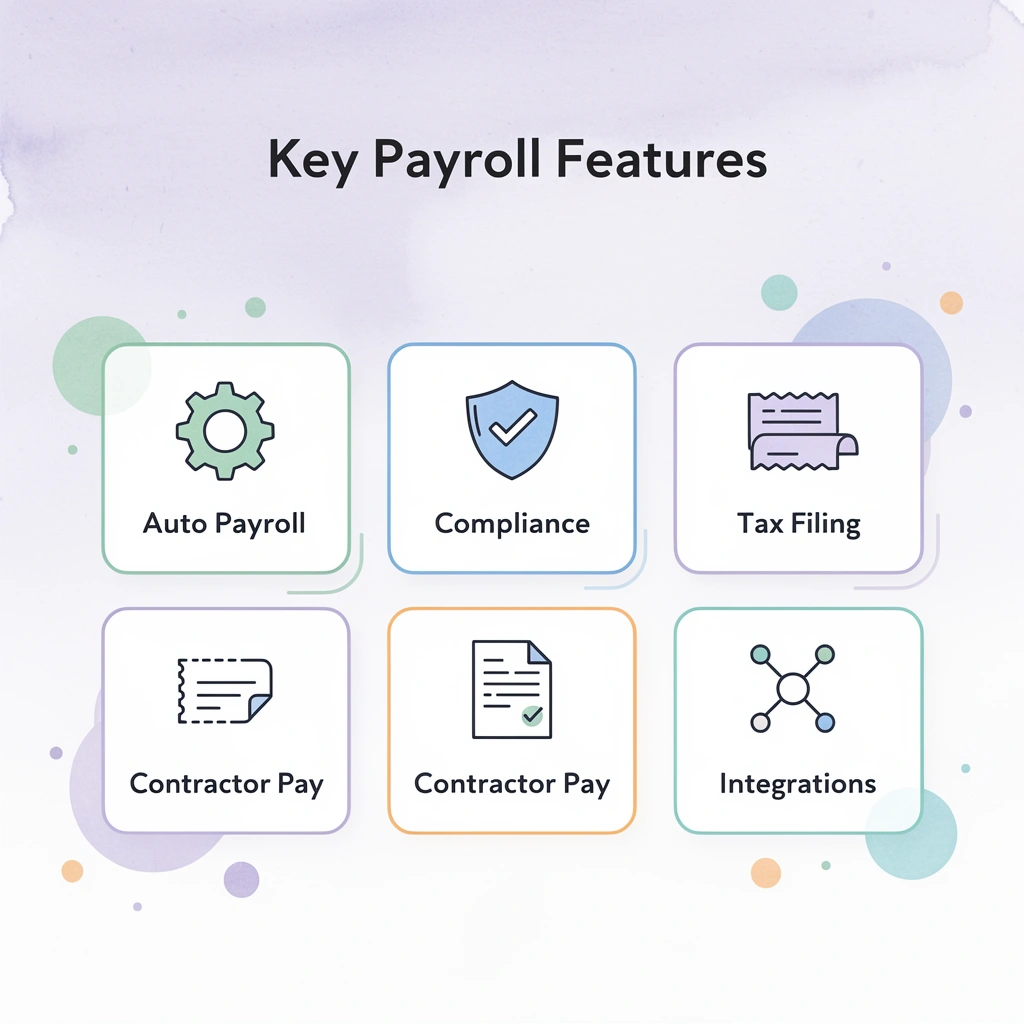
Staffing firms moving fastest treat payroll as a placement capability rather than a back-office function. When contractors in Buenos Aires or Lagos can be onboarded, papered, and paid within the same business day, that speed becomes a competitive advantage. Payroll software like Ontop handles contractor onboarding, compliance documentation, and cross-border payments across 150+ countries from a single platform, with USD accounts and a Global Visa Card that give contractors real financial utility beyond wire transfers.
How does Ontop reduce payroll errors for staffing agencies?
Most staffing agencies send contractor payments through fragmented tools: separate systems for agreements, tax paperwork, and transfers. This creates growing risk—mismatched records, delayed payments, and classification mistakes that surface during audits. Ontop consolidates this stack into a single workflow, eliminating handoff points where errors can occur.
2. Deel
Deel built its reputation on offering a wide range of services, covering both contractor management and full Employer of Record services. This makes it useful for agencies placing a mix of independent contractors and direct employees across international markets. The onboarding workflows are organized, and contract localization is thorough, though the EOR layer adds cost and process complexity that pure contractor-focused agencies may not need.
3. Remote
Remote's main strength is compliance infrastructure. For staffing firms placing talent in regulated markets such as Germany, France, or Brazil, Remote provides local employment support and benefits administration to reduce legal risk. The tradeoff is that the platform is built around the employment model, which can feel burdensome for agencies with mostly contractor-based workforces.
4. Rippling
Rippling's biggest difference is its automation scope. While most payroll platforms stop at calculating wages and filing taxes, Rippling connects payroll to HR administration, device management, and workflow automation, allowing a new contractor to be onboarded, granted system access, and added to payroll in a single process. For agencies managing numerous placements with significant IT coordination, this integration eliminates manual handoffs that slow operations.
According to the Recruiterflow Blog, staffing companies can save up to 80% of the time spent on payroll processing with automated payroll software, replacing manual reconciliation with measurable gains.
5. Papaya Global
Papaya Global is built to grow. Large staffing companies managing payroll across dozens of countries benefit from a unified dashboard that provides workforce analytics and cross-border compliance support. The platform suits organizations with dedicated payroll operations teams rather than lean agencies seeking lightweight solutions.
6. Multiplier
Multiplier targets agencies actively expanding into new countries, offering global payroll, contractor management, and Employer of Record services. The platform accelerates market entry by reducing the research burden of understanding local compliance requirements, which proves valuable for staffing firms opening placements in Southeast Asia or the Middle East for the first time.
7. Oyster
Oyster focuses on sustainable global employment programs rather than one-time placements. Its benefits administration and compliance management tools help agencies provide contractors and employees with a consistent experience across locations, which distinguishes them in the competition for specialized talent.
8. Gusto
Gusto's limitation is geography, not functionality. Within the US, it handles payroll processing, tax filing, and employee benefits administration with an intuitive interface. It fails when a staffing agency needs to pay someone outside the US. Ontop solves this by enabling payroll processing across 150+ countries, making global workforce payments seamless.
The tax compliance risk is real: the Recruiterflow Blog reports that over 40% of small businesses incur IRS penalties due to incorrect payroll tax filings, a consequence of payroll complexity outpacing the systems managing it.
9. Paychex
Paychex works well for growing staffing firms that need payroll, HR, and workforce management in a single integrated platform. The compliance resources and tax services are well-suited to US-based operations, and the platform scales with your headcount. It's a dependable option for agencies that have outgrown spreadsheets but don't yet manage global workforces.
10. ADP Workforce Now
ADP Workforce Now suits organizations with dedicated payroll staff handling high transaction volumes. Its enterprise-grade reporting, time-and-attendance tracking, and scalable infrastructure serve large staffing companies managing thousands of workers across multiple clients. Implementation requires substantial investment, justified by high transaction volume.
Choosing the right fit
Thinking about your constraints helps here. If your workforce consists mostly of international contractors, EOR-focused platforms add unnecessary costs and process friction. If your placements are in the US and growing, mid-market tools offer robust functionality without the complexity of global compliance. If you're scaling across both, the gap between your current platform's capacity and growth requirements will first appear in payroll error rates.
The right payroll software removes friction between placing a worker and paying them accurately and on time. That alignment between platform capability and operational model is where the selection decision lies.
But choosing the right platform is only half the equation; the other half is where most agencies leave serious growth on the table.
How the Right Payroll Software Helps Staffing Companies Grow
Payroll software stops being a back-office function the moment it determines how fast you can place workers, how cleanly you can enter new markets, and how much of your team's week goes to actual growth versus administrative tasks. Our payroll software helps agencies remove these bottlenecks, transforming what's typically a constraint into a competitive advantage.
💡 Tip: If your payroll setup slows placements, it's not an HR problem—it's a revenue problem. Every back-office delay is a growth delay.
"Payroll software helps agencies remove bottlenecks, turning what's typically a constraint into a competitive advantage." — Core Principle
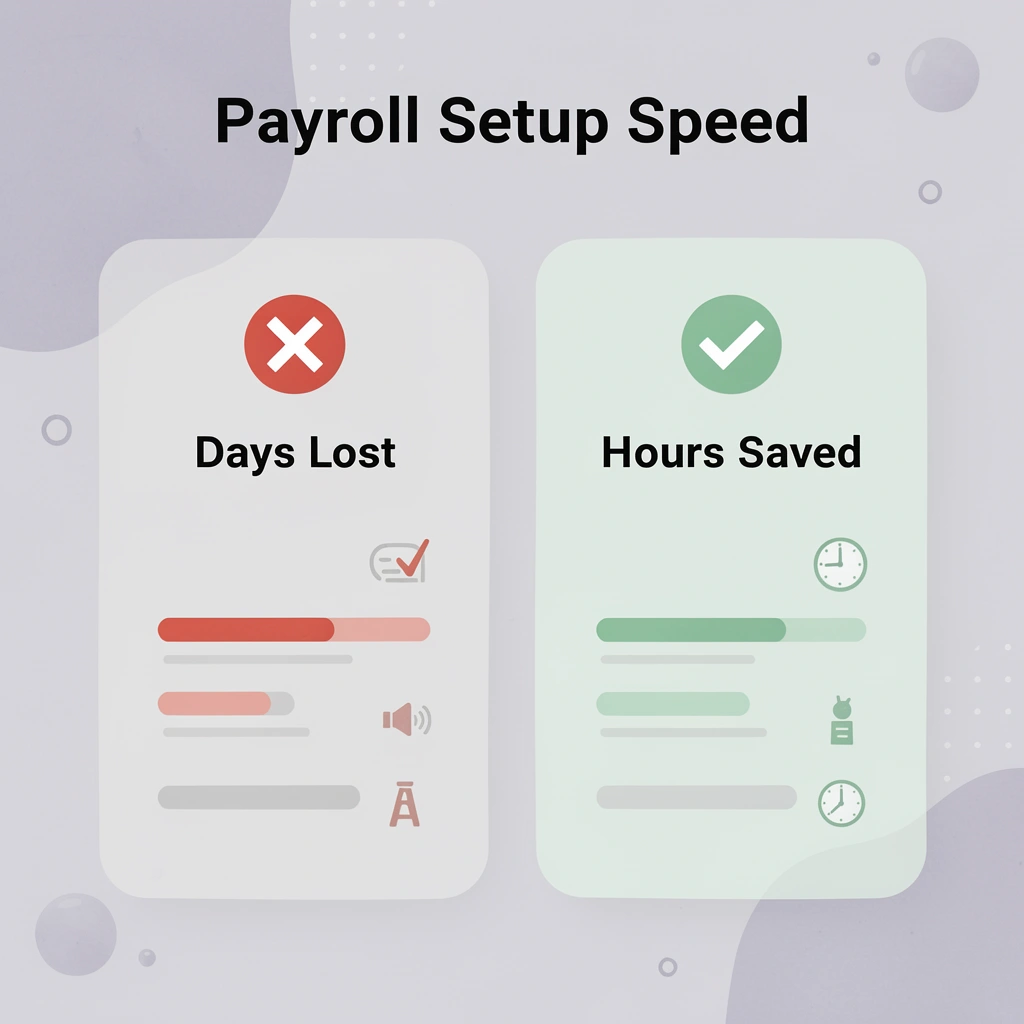
The agencies winning right now are the ones that removed friction from placement to payment. Speed of onboarding directly translates to speed of revenue recognition. When payroll setup takes days instead of hours, that delay compounds across every placement, every week, every quarter.
🎯 Key Point: Faster payroll setup = faster revenue. The difference between a days-long process and an hours-long one isn't just operational — it's the gap between agencies that scale and those that stall.
- Days to onboard: Creates a bottleneck that delays placements and results in compounding revenue loss as talent sits idle.
- Hours to onboard: Enables immediate deployment, leading to faster placements and accelerated revenue recognition for the agency.
- Automated workflows: Removes manual friction, allowing the team to shift focus from administrative recovery to high-impact growth and client acquisition.
Why does administrative overhead grow faster than headcount does?
A pattern emerges consistently across growing staffing firms: administrative overhead scales faster than headcount. A team processing payroll for 50 contractors manually can manage. At 200 contractors across three countries, the same manual process breaks down. According to Indeed for Employers, 14 payroll software tools were reviewed for 2025, reflecting how crowded this space has become. Firms that treat payroll automation as a scaling tool rather than a compliance checkbox grow without a proportional increase in administrative costs.
What is the real cost of managing cross-border payments manually?
Most staffing teams handle cross-border payments through wire transfers, local banking relationships, and currency conversion workarounds. Hidden costs extend beyond transaction fees to include time spent matching payments, chasing confirmations, and managing currency risk. Platforms like Ontop consolidate contractor payments across 150+ countries into a single workflow, providing contractors with a global financial account while reducing the back-and-forth that slows agencies down. This shift compresses what once took days into minutes.
How does payroll efficiency become a competitive advantage for staffing firms?
Companies that treat payroll efficiency as a competitive signal win on talent retention. Workers notice reliable pay and a smooth onboarding process, and they refer others when the experience is consistent. Workforce.com identified 14 best payroll software services for 2025, with the strongest performers sharing the ability to integrate workflows: connecting placement, compliance, and payment without manual intervention at each step. That integration transforms payroll from a cost center into a growth lever.
The agencies that scale without adding proportional overhead discovered this early: the right payroll infrastructure enables a different kind of growth.
The question worth considering is whether your current platform serves your existing workforce or the one you're still trying to build.
Related Reading
- How To Pay a Foreign Contractor
- How to Hire Overseas Contractors
- How to Hire a Remote Team
- How to Calculate Time for Payroll
- How to Hire International Employees
- Best Way To Pay International Contractors
- Best Global Payroll Companies
- Best Hiring Tools
How Ontop Helps Staffing Companies Manage a Global Workforce
As staffing companies grow around the world, payroll and workforce management become much more complex. Hiring international contractors, following compliance requirements, managing payments across multiple countries, and keeping accurate documentation create administrative challenges that slow growth. Local systems are not enough once agencies start hiring talent globally.
"The complexity of managing a global workforce — from compliance requirements to multi-country payments — creates administrative burdens that local systems simply cannot handle." — Ontop
🚨 Warning: Relying on local payroll systems when scaling internationally is one of the most common mistakes staffing agencies make — and it can lead to compliance failures, payment delays, and lost talent.
💡 Tip: Staffing companies expanding globally need a unified platform that handles contractor hiring, multi-country payments, and compliance documentation all in one place — rather than patching together disconnected local tools.
- Hiring international contractors: Requires navigating complex, region-specific onboarding and classification hurdles that can stall talent acquisition.
- Compliance requirements: Creates a high risk of costly legal penalties and reputational damage across multiple jurisdictions if local labor laws are misinterpreted.
- Multi-country payments: Introduces significant operational friction due to fluctuating currency exchange rates, banking delays, and diverse international payment standards.
- Accurate documentation: Generates a heavy administrative burden that drains internal resources and slows down overall operational growth.

Is Ontop built for international contractors and distributed teams?
Ontop is designed to help companies manage global talent without the operational complexity of international hiring. Instead of relying on multiple providers for onboarding, payments, contracts, and workforce administration, staffing companies can manage these processes through a single platform. This centralized approach maintains visibility across their workforce while simplifying day-to-day operations.
How does Ontop bring hiring, onboarding, and payments together?
Ontop brings hiring, onboarding, workforce management, and payments together in one platform. Agencies can onboard contractors quickly, collect required documentation, manage contracts, and process payments without switching between multiple tools. This streamlined approach helps staffing companies place talent faster and reduces manual work.
How does Ontop support payments across 150+ countries?
Ontop supports payments in more than 150 countries, enabling staffing firms to work with talent regardless of location. Rather than managing multiple payment providers or navigating different local payment processes, agencies can handle international payments through our platform. This flexibility allows staffing companies to reach a wider pool of talented workers while maintaining a consistent payment experience.
How does Ontop help staffing companies reduce compliance risk?
Worker classification rules, local labor regulations, tax requirements, and contractual obligations vary significantly between jurisdictions. Ontop helps staffing companies manage these challenges through compliance support that reduces risk. By enabling agencies to maintain proper documentation and contractor agreements, our platform supports more compliant hiring and payment processes.
Ontop simplifies contract and documentation management by centralizing contractor agreements within the platform. Important records can be collected, organized, and maintained in one place, reducing reliance on manual processes and scattered files. This creates a more efficient workflow as agencies scale.
What flexible payment options does Ontop offer global workers?
Contractors expect payment flexibility based on their location and financial needs. Ontop provides flexible payment options that help staffing firms work with diverse global workforces while delivering better payment experiences. Eligible workers can access USD accounts and a Global Visa Card, enabling greater flexibility when managing international earnings.
How does Ontop scale with growing staffing firms?
Ontop is designed to grow with agencies. It allows them to manage larger contractor networks, enter new markets, and support distributed teams without dramatically increasing administrative overhead, helping agencies maintain operational efficiency as they pursue global growth.
By centralizing onboarding, payments, contracts, compliance support, and workforce administration, Ontop reduces the manual work required to manage global contractors. Streamlined processes and flexible payment options improve the worker experience, freeing staffing companies to focus on recruiting talent, serving clients, and growing their business.
Book a Demo Today - See why 950+ Companies Trust OnTop to Power their Global Teams
If your payroll platform was built for a workforce model that no longer fits, every placement carries hidden friction. Staffing companies hiring, onboarding, and paying global contractors faster—without compliance complexity—are booking a demo with Ontop to see how our payroll software works. Over 950 companies already use Ontop to power their global teams, and the gap between them and firms patching together legacy tools grows wider every quarter.
"The gap between firms using modern contractor-first payroll infrastructure and those patching together legacy tools grows wider every quarter." — Ontop, 2024
🎯 Key Point: 950+ companies have already made the switch to Ontop — every quarter you delay is a quarter your competitors pull further ahead.
💡 Tip: If your current platform wasn't designed for cross-border contractor payroll, you're not just losing time — you're accumulating invisible compliance risk with every placement.
- Legacy Payroll Tools: Rigidly designed for traditional employee models; Ontop: Purpose-built for contractor-first, cross-border agility.
- Legacy Payroll Tools: Relies on manual compliance workarounds; Ontop: Provides automated, built-in compliance across all borders.
- Legacy Payroll Tools: Slow, friction-heavy onboarding processes; Ontop: Delivers fast, streamlined onboarding for global talent.
- Legacy Payroll Tools: Often relies on patched-together integrations; Ontop: Built on a unified, purpose-designed payroll infrastructure.
- Legacy Payroll Tools: Often leads to growing operational gaps; Ontop: Proven reliability, trusted by 950+ companies worldwide.
Is your payroll infrastructure built for the contractor-first, cross-border workforce you're placing now, or the one from five years ago? If there's hesitation, that's the demo worth taking.
⚠️ Warning: Hesitation here isn't neutral. Every quarter spent on outdated payroll infrastructure means more hidden friction, more compliance exposure, and more ground lost to competitors running on modern global payroll tools.
✅ Best Practice: Book a live demo with Ontop to see how 950+ staffing companies are hiring, onboarding, and paying global contractors faster with zero compliance complexity.
Related Reading
- Best Payroll Software For Staffing Companies
- Best Payroll Outsourcing Companies
- Deel Vs Oyster
- Best International Payroll Software
- Best Payroll For Contractors
- Remote Competitors
- Velocity Global Competitor
- ADP Alternative