






Managing payroll for contractors across multiple countries looks straightforward until currency differences, local tax rules, and varying payment schedules turn it into a logistical headache. Businesses working with independent contractors spread across time zones often find that the tools built for traditional employees simply do not hold up under the complexity of global contractor payments.
Ontop is a platform designed specifically for this challenge, helping companies send compliant payments in local currencies without drowning in paperwork or legal fine print. Whether a business manages five contractors or fifty, the right payroll software makes it possible to handle compensation reliably and stay focused on growth.
Table of Contents
- Getting Paid Shouldn't Be the Hardest Part of Freelancing
- Why Traditional Payment Methods Often Fall Short for Contractors
- What Makes a Great Payroll Solution for Contractors?
- 10 Best Payroll Solutions for Contractors in 2026
- How the Right Payroll Platform Can Improve More Than Just Payments
- How Ontop Helps Contractors Get Paid Faster and Work Globally
- Book a Demo Today - See why 950+ Companies Trust OnTop to Power their Global Teams
Summary
- Late or missed payments remain a structural problem for contractors working across borders, not an exception. According to Dubsado's State of Freelancing in 2025, over 70% of freelancers have experienced at least one late or non-payment from a client. The income often exists, and the work is approved, but currency conversions, bank intermediaries, and country-specific compliance requirements block access to it.
- Fragmented payment infrastructure compounds the problem as client volume grows. Contractors commonly manage separate tools for invoicing, international transfers, currency conversion, and tax documentation, each operating in isolation. According to Paystand, 61% of contractors report cash flow problems caused by late payments, and those problems ripple outward into budgeting, recurring expenses, and month-to-month financial planning.
- Cross-border compliance is where traditional payment methods show their sharpest limitations. Bank transfers and payment platforms move money but offer no guidance on local contractor classification rules, documentation requirements, or tax obligations for foreign-currency payments. That responsibility lands entirely on the contractor, often without warning. According to the Rabbet 2025 Construction Payments Report, slow payments act as a 14% hidden tax on the U.S. construction industry, draining $299 billion in 2025 alone, a figure that reflects cumulative drag rather than individual transaction fees.
- Transparent pricing is rarer than it should be in international payment platforms. A platform advertising low transfer fees while applying a 2.5% currency conversion markup on every withdrawal is not inexpensive; it is expensive in a way designed to be invisible. Contractors building sustainable international careers tend to evaluate full cost structures before committing, not just headline fees.
- Administrative overhead accumulates in ways that are easy to underestimate until they compound. According to Rightworks, 40% of small businesses spend more than 80 hours per year on federal taxes alone, and contractors operating across multiple jurisdictions face a version of this problem that multiplies with each new client relationship. That time has a direct cost measured in billable hours not sent, proposals not written, and clients not pursued.
- Financial predictability matters as much as payment speed for contractors managing multiple client relationships. Predictable payment cycles allow contractors to commit to expenses, invest before a project starts, and take on work they genuinely want rather than only what feels financially safe. Rippling's payroll research shows that companies automating payroll reduce processing time by up to 80% and that efficiency flows directly to contractors when client-side bottlenecks are removed.
- Payroll software addresses this by consolidating contractor onboarding, compliance documentation, multi-currency payments, and financial tools into a single account rather than a collection of disconnected workarounds, thereby reducing the administrative surface area that quietly grows behind every scaling freelance business.
Getting Paid Shouldn't Be the Hardest Part of Freelancing
Getting paid is supposed to be the reward for good work. Instead, for millions of contractors working across borders, it has become its own full-time problem between the work they do and the money they earn.
"For millions of freelancers, the hardest part of the job isn't the work itself: it's getting paid for it."
🚨 Warning: If you're treating late payments as a normal part of freelancing, you're absorbing a cost that was never yours to carry.
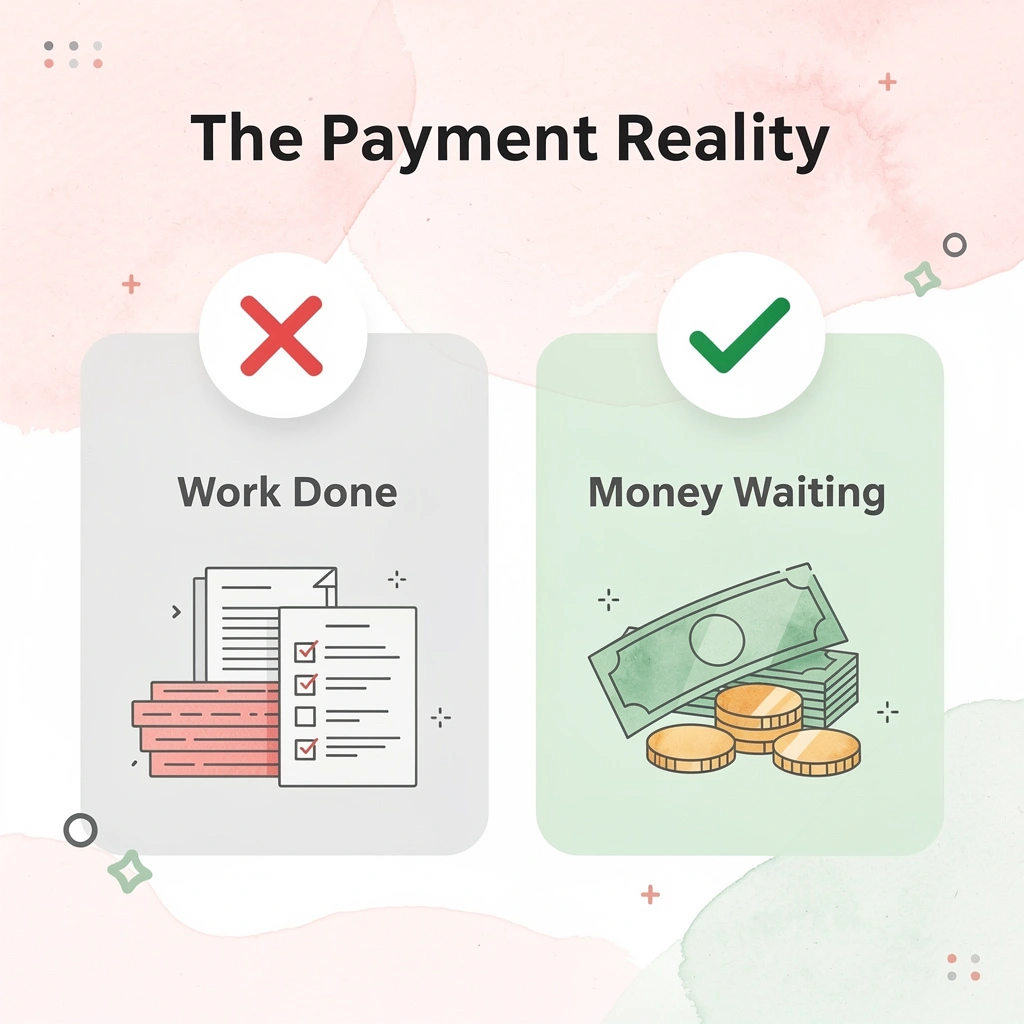
A contractor finishes a project on time, sends a clean invoice, and then waits. Sometimes days. Sometimes weeks. According to Dubsado's State of Freelancing in 2025, over 70% of freelancers have experienced at least one late or non-payment from a client. This is not just a rare problem — it is a structural problem built into how international payments were designed long before remote work became common.
- 70%+ experience with late/non-payment: Leads to chronic financial stress, lost income, and dangerous cash flow gaps for independent workers.
- Days to weeks of waiting: Creates erratic, unpredictable revenue cycles that make personal financial planning nearly impossible.
- Cross-border payment friction: Results in eroded earnings through high hidden fees and frustratingly slow global transfer speeds.
- Pre-remote payment infrastructure: Traditional banking systems are ill-equipped for today’s workforce, causing significant administrative friction for both parties.
🔑 Takeaway: Late and missing payments aren't edge cases — they're a systemic flaw affecting the majority of freelancers worldwide, rooted in payment infrastructure that was never designed for the modern remote economy.
💡 Tip: Protect your cash flow by building payment terms, late fees, and upfront deposits into every contract before work begins.
Why does accessing earned income break down for international contractors?
The income often exists. The work was completed, the client is satisfied, and the invoice has been approved. What breaks down is access to that income. Currency conversions eat into margins. Bank intermediaries add transfer fees before funds clear. Compliance requirements vary by country and create processing delays. For contractors managing multi-currency payments across several clients, the administrative burden compounds quickly.
Most contractors piece together wire transfers, PayPal accounts, and whatever payment method each client prefers. This works until the client base grows across three or four countries, each operating on different payment timelines and currencies. Platforms like Ontop address this by consolidating compliant contractor payments across 150-plus countries into a single infrastructure, eliminating the need to manage each client relationship as a separate financial system.
Why were legacy payroll systems never built for independent contractors?
Contractor payroll has long been treated as an afterthought in global hiring. Old systems were built around full-time employment models, with processes designed for payroll departments rather than independent professionals moving between projects and time zones. This mismatch is why contractors describe payment logistics as more complicated than the actual work.
The global contractor workforce is no longer a niche category: it is the direction the entire labor market is moving. Contractors building careers in this space deserve financial tools that match the sophistication of their work.
But understanding why payments fail is only part of the picture; the reasons run deeper than most expect.
Related Reading
- Best International Payroll Software
- Pay International Employees
- How Much Does It Cost To Outsource Payroll
- Global Payroll Implementation
- Benefits Of Hiring Remote Workers
- International Payroll Management
- Multi-Country Payroll Outsourcing
Why Traditional Payment Methods Often Fall Short for Contractors
Traditional payment methods fail contractors because they were never designed for modern contracting: managing multiple clients across continents with overlapping payment schedules and varying compliance requirements.
"The infrastructure built for traditional employment simply wasn't designed to handle the complexity of multi-client, cross-border contractor payments — and that gap costs contractors time, money, and compliance certainty." — Industry Insight
⚠️ Warning: Using outdated payment systems for cross-border contractor work can expose you to serious compliance risks and costly payment delays across multiple jurisdictions.
- Multi-client management: Traditional systems are built for single-payer payroll, failing to accommodate contractors juggling multiple simultaneous clients.
- Cross-border payments: Legacy methods rely on slow, high-fee wire transfers, whereas modern contractors require fast, low-cost global transfers.
- Compliance requirements: Old tools focus on one jurisdiction, whereas modern needs demand navigation of varying international standards simultaneously.
- Payment schedules: Traditional systems enforce rigid, uniform cycles, ignoring the reality of overlapping, flexible timelines required by modern contract work.
💡 Tip: Contractors managing more than 2 international clients should immediately evaluate whether their current payment infrastructure can handle overlapping schedules and multi-jurisdiction compliance — most cannot.
🔑 Takeaway: The core problem isn't just inconvenience — traditional payment systems were architecturally built for a single-employer, single-country model that is fundamentally incompatible with modern global contracting.

When the tools don't talk to each other
The failure point is usually fragmentation. A contractor might use one platform to send invoices, a second to receive international transfers, a third to convert currencies, and a fourth to organize tax documentation. Each tool operates independently, creating a workflow that is exhausting to maintain and where errors accumulate silently until they become costly.
What does fragmentation actually cost contractors?
The financial cost is real. According to Paystand, 61% of contractors report cash flow problems caused by late payments. When income arrives unpredictably across multiple currencies and platforms, budgeting becomes a structural problem rather than a skill problem.
Why does the friction get worse as client volume grows?
Most contractors accept this friction as a cost of doing business internationally, building buffer time into cash flow estimates and spending hours each month reconciling invoices against deposits. As client volume grows, that buffer evaporates. What felt manageable at two or three clients becomes unsustainable at eight or ten. Platforms like Ontop address this by consolidating contracts, compliance, and multi-currency payments into a single workflow, eliminating manual reconciliation across disconnected systems.
The Compliance Gap Nobody Warns You About
Cross-border compliance is where traditional payment methods fall short. Bank transfers and payment platforms move money, but they don't help contractors understand what documentation is required in a given country, whether they're classified correctly under local law, or what tax obligations arise from a foreign-currency payment. That responsibility lands entirely on the contractor, often without warning and sometimes after the fact. A contractor working with a client in Germany faces different requirements than one working with a client in Brazil—neither their bank nor their payment platform will flag the difference.
What does payment friction actually cost contractors over time?
According to the Rabbet 2025 Construction Payments Report, slow payments act as a 14% hidden tax on the U.S. construction industry, draining $299 billion in 2025 alone. The cost of payment friction extends beyond individual transaction fees to the total drag on an entire profession whose financial tools were never updated to match how contractors actually work. Traditional tools treat compliance and payment as separate problems, but for contractors building global careers, they are one and the same.
The harder question is not whether your current payment setup technically works, but what it costs to maintain.
What Makes a Great Payroll Solution for Contractors?
A great payroll solution for contractors takes care of the hard work behind the scenes so contractors can focus on work that actually makes them money. Our payroll software handles the complexities automatically, so you can concentrate on what matters most. If a platform needs constant attention, it has already failed.
"The best payroll platform is one you barely have to think about — it handles complexity automatically so contractors stay focused on billable work, not admin overhead." — Industry Best Practice
🎯 Key Point: A truly great payroll solution should run seamlessly in the background — zero manual intervention, zero headaches, and zero wasted time on administrative tasks.
💡 Tip: When evaluating a contractor payroll platform, ask yourself: How much time will I spend managing this tool each week? If the answer is more than a few minutes, keep looking.
- Automation: A great solution handles complexities automatically, whereas a subpar one requires constant manual input.
- Time Investment: A great system is minimal and runs behind the scenes; a subpar one is high-maintenance and demands regular attention.
- Focus: A great solution lets contractors focus on billable work; a subpar one distracts from money-making tasks.
- Reliability: A great platform is consistent and dependable; a subpar one is prone to errors and interruptions.

When fragmentation becomes the real cost
Contractors cobble together four or five tools because no single platform covers contracts, payments, compliance, and currency management. Each additional tool introduces another login, another fee structure, and another point of failure when client payments are late or tax documents go missing. This administrative burden quietly erodes both time and earnings in ways that rarely appear as a single line item.
How does consolidation change the equation as client volume grows?
As your client base expands across multiple locations, record and payment matching grows faster than your income. Payroll software designed for this purpose consolidates contractor onboarding, compliance documentation, multi-currency payments, and financial tools into a single platform, eliminating scattered workarounds. Ontop's payroll software streamlines this process, simplifying management of your growing contractor base across multiple locations.
What separates useful from essential
According to Lumber, construction companies spend up to 80% of project costs on labor. For contractors, you are the labor. The platform that manages your payments, ensures compliance, and converts your money directly affects your income. Accuracy matters at every step.
Transparent pricing is where most platforms fail. A platform that charges low transfer fees but applies a 2.5% currency conversion markup on every withdrawal is expensive in ways that are hard to see. Contractors building lasting international careers read the full cost structure before committing, not just the headline fee.
The scaling problem most platforms ignore
Compliance support isn't needed on day one; it's critical on month eighteen, when you're working across three jurisdictions, a client requests updated tax documentation, and your platform cannot help. A payroll solution that supports contractor classification requirements, local payment regulations, and documentation workflows across 150+ countries isn't overbuilt—it's the right size for the way global contractor careers develop.
The right platform grows with your decisions, clients, and countries of operation. Distinguishing between platforms that deliver on this promise and those that only look good in comparison tables is where evaluation begins.
Related Reading
- How To Pay a Foreign Contractor
- How to Hire Overseas Contractors
- How to Hire a Remote Team
- How to Calculate Time for Payroll
- How to Hire International Employees
- Best Way To Pay International Contractors
- Best Global Payroll Companies
- Best Hiring Tools
10 Best Payroll Solutions for Contractors in 2026
The right platform shapes how reliably you get paid, how well your contracts hold up across jurisdictions, and how much administrative work you have with each new client.
"The right payroll solution isn't just about payments — it's about contract integrity, cross-border compliance, and reducing administrative overhead with every client engagement."
💡 Tip: When evaluating payroll platforms, prioritize tools that handle multi-jurisdiction contracts automatically — this single feature can save contractors hours of manual work per client.
⚠️ Warning: Choosing the wrong platform can lead to payment delays, compliance failures, and contract disputes that are costly to resolve across different legal systems.
- Payment Reliability: Guarantees consistent, predictable disbursements, ensuring you get paid on time, every time, regardless of client location.
- Jurisdiction Compliance: Automatically manages international labor laws, keeping contracts legally sound and risk-free across global borders.
- Administrative Load: Streamlines onboarding and billing, significantly reducing manual overhead with each new client you add to your portfolio.

🔑 Takeaway: The best payroll solutions for contractors in 2026 don't just process payments — they protect your contracts, streamline compliance, and minimize the administrative burden that comes with scaling your client base.
1. Ontop
Ontop is built for contractors who have outgrown simple payment tools. Most start with invoicing, wire transfers, and currency accounts—until clients in Germany, Singapore, and Brazil arrive simultaneously. Ontop combines onboarding, contract management, multi-currency payments, and a global Visa card into one account, covering 150+ countries without requiring contractors to rebuild their setup for each new client location. More than 950 companies already use it to manage global teams, so contractors adopt a proven system rather than an experimental one.
2. Deel
Deel earns its reputation through breadth. The platform handles contractor agreements, compliance documentation, and international payments across numerous countries, making it the default choice for remote-first companies that need to onboard contractors quickly without building legal infrastructure from scratch. For contractors, this means faster activation and fewer delays before the first payment clears.
3. Remote
The main problem with most international contractor arrangements occurs at the compliance layer beneath payment: local classification rules, documentation requirements, and jurisdiction-specific tax obligations. Ontop addresses this by offering localized expertise and governance tools that reduce legal exposure for both contractors and hiring companies.
4. Payoneer
Contractors working across multiple freelance marketplaces face payment fragmentation. Payoneer solves this by connecting directly with major platforms and consolidating multi-currency income into one account. Flexible withdrawal options and a broad international payment network simplify fund transfers.
5. Wise
Transparent fee structures are rare in international payments. Wise built its identity around this gap, offering mid-market exchange rates and clear cost breakdowns before confirmation. For contractors earning in one currency while spending in another, that predictability matters more than any headline feature.
Contractors managing three or more currencies often accumulate small, invisible conversion losses that only surface at tax time. Platforms that display real exchange rates upfront rather than burying margins in transactions solve this visibility problem.
6. Multiplier
Multiplier positions itself as a payroll and compliance layer for companies scaling internationally. The platform handles multi-country payment processing and contractor management from a centralized interface, reducing administrative overhead and accelerating payment cycles.
7. Oyster
Most distributed team tools prioritize HR managers over contractors. Oyster equips companies with the tools and knowledge to hire globally while complying with local laws. Contractors receive onboarding support and consistent payment processing across countries.
Most contractors handle payments one client at a time, addressing issues as they arise. Payroll software like Ontop replaces ad-hoc payment processing with a comprehensive financial system. Our platform enables contractors to maintain a global account that receives, holds, and distributes funds across multiple currencies without requiring separate setups for each client.
8. Rippling
Rippling brings payroll, HR, and IT together in one system, creating value for contractors within larger organizations. The automation reduces manual work and accelerates payment timelines. According to PCMag's 2026 review of the best payroll services, OnPay received 4.5 out of 5 stars as the best overall payroll service, demonstrating how top platforms combine reliability with usability.
9. Papaya Global
Papaya Global specializes in payroll automation, multi-country compliance management, and reporting analytics for enterprise scale. The platform provides finance teams with visibility across large contractor populations and typically delivers more consistent payment timing and cleaner year-end documentation for contractors in long-term relationships with enterprise clients.
10. Velocity Global
Velocity Global handles global expansion and workforce compliance, making it ideal for contractors supporting clients entering new markets. The platform manages local labor law and payment regulations, reducing delays and compliance gaps that could affect contractor payments.
Choosing the platform that fits your actual workflow
The platforms that work best for independent contractors in 2026 treat compliance and payment as one problem, not two separate ones. Contractors who separate those functions—using one tool for contracts and another for payments—consistently report reconciliation issues and documentation gaps that create problems during tax season or when clients request proof of engagement.
Does your current setup match the complexity of your client relationships?
If your work is focused on a single region with a small number of clients, a payment-focused platform may suffice. If you manage multiple client relationships across different countries, receive income in multiple currencies, and handle your own contract and compliance documentation, the operational cost of a fragmented setup will exceed that of a more complete solution.
The right choice depends on who is on the other side of the transaction. Some platforms are optimized for contractors; others for the companies hiring them. When a client already uses specific payroll infrastructure, the smoothest path is often a platform that integrates cleanly with their existing systems rather than requiring internal changes.
How does platform choice affect your financial predictability over time?
What most contractors underestimate is how much the choice of platform affects financial predictability, not just payment speed. Currency exposure, transfer timing, and documentation completeness all influence how accurately you can forecast monthly income. A platform that processes payments reliably but obscures exchange rates or delays settlement windows creates financial uncertainty that compounds as client volume grows.
How the Right Payroll Platform Can Improve More Than Just Payments
Payments are the starting point, not the end goal. The right payroll infrastructure quietly transforms how contractors work — not just how they get paid.
"The right payroll infrastructure quietly changes how contractors work, not just how they get paid." — Core Insight
💡 Tip: Don't evaluate a payroll platform solely on transaction speed — the real value lies in how it shapes the entire contractor experience from onboarding to payment.
🔑 Takeaway: A truly powerful payroll solution goes beyond processing checks — it becomes the operational backbone that drives efficiency, trust, and long-term contractor retention.
- Primary Function: A basic platform merely processes payments, while the right platform actively transforms how work happens through integrated workflows.
- Contractor Experience: A basic platform feels purely transactional, whereas the right platform fosters a relationship-driven connection between company and worker.
- Business Value: A basic platform acts only as a starting point, while the right platform provides the end-to-end infrastructure necessary for global scale.
Where the real-time drain hides
Administrative overhead builds up invisibly: contract changes, currency reconciliations, compliance questions answered through multiple emails. According to Rightworks' Complete Guide to Payroll Software, 40% of small businesses spend more than 80 hours per year on federal taxes alone, and contractors working across multiple jurisdictions face this problem multiplied with each new client. That time translates directly to billable hours never sent, proposals never written, and clients never pursued.
Payroll software built for global contractors consolidates administrative layers into a single workflow, eliminating the scattered-tool approach: one platform for contracts, another for invoicing, separate systems for payments and tax records. This fragmentation breaks down as you scale beyond a handful of clients. Our platform consolidates these processes so you can focus on growing your business rather than managing administrative complexity.
What consistency actually buys you
Financial stability for a contractor means knowing when earnings arrive with sufficient accuracy to make informed decisions. Predictable payment cycles let you commit to rent in a new city, invest in equipment before a project starts, or take on a lower-rate client you want to work with because the financial floor holds. That confidence comes from removing uncertainty, not from earning more.
Rippling's payroll research shows that companies automating payroll reduce processing time by up to 80%. This efficiency benefits contractors when their clients' platforms eliminate bottlenecks: faster processing enables faster settlement and shorter gaps between work delivery and payment.
The compliance layer most contractors underestimate
Working across borders brings specific risks that accumulate over time. Different countries have different rules for classifying contractors, required paperwork, and tax treatment. A contractor working in five different markets without a clear compliance plan accumulates risk. Platforms that include compliance support directly in payment and contract workflows, as Ontop does, prevent that risk before it becomes a problem.
Contractors who grow successfully treat payroll systems like engineers treat building design: built for what's coming next, not what exists today.
How Ontop Helps Contractors Get Paid Faster and Work Globally
For many contractors, the biggest challenge is not finding work—it's managing everything that happens after. International payments, contracts, compliance requirements, onboarding processes, and financial management can quickly become time-consuming, especially for freelancers and remote professionals working across multiple countries. Ontop is designed to simplify these challenges by providing a platform built specifically for the realities of global work.
"For global contractors, the friction isn't in landing the job—it's in getting paid on time, staying compliant, and managing cross-border complexity without losing hours of productive work." — Ontop
💡 Tip: If you're a freelancer or remote professional juggling clients across borders, look for platforms that handle payments, contracts, and compliance in one place—it can save you hours every week.
🎯 Key Point: Ontop was built specifically for the realities of global work—addressing the operational overhead that slows contractors down after the deal is signed.
- International Payments: Costs you delays, conversion fees, and financial uncertainty; Ontop delivers fast, reliable cross-border transfers.
- Compliance Requirements: Risks legal penalties and demands time-consuming research; Ontop provides built-in compliance for global markets.
- Contract Management: Leads to endless back-and-forth, errors, and lost documentation; Ontop offers streamlined, digital contract workflows.
- Onboarding Processes: Results in slow starts and missed income; Ontop enables rapid, simplified remote onboarding.
- Financial Management: Forces reliance on scattered tools and manual tracking; Ontop centralizes everything within one intuitive financial platform.

How does Ontop simplify onboarding and cross-border payments?
Traditional onboarding processes slow down project starts. Contractors must complete paperwork, submit documentation, and navigate multiple systems before beginning work or receiving payments. Ontop streamlines this by enabling contractors to onboard with international clients quickly and focus on delivering value rather than managing administrative requirements.
Ontop supports payments in more than 150 countries, enabling contractors to work with international clients regardless of location. Whether serving a startup in North America, an agency in Europe, or a company in Asia, the platform provides a centralized way to manage cross-border payments.
How does Ontop handle compliance and contract management?
Working internationally requires managing contracts, paperwork, and regulatory requirements that vary by country. Manual handling increases workload and the risk of errors. Ontop simplifies contract management and compliance, reducing operational complexity.
What financial tools does Ontop provide for contractors?
Ontop gives contractors access to a USD account, which helps them receive and manage earnings from international clients. This is especially useful for freelancers dealing with currency fluctuations and managing payments more efficiently.
Ontop's global Visa card offers a convenient way for remote professionals and digital nomads to manage spending. Whether paying for travel, software subscriptions, or business purchases, direct access to earnings simplifies financial management for location-independent workers.
Beyond payments and compliance, Ontop offers additional benefits that support contractors throughout their careers, delivering value beyond basic payment processing.
Why do companies and contractors trust Ontop for global work?
Ontop is trusted by more than 950 companies managing global teams, demonstrating its capacity to support international workforce operations at scale. This growing network connects contractors with organizations embracing global hiring and remote work.
Freelancers, contractors, remote professionals, and digital nomads share a common challenge: managing work across borders without unnecessary administrative burdens. Ontop combines onboarding, payments, compliance support, financial tools, and contractor benefits into a single platform, allowing contractors to manage their entire workflow in one place rather than cobbling together multiple solutions.
Book a Demo Today - See why 950+ Companies Trust OnTop to Power their Global Teams
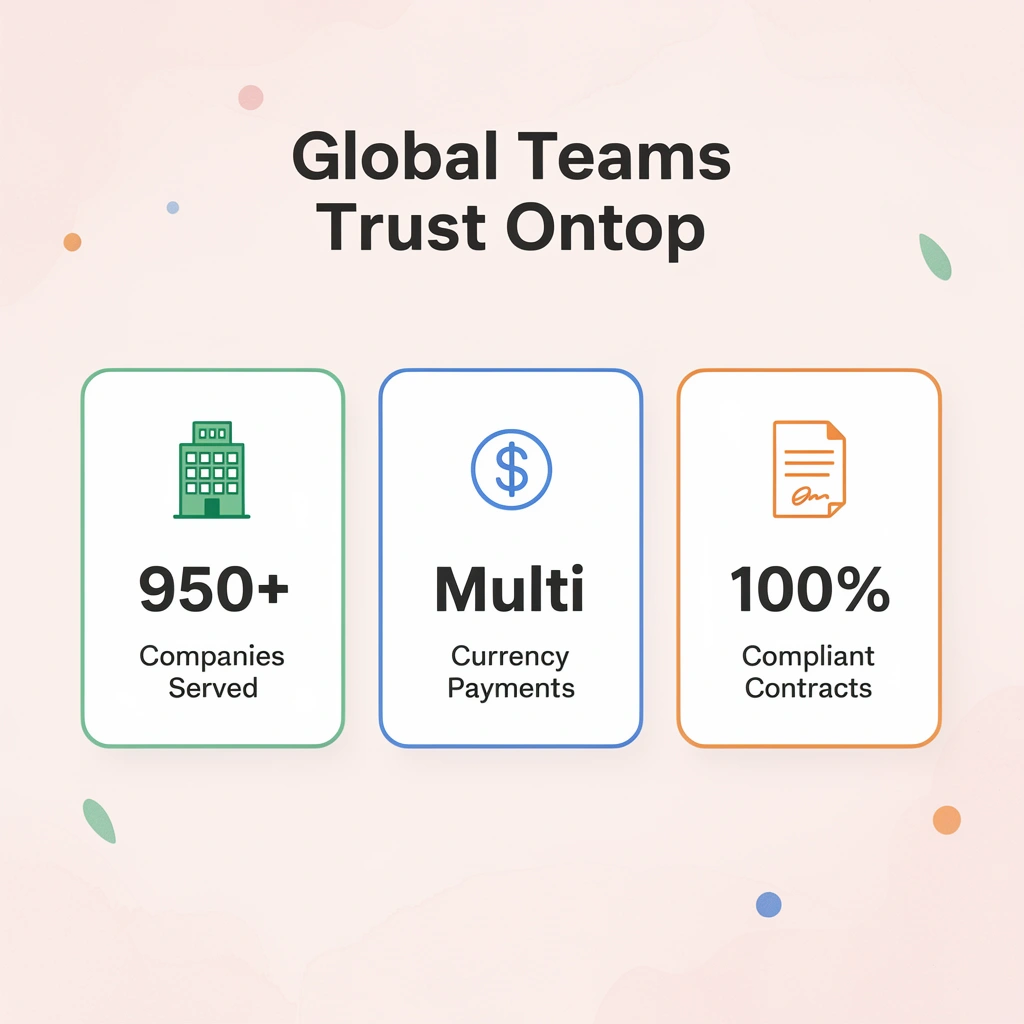
Building payroll infrastructure for what comes next means choosing tools designed for that future now. If you manage a global team or hire contractors across borders, payroll software like Ontop gives you compliant contracts, multi-currency payments, and consolidated financial management across 150+ countries — without the overhead of legacy employment models. Over 950 companies already trust Ontop to run their global contractor operations, and the platform scales with their complexity.
"Over 950 companies already trust Ontop to power their global contractor operations across 150+ countries — without the overhead of legacy employment models."
🎯 Key Point: Ontop isn't just a payment tool — it's a full-stack global workforce platform built for compliant hiring, multi-currency payroll, and cross-border contractor management at scale.
- Compliant Contracts: Eliminates legal uncertainty by providing standardized, enforceable agreements across 150+ countries.
- Multi-Currency Payments: Removes exchange rate headaches by letting you pay contractors in their local currency seamlessly.
- Consolidated Financial Management: Increases operational efficiency with one dashboard to monitor your entire global operation.
- 950+ Companies Trust Ontop: Offers you the security of a proven infrastructure used by teams at scale to manage high-growth complexity.
Ontop Quick Start lets you create an account, explore payment options available in your country, and receive payments from global clients in your first session. No sales call required. It's the fastest way to achieve a fully operational global payroll setup, with no friction between you and your first cross-border payment.
💡 Tip: Use Ontop Quick Start to explore your country's available payment options and receive your first international payment without speaking to a sales rep. Speed and simplicity built in from day one.
✅ Best Practice: Don't wait until your team grows to build compliant global payroll infrastructure. Set up Ontop now and scale without the complexity of legacy systems.
Related Reading
- Best Payroll Software For Staffing Companies
- Best Payroll Outsourcing Companies
- Deel Vs Oyster
- Best International Payroll Software
- Best Payroll For Contractors
- Remote Competitors
- Velocity Global Competitor
- ADP Alternative