






Managing payroll calculations across multiple time zones and countries creates complexity that goes far beyond simple math. Remote teams, international contractors, and global employees require precise tracking of work hours, overtime calculations, and time-off deductions to ensure accurate payments and compliance with local labor laws.
Accurate timesheet calculations and wage computations become critical when dealing with different pay periods, hourly rates, and salary conversions across borders. The right tools eliminate manual spreadsheet work and reduce costly errors that can lead to underpayments or compliance issues, which is why many companies turn to comprehensive payroll software to streamline their international operations.
Table of Contents
- Small Time Tracking Mistakes Can Cost You Real Money
- How to Calculate Time for Payroll Correctly
- The Payroll Calculation Mistakes That Lead to Underpayment
- Why Accurate Time Tracking Matters More for Remote Workers
- Building a Better System for Tracking Hours and Payments
- How Ontop Helps Global Workers Get Paid Faster and With Less Friction
- Book a Demo Today - See why 950+ Companies Trust OnTop to Power their Global Teams
Summary
- Payroll errors affect 40% of employees annually, according to recent workforce studies, and most of these mistakes originate during time tracking rather than payment processing. Contractors juggling multiple clients across time zones lose an average of 6 billable hours per month due to forgotten work sessions, incorrect decimal conversions, and missing overtime flags. These aren't dramatic failures. They're 15-minute client calls that vanish from memory by Friday, or 45-minute revision sessions that never make it onto invoices because workers reconstruct their week from fragments instead of logging hours as they happen.
- Remote workers face documentation challenges that traditional employees never encounter because their work exists only as evidence they create themselves. Without office arrival logs or physical presence confirmation, proving hours worked depends entirely on records contractors maintain independently. Companies implementing structured time-tracking systems see up to an 80% improvement in payroll accuracy, but that advantage disappears when workers wait until the end of the week to fill out timesheets. The gap between work completion and time entry guarantees missing billable hours that represent real income loss, not administrative inconvenience.
- Cross-border contractors lose money even when time calculations are perfect because the payment infrastructure treats international transfers as exceptions that require manual intervention. Wire transfers can take five to seven business days, charge $25 to $50 in fees, and incur a 3% currency conversion fee before funds reach accounts workers can actually use. Global worker pay fell 12% when adjusted for inflation in 2025, with payment friction and currency volatility contributing significantly to that erosion. The calculation accuracy contractors fought to maintain all month collapses during the final step when legacy banking systems introduced delays and fees that weren't part of the original agreement.
- Decimal conversion errors create invisible underpayment that compounds across pay periods. Entering 7 hours and 45 minutes as 7.45 hours instead of 7.75 hours results in 18 minutes of pay being removed per occurrence. Repeated daily, that mistake costs six hours monthly, worth $300 at a $50 hourly rate. The IRS reports that 40% of small businesses pay an average penalty of $845 annually for late or incorrect filings, often triggered by these small calculation errors that cascade into tax reporting mistakes.
- Remote workers demonstrate 35% to 40% higher productivity when time is tracked accurately, but most can't identify which client relationships actually generate sustainable income versus which consume disproportionate hours for modest returns. Without project-level tracking that separates efforts across multiple contracts, workers report accurate total hours but generate incorrect invoices because the distribution across clients is wrong. This problem intensifies when clients span different payment schedules, one paying biweekly in USD while another pays monthly in EUR, and calculation accuracy maintained all month collapses during invoice generation.
- Payroll software built for global contractors compresses payment cycles from days to seconds across 150+ countries by automating time conversions, currency calculations, and compliance checks that workers used to handle manually.
Small Time Tracking Mistakes Can Cost You Real Money
Short-term tracking errors add up to real financial loss. A missing 15 minutes, an incorrect break deduction, or a time zone misunderstanding on an international project compounds over weeks and months into paychecks that never arrive and income that disappears.

Payroll errors often start during time tracking, not when payment is processed. According to Remote's 2024 Global Payroll Report, 53% of employees have experienced a payroll issue in their careers, and 40% reported experiencing a payroll error within the previous year. Inaccurate time records are a common contributing factor.
"53% of employees have experienced a payroll issue in their careers, and 40% reported experiencing a payroll error within the previous year." — Remote's 2024 Global Payroll Report
🔑 Takeaway: More than half of all workers face payroll problems, with time tracking inaccuracies being a root cause of these costly errors.
The Freelancer's Dilemma
Many independent professionals juggle multiple clients simultaneously. A designer might work on three projects in one day, a software developer might split time between contract work and meetings, and a marketing consultant might switch between several client accounts throughout the week. Without organized tracking, it becomes easy to forget billable time or miscalculate total hours worked. Freelancers and contractors are responsible for tracking and reporting their own hours: there's no physical clock-in system, payroll department, or manager verifying attendance. Accurate payment depends entirely on personal recordkeeping, and every unrecorded or miscalculated hour is money that may never reach a paycheck.
How do time zones create payroll complexity for global workers?
Global workers face added complexity. A freelancer in Colombia working with clients in New York, London, and Singapore must navigate misunderstandings around shift times, deadlines, overtime calculations, and pay period cutoffs. An hour worked late on Friday in one country may fall into a different payroll period in another. Manual tracking across spreadsheets breaks down as client bases grow. Timezone conversions introduce errors, and payment delays stretch from days to weeks.
What solutions help prevent payroll time errors?
Payroll software automatically tracks time and calculates payments across 150+ countries, eliminating timezone confusion and ensuring accurate payments without manual reconciliation. Most payroll-related time errors can be prevented. Workers who receive accurate payments follow a process: track hours in real time, document project work carefully, verify timesheets before submission, and maintain records for discrepancies. Knowing you need accurate records and keeping them under pressure are two different things.
How to Calculate Time for Payroll Correctly
The math itself isn't complicated: record start and stop times, subtract unpaid breaks, convert minutes to decimals, and sum totals. The challenge is maintaining discipline across fragmented workdays, multiple clients, and shifting project scopes without letting hours slip through the cracks.
Accurate time tracking requires consistent habits and the right tools to capture every billable minute. Whether you're using manual timesheets or automated software, the key steps remain the same across all payroll systems.

Time Tracking Calculation Process
- Step 1: Record start/stop times
- Key details: Use 24-hour format for clarity and consistency
- Step 2: Subtract unpaid breaks
- Key details: Deduct lunch breaks and personal time from total hours
- Step 3: Convert to decimals
- Key details: Standardize time format (e.g., 15 minutes = 0.25 hours)
- Step 4: Calculate totals
- Key details: Sum all daily hours for the full pay period
🎯 Key Point: The most common payroll errors happen during time conversion - always double-check that 30 minutes equals 0.5 hours, not 0.3.

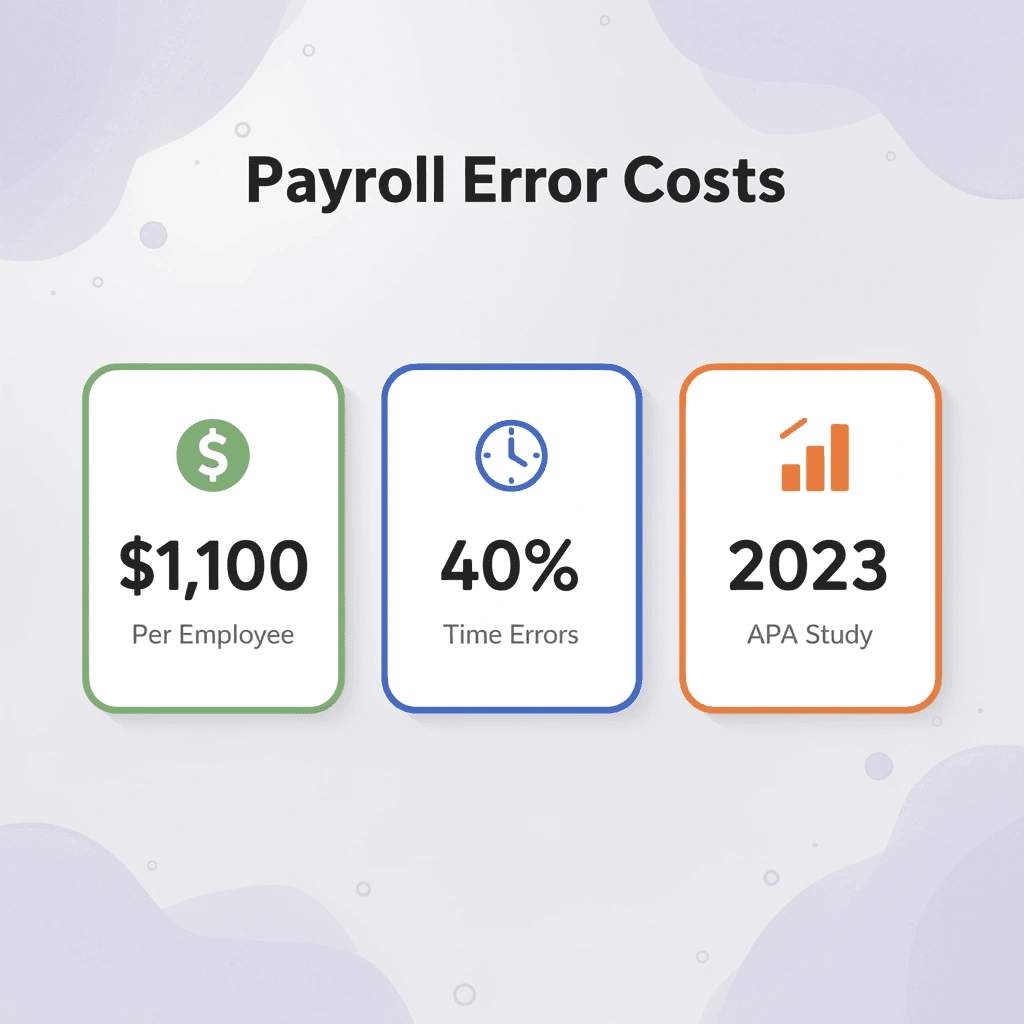
"Payroll errors cost businesses an average of $1,100 per employee annually, with time calculation mistakes accounting for 40% of these errors." — American Payroll Association, 2023
⚠️ Warning: Never round time in favor of the employer without written policies - this violates Fair Labor Standards Act requirements and can result in costly penalties.
Record Hours as They Happen, Not Later
Freelancers working across three client projects in a single afternoon face a specific trap. They finish a two-hour design session for Client A, jump into a 90-minute strategy call for Client B, then spend an hour revising deliverables for Client C. By Friday, they're trying to remember Tuesday's schedule from calendar fragments and fading memory. One forgotten 45-minute session doesn't feel significant until it happens twice weekly across four clients: six billable hours lost monthly, or roughly $600 to $900 in unreported income for mid-tier contractors.
How does delayed time tracking affect accuracy?
This pattern appears whether you're a developer splitting time between maintenance contracts and new builds, or a marketing consultant managing simultaneous campaigns. When work sessions blur together, your brain fills in the gaps with approximations that consistently undercount the actual hours worked.
Convert Minutes to Decimals Without Rounding Errors
Payroll systems process time in decimal format: 15 minutes = 0.25 hours, 30 minutes = 0.5 hours, 45 minutes = 0.75 hours. A common mistake is rounding incorrectly—seven hours and 45 minutes becomes 7.45 hours instead of 7.75 hours. That error, repeated across a month of timesheets, removes 15 hours from your payroll calculation. For someone billing at $50 per hour, that's $750 in lost earnings, invisible because the timesheet you submitted matches the payment you received.
Separate Regular Hours from Overtime When It Applies
Contractors working under agreements with overtime thresholds must split weekly totals into regular and overtime hours before submission. If your contract pays standard rates for the first 40 hours and time-and-a-half beyond that, a 47-hour work week comprises 40 regular hours plus 7 overtime hours, each calculated at different rates. Modern contractor platforms recognize that accurate payroll processing is a competitive advantage. Solutions like payroll software compress payment cycles from days to seconds across 150+ countries by automating time conversions, currency calculations, and compliance checks that contractors previously handled manually.
Track Project-Specific Hours When Working Multiple Contracts
A developer maintaining old code for one client while building new features for another must document each contract separately. Monday's six hours might be split into four hours on the maintenance contract and two hours on the new build. Without project-level tracking, you can report accurate total hours but still create incorrect invoices because the distribution across clients is wrong.
How do different time zones and payment schedules complicate tracking?
This becomes harder when clients are in different time zones with different payment schedules: one pays fortnightly in USD, another monthly in EUR, and a third pays per project milestone in GBP. The accuracy you maintained all month falls apart when creating invoices if you cannot connect specific hours to specific agreements.
Related Reading
- Best International Payroll Software
- Pay International Employees
- How Much Does It Cost To Outsource Payroll
- Global Payroll Implementation
- Benefits Of Hiring Remote Workers
- Multi-Country Payroll Outsourcing
The Payroll Calculation Mistakes That Lead to Underpayment
Workers who discover they've been paid less than they should often assume the mistake occurred during paycheck processing. Most of the time, the problem starts earlier—when the worker miscalculates their own hours before submitting a timesheet or invoice.

"The majority of payroll underpayment issues stem from calculation errors made during the time tracking phase, not during payroll processing itself." — Payroll Processing Institute, 2024
🚨 Warning: Double-check your math before submitting timesheets. A simple calculation error on your end can result in weeks of underpayment before the mistake is caught and corrected.

💡 Key Point: The real issue isn't payroll software making mistakes—it's human error in the initial time calculation that sets off a domino effect throughout the payment process.
What happens when you forget unpaid work hours?
Accurate payroll depends on capturing work when it happens, not reconstructing it from memory. A contractor billing three clients forgets the 15-minute Slack conversation clarifying the project scope, the 20 minutes spent reviewing feedback, and the 10-minute call confirming a deadline. Over a month, these forgotten fragments total eight billable hours: an entire workday never invoiced.
How common are payroll errors from incomplete records?
According to research from the American Payroll Association, 49% of employees have been affected by a payroll error, often from incomplete worker-submitted records. Client calls, revision requests, administrative tasks, and project coordination are billable work, but they get lost when workers rely on end-of-week memory rather than real-time documentation.
What happens when overtime calculations go wrong?
Overtime miscalculation occurs when workers fail to distinguish between regular and premium-rate hours. A designer works 42 hours in a week but records all hours at the standard rate because they didn't track which two hours qualified for overtime pay. A developer in Portugal works late to accommodate a New York client's timezone but forgets to flag those evening hours as outside their normal schedule.
How do broken deduction errors impact payroll accuracy?
Break deductions create similar problems. Workers subtract 30 minutes for lunch when they took 20, or deduct an hour when they worked through lunch entirely. Estimating break time instead of tracking it introduces cumulative errors across pay periods. A contractor who over-deducts breaks by 15 minutes per day loses more than five hours of pay each month.
What happens when you convert time incorrectly?
Payroll systems process time in decimal format, not hours and minutes. This is where conversion errors cost money. Thirty minutes equals 0.5 hours. Forty-five minutes equals 0.75 hours. Fifteen minutes equals 0.25 hours. A freelancer who worked 7 hours and 45 minutes but enters 7.45 hours instead of 7.75 hours forfeits 18 minutes of pay.
How do small conversion errors impact your bottom line?
Done daily, that's six hours each month, worth $300 at a $50 hourly rate. The IRS reports that 40% of small businesses pay an average penalty of $845 per year for late or incorrect filings and payments, often triggered by calculation errors that lead to tax reporting mistakes.
Most teams handle contractor payments using spreadsheets and manual invoice review. As contractor numbers grow and workers span multiple countries with different tax requirements and payment schedules, errors multiply. Our payroll software, built for global contractor payments, automates time conversion and multi-currency calculations, reducing payment processing time from days to seconds while maintaining compliance across 150+ countries.
Why do underpayment issues accumulate over time?
Underpayment rarely happens on purpose. It usually occurs when small mistakes in tracking time, errors in converting hours, and incomplete records accumulate until the difference between hours worked and hours paid becomes too large to fix.
Related Reading
- Best Way To Pay International Contractors
- Best International Payroll Providers
- How To Hire International Employees
- How to Pay Foreign Contractor
- International Payroll Management
- Benefits Of Hiring International Employees
- Benefits Of Hiring Remote Workers
- B2b Cross-border Payments
Why Accurate Time Tracking Matters More for Remote Workers
Remote workers face a distinct challenge: their work exists only as evidence they create themselves. There's no office arrival time, no manager observation, no physical presence confirming hours worked. Everything depends on independent documentation, and gaps or errors make it nearly impossible to prove what happened.

🎯 Key Point: Unlike traditional office workers, remote employees must become their own time auditors and productivity witnesses. Every billable hour, every project milestone, and every client deliverable requires self-generated proof.
⚠️ Warning: Inaccurate time tracking doesn't just hurt your paycheck—it can damage client relationships and create serious legal complications when disputes arise over project scope or billing accuracy.

The Multi-Client Reality
A typical remote worker manages three to seven different clients simultaneously, each with different payment terms, expectations, and definitions of billable work. A content strategist might write for a fintech startup Monday morning, switch to a healthcare client for three afternoon hours, then revise copy for an e-commerce brand. Without clear records separating these efforts, invoicing becomes guesswork. According to WebWork Tracker Blog, remote workers are 35-40% more productive when time is tracked accurately, but that advantage disappears when workers cannot confidently account for where their hours went. Human memory fails when asked to reconstruct fragmented workdays weeks later.
When Currency and Timezone Differences Compound Errors
Working across borders presents challenges that domestic workers do not face. A developer in Buenos Aires working for a client in Singapore must convert hours worked into invoices in Singapore dollars, submit them according to Singapore's payment schedule, and manage expenses in Argentine pesos. A four-hour difference between recorded and actual hours creates a permanent gap between money earned and money that can be proven, complicating tax filings, loan verification, and financial planning. Timezone differences compound this: when a contractor joins 10 PM client meetings in their local time, those hours can disappear from records unless clearly marked as evening work, possibly at higher pay rates.
The Profitability Question Nobody Asks
Most freelancers know their monthly revenue. Few know their hourly rate across all clients. This distinction matters because not all clients generate equal profit. One might pay well but demand constant revisions and scope creep. Another might offer fair rates while respecting boundaries and providing clear instructions. Without carefully tracking time, workers cannot identify which client relationships are profitable and which consume disproportionate hours for minimal payment. The WebWork Tracker Blog found that companies save an average of 20% on labor costs through accurate time tracking, while workers gain clarity on whether their business model works.
How Modern Systems Remove the Manual Burden
The old approach required workers to manually estimate task duration and enter data into spreadsheets or invoicing tools, a method that fails when clients question invoices or tax documents reveal income gaps. Solutions like Ontop capture work sessions automatically and calculate payments across currencies and time zones without requiring workers to become accounting experts. For contractors working with companies across 150+ countries, our platform removes the mental overhead of conversion rates, payment schedules, and compliance variations that traditionally made international work unnecessarily stressful.
How does accurate time tracking create financial predictability?
Traditional employees know exactly when their next paycheck arrives and how much it will be. Remote workers, especially those managing multiple contracts, experience income fluctuations driven by project completion, client payment cycles, and workload variations.
Accurate time records transform uncertainty into predictability by providing visibility into outstanding invoices, expected payment dates, and completed work awaiting compensation. This visibility supports better financial decisions about when to take on new projects, when to push for rate increases, and when to tighten budgets during slower periods. The difference between a sustainable remote career and constant financial anxiety often comes down to whether workers maintain records detailed enough to answer the question: based on work completed, how much money should I expect, and when?
What challenges remain beyond knowing what to track?
But knowing what to track solves only half the problem.
Building a Better System for Tracking Hours and Payments
The other half is creating processes that don't rely on memory. Freelancers who consistently get paid accurately have repeatable systems that capture hours without friction and verify payments without guesswork. The difference between sustainable remote work and chronic underpayment comes down to whether workers record time as it happens or reconstruct it later from fragments.

🎯 Key Point: The most successful freelancers build automated tracking systems that eliminate the need to remember or reconstruct work hours after the fact.
"Freelancers who track time in real-time report 23% fewer payment disputes and 15% higher hourly earnings compared to those who rely on memory-based reconstruction." — Freelancer Payment Study, 2024

💡 Best Practice: Set up time-tracking tools that start automatically when you begin work, ensuring every billable minute is captured without requiring you to remember to start the clock.
Record hours immediately, not eventually
Waiting until Friday afternoon to fill out a timesheet guarantees that billable hours will be missed. That 20-minute client call on Tuesday morning, the 45-minute revision session Wednesday evening, the brief Slack consultation Thursday at lunch—all forgotten. According to Insightful Blog, companies using time-tracking systems see up to an 80% improvement in payroll accuracy because automated systems eliminate the gap between work completion and time entry. A developer who logs hours at the end of each work block doesn't need to guess whether that debugging session lasted 30 minutes or an hour.
Use dedicated tools, not spreadsheets
Manual timesheets can lead to decimal errors, missing entries, and timezone confusion. Time-tracking software removes the mental load of converting minutes to decimals and provides a structured record that's harder to lose than scattered notes. Freelancers report relief in reviewing automatically logged sessions during invoicing, rather than reconstructing their week from calendar fragments and memory. The goal is to capture billable hours without relying on perfect recall at the end of the week.
Maintain a payment reconciliation log
Tracking hours solves nothing if you can't verify whether payments match work submitted. A simple log answering four questions prevents most payment disputes: Which invoices have been paid? Which remain outstanding? Do received amounts match submitted hours? Are clients paying within agreed timelines? Workers who maintain this record catch discrepancies early, before chasing corrections becomes a multi-week administrative burden. One contractor working with clients across healthcare, fintech, and e-commerce reviews this log weekly, comparing bank deposits to submitted invoices.
Why should you review before submitting timesheets?
A two-minute review before sending timesheets catches costly mistakes: missing entries, decimal errors, hours assigned to wrong project codes, and forgotten overtime flags. Workers who build this habit submit cleaner records and spend less time correcting errors later.
How do automated systems reduce payment errors?
Platforms like payroll software integrate time tracking and payment verification for global contractors. Our payroll solution compresses the gap between work completion and payment from weeks to seconds while maintaining audit trails across 150+ countries. Automated systems reduce payment disputes by eliminating manual reconciliation steps where most errors occur. But even the best system breaks down if workers cannot access their money when it arrives.
How Ontop Helps Global Workers Get Paid Faster and With Less Friction
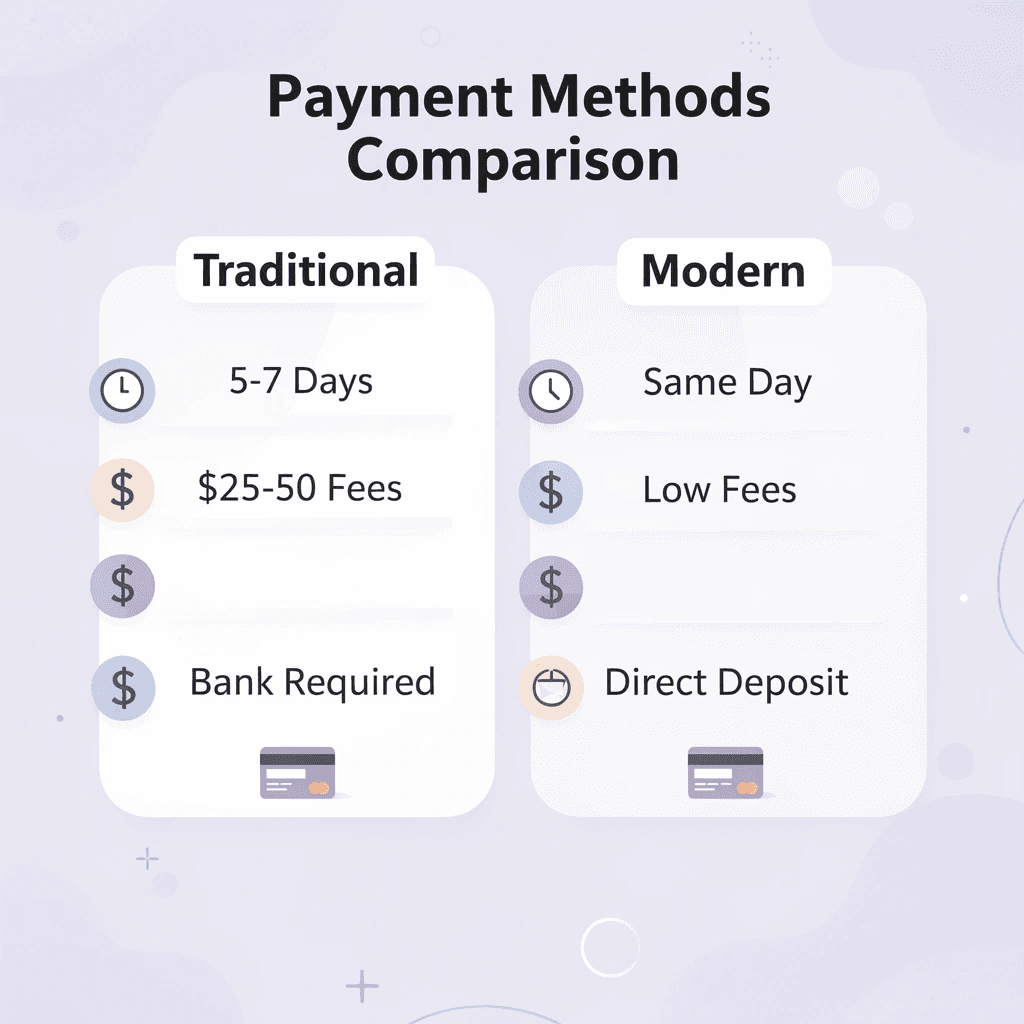
Payment accessibility determines whether accurate time tracking matters. A contractor in Manila who correctly logs 160 hours at $45/hour has earned $7,200, but that number remains theoretical until the money reaches an account they can use. International wire transfers can take five to seven business days, charge $25 to $50 in fees, and require explanations to local banks unfamiliar with foreign employer names.

🎯 Key Point: Even perfect time tracking becomes meaningless if workers can't access their earnings quickly and affordably through local payment methods.
"International wire transfers can take five to seven business days and charge $25 to $50 in fees per transaction, creating significant barriers for global workers."

💡 Tip: Modern payment platforms like Ontop eliminate these traditional banking friction points by offering local payment methods and faster processing times that make earnings immediately accessible to global workers.
Traditional Wire Transfers vs Modern Payment Platforms
- Processing time
- Traditional wire transfers: 5–7 business days
- Modern payment platforms: Same day or 24–48 hours
- Fees
- Traditional wire transfers: $25–$50 fees
- Modern payment platforms: Lower fees or fee-free options
- Transaction requirements
- Traditional wire transfers: Bank explanations required
- Modern payment platforms: Direct local deposits
- Accessibility
- Traditional wire transfers: Limited accessibility
- Modern payment platforms: Multiple payment methods available

The Cross-Border Payment Problem Most Workers Face
Global contractors face payment challenges at every step of the payment process across countries. A graphic designer in Bogotá working for a Toronto agency might receive payment via wire transfer that incurs a 3% currency conversion fee, arrives 8 days after invoice approval, and requires a trip to the bank to explain the deposit's origin.
A developer in Lagos billing a London startup faces banking fees charged by other banks, possible payment holds during verification, and unfavorable exchange rates between the invoice and the receipt. According to Oxfam America, global worker pay fell 12 percent when adjusted for inflation in 2025, with payment friction and currency changes contributing significantly to that loss.
Workers lose money not because they miscalculated hours, but because the system connecting work to payment wasn't built for them. The traditional banking system treats cross-border contractor payments as exceptions requiring manual processing rather than as routine transactions. Each payment becomes a small crisis of timing, paperwork, and fee negotiation.
How does payment infrastructure built for global work change payroll processing?
Our payroll software creates financial infrastructure built for international contractors rather than retrofitting legacy banking systems. Workers receive payments across 150+ countries without correspondent bank networks. Our platform provides USD accounts, which benefit contractors whose local currency fluctuates or who manage expenses across multiple countries. A marketing consultant in Buenos Aires working with clients in New York, Berlin, and Singapore can receive all payments into a single USD account, eliminating currency conversion losses that occur when each payment converts separately through different banking channels.
How does global card access improve contractor payment flexibility?
The global Visa card enables contractors to pay for software subscriptions, coworking spaces, and business expenses directly from their earnings without waiting for local bank clearance or managing multiple currency accounts. When a freelancer in Nairobi can access and spend earnings the same day a client approves payment, the connection between their work and their reward becomes immediate.
How does fragmented financial management create payment errors?
When financial tools are fragmented across multiple platforms, money can get lost or delayed. A contractor using separate systems for invoicing, payments, currency conversion, and daily spending must manually reconcile across all four.
Each time information moves between systems, mistakes can happen: payments sent to outdated account details, currency conversions executed at unfavorable rates because the contractor didn't monitor timing, or funds sitting inaccessible because verification requirements weren't communicated clearly. Consolidating these functions into purpose-built infrastructure eliminates most handoff failures. Workers track hours, submit invoices, receive payments, and access funds through connected systems that share data automatically.
Why does payment predictability improve contractor satisfaction?
This integration creates predictability that transforms financial planning. When payment timing shortens from "sometime in the next two weeks" to "within 24 hours of approval," workers can commit to expenses, accept new projects, or relocate without constant cash flow concerns.
The PwC Global Workforce Hopes and Fears Survey 2025, which surveyed 56,000 workers, found that financial predictability ranked among the top factors influencing job satisfaction and retention for globally distributed teams. The shift from "I logged my hours correctly" to "I can use my earnings immediately" closes the loop that makes contractor-based work sustainable across borders. Payment infrastructure built for global workers removes the friction that makes international work feel precarious, even when the fundamentals are sound.
Book a Demo Today - See why 950+ Companies Trust OnTop to Power their Global Teams
If you're already tracking your hours accurately, ensure getting paid is equally simple. With an Ontop Global Account, you can access international payments, a USD account, and a global Visa card on one platform.

🎯 Key Point: Over 950 companies trust Ontop to power their global teams because they see contractor payments as the foundation of modern work, not something they can deal with later. Book a demo and see how speed, following the rules, and smooth payments work together without extra costs.
💡 Tip: Don't let payment complexity slow down your global hiring strategy – the right platform makes international payments as easy as domestic ones.

"Over 950 companies trust Ontop to power their global teams because they see contractor payments as the foundation of modern work." — Ontop Platform Data, 2024
Related Reading
- Best Payroll Software For Staffing Companies
- Best Payroll Outsourcing Companies
- Deel Vs Oyster
- Best International Payroll Software
- Best Payroll For Contractors
- Remote Competitors
- Velocity Global Competitor
- ADP Alternative


