





Completing a project and navigating payment options can be challenging for many independent professionals. Establishing clear billing terms and tracking deductible expenses are key to managing cash flow and ensuring accurate tax records. Balancing invoicing, payment collection, and bookkeeping requires streamlined practices to reduce administrative burden. Organized record-keeping simplifies the transition from project completion to receiving payment.
Efficient processes not only ease financial management but also save valuable time for core work. Clear procedures benefit both cash flow stability and tax preparation by minimizing paperwork. In this context, ontop’s payroll software offers a streamlined solution that simplifies invoicing, payment collection, and contractor management.
Summary
- Approximately 70% of independent contractors receive a 1099, and over 10 million 1099 forms are issued annually, making contractor classification and consistent reporting routine compliance issues for businesses and a cash-flow reality for workers.
- Errors and timing problems are widespread: about 30% of 1099 contractors fail to file the correct forms on time. The IRS can assess penalties of up to $270 per late 1099, turning small paperwork gaps into high costs.
- Payment rails shape negotiations and efficiency: over 70% of contractors prefer direct deposit, and clients must issue Form 1099-NEC for payments of $600 or more, so invoice structure and payment routing directly affect tax reporting and audit traces.
- Late payments are endemic: 70% of 1099 contractors report late payments, and 20% have pursued legal action to recover funds, making enforceable contract clauses and clear escalation thresholds practical necessities.
- Cross-border work amplifies compliance risk: 70% of digital nomads work as independent contractors, and 85% prefer flexible contract terms. Meanwhile, residency tests such as the 183-day standard and local VAT rules can create unexpected filing and withholding obligations.
- This is where Ontop's payroll software fits in: it centralizes contract generation, payment rails, identity checks, and tax reporting, so teams maintain an auditable payment trail and shorten reconciliation cycles.
What Is a 1099 Form Independent Contractor?
A 1099 independent contractor is a self-employed worker paid for services by a client. This worker is responsible for their own taxes, invoicing, and records rather than receiving a W-2 payroll. This status places legal responsibility on the worker, which affects how they negotiate, protect themselves through contracts, and prepare for audits. To streamline payroll processes, our payroll software can help you manage employee classifications effectively.
Why does classification matter for cash flow and legal risk?
Misclassification is not just an abstract tax issue; it directly affects who takes on the risk. When a company treats someone like an employee but classifies them as a contractor, the worker often faces unexpected tax bills and the burden of proving their status. This situation often occurs in small agencies and family-run businesses, where convenience-driven decisions lead to months of back-and-forth with accountants and, at times, the IRS.
This occurs because the paperwork and payment records do not align with the actual working relationship.
What does being 1099 change about daily operations?
Running a business as a 1099 contractor is a lot like managing a small company. You track your income, issue invoices, gather receipts, and save for self-employment and estimated taxes. This can be tiring, especially when bookkeeping builds up alongside high fixed costs, such as student loans or healthcare expenses.
The emotional strain can be high; many people report feeling betrayed when a trusted client suddenly changes status. This feeling of vulnerability often leads some to seek formal determinations or legal remedies.
How common is this situation, and why should companies care?
According to the IRS, approximately 70% of independent contractors receive Form 1099, indicating that this is the standard payment method for most contract work and, therefore, a routine compliance area for businesses.
At scale, the paperwork burden matters: the IRS issues over 10 million 1099 forms annually to independent contractors, underscoring how inconsistent processes directly increase audit exposure and administrative costs for hiring teams.
What are the challenges with 1099 administration?
Most teams handle 1099 administration using spreadsheets and scattered email threads. This approach is familiar and requires no new tools, but it creates gaps in truth as headcount or contractor volume increases. Contracts might be in one inbox, payments in another, and compliance checks are often missed.
Teams find that platforms like Ontop, which bring together contract generation, compliance checks, and payment records, can reduce review cycles from days to hours. This efficiency also maintains a clear audit trail, significantly reducing the risk that a missed form or undocumented payment will become an expensive issue.
What concrete mistakes make audits likelier?
The failure point is usually inconsistent documentation. A client who pays for results but controls hours, tools, and reporting, while issuing a 1099 without a matching contract, leaves both parties exposed. This situation is like driving a car without a maintenance log; you might reach your destination, but the first sign of trouble can be expensive to diagnose and fix.
Simple steps, such as standardized contracts and documented payment trails, can turn this liability into traceable evidence if proof is ever needed.
How can you view 1099 status positively?
You can treat 1099 status as a burden, or as the operating manual for a small business: clear rules, consistent records, and predictable cash flow. What happens next shows the paperwork that quietly decides whether a year ends with relief or an audit.
Related Reading
- Independent Contractor
- How to Calculate Net Income
- Virtual Business
- Freelance Brand Scaling
- Independent Contractor Agreement
What Forms You Actually Need as a 1099 Contractor

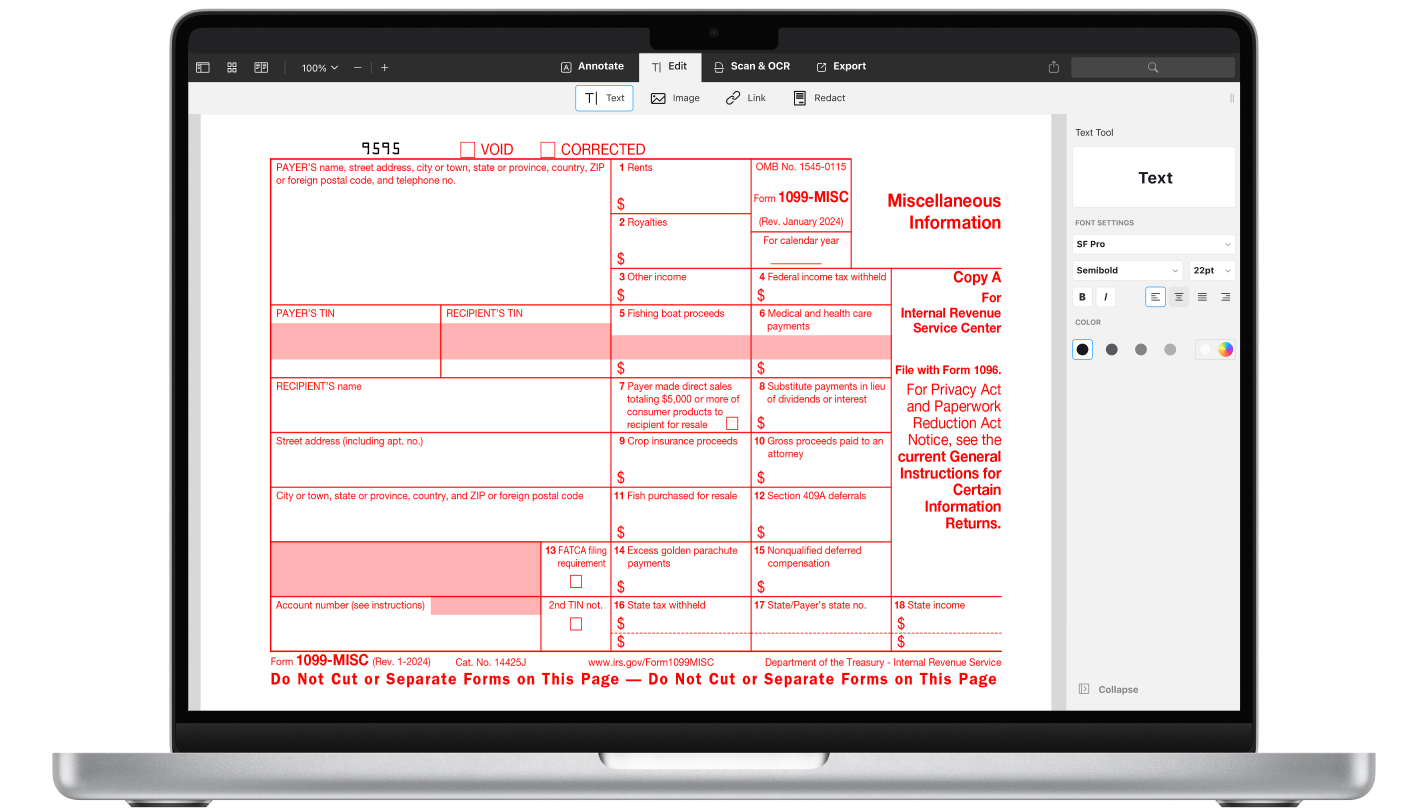
You need two sets of forms: the ones clients or payment platforms give you to report what they paid you, and the tax and payment forms you fill out yourself to report that money and pay self-employment tax. Besides the W-9 and 1099s mentioned earlier, expect to fill out Form 1040, Schedule C, and Schedule SE.
You will also need quarterly estimated tax vouchers (Form 1040-ES) and a few other specific forms if you claim the home office, equipment depreciation, or work under an EIN. To streamline this process, consider using our payroll software to manage your payments and taxes efficiently.
Which IRS forms do I file on my own tax return?
Schedule C, Profit or Loss from Business, is where gross receipts and most business expenses are reported.
Key forms to consider include
- The form that calculates self-employment tax, Schedule SE, covers Social Security and Medicare if you do not receive a W-2.
- Form 1040-ES, which contains the vouchers and worksheets for quarterly estimated tax payments. This is especially helpful because you are not subject to withholding as an employee.
- If you use a home office, Form 8829 helps you take that deduction. Additionally, if you depreciate assets, use Form 4562.
These forms translate bookkeeping into tax results, so keeping your records organized is essential.
When will I get different 1099 types from payers?
- Clients usually issue a 1099-NEC when they pay you directly.
- In contrast, payment processors or marketplaces can issue a 1099-K under different rules.
- State and local regulations can affect who files what and when; this is very important.
- According to Business by the Book, "30% of 1099 contractors fail to file the correct forms on time," and timing and form selection are common operational risks.
If you work as an LLC or choose corporate tax treatment, the filing rules can change, so it's important to check the requirements for your entity early.
What local or business forms might surprise you?
- Many cities and states require business registrations, gross receipts taxes, or local business income filings.
- In places like Philadelphia, removing certain exemptions has made contractors file and pay taxes they did not expect. This has caused real cash-flow problems.
- If you want to separate personal and business records, apply for an EIN with Form SS-4. This also helps when a client or bank asks for an employer identification number instead of your SSN.
- If a payer does not collect the correct information and backup withholding is needed, it creates extra paperwork and financial issues for both you and the payer. The risk is not small because the Business by the Book, "IRS issues penalties of up to $270 per form for late 1099 submissions," states that a few missed forms can quickly lead to large penalties.
How do contractors usually manage this, and where does it break?
Most teams manage 1099 administration using spreadsheets and email because these methods are easy to use and require no additional approvals. This works for a few clients, but as the number of return lines, digital payments, and local taxes increases, spreadsheets become ineffective. Version gaps appear, and it can take days to reconcile everything.
Platforms like Ontop centralize contract generation, compliance checks, and payment records. This makes review cycles much shorter and provides a clear audit trail, which stops the need to piece together the year from scattered PDFs.
What metaphor helps understand tax documentation?
A helpful metaphor for understanding tax documentation is to think of your tax folder as a neatly labeled toolbox rather than a junk drawer. When parts are missing, repairs can cost you more time and money. This disorganization can make audits feel like scavenger hunts, increasing stress.
What hidden traps do contractors face?
That simple paper trail hides a trap, few contractors notice until tax season arrives.
How to Set Up Payments Correctly as a 1099 Contractor

Start by treating payments as a system your business can use repeatedly. Choose secure, trackable rails for your transactions, clearly define the exact invoice terms, and set up automated reconciliation.
These steps will help you stop chasing the same late payments every month. By using these strategies, you can change unpredictable cash flow into predictable revenue.
Which payment rails should I accept?
Make sure to prioritize a primary rail you control, like a business bank account for ACH or direct deposit. After that, add one reliable secondary option for international clients.
According to Routable, over 70% of contractors prefer direct deposit, which streamlines payments and reduces negotiation and back-and-forth. For cross-border work, support a single global payout method that returns funds to you with clear fees.
Also, collect the client’s preferred local option in advance to avoid discovering the hard way when funds take weeks to clear.
What exactly goes on every invoice?
Make the invoice a single source of truth. Include the invoice number, issue and due dates, line-item descriptions with units and rates, and the exact total in the billed currency. Payment instructions should include the account routing details or a payment link, along with a required payment reference. Additionally, add a short clause linking to the signed contract or SOW.
Capture the payer’s legal name and address on your onboarding form. If a client pays a contractor $600 or more, IRS Form 1099-NEC is required. This mismatch can start audits. Treat each invoice as both a receipt and a legal notice, not just a polite request.
How do I structure deposits, milestones, and final handoffs without sounding hostile?
Make the first payment sufficiently unconditional to start work while remaining sufficiently conditional to protect your interests.
Use a short deposit clause that specifies percentages and the scope tied to milestones, along with stipulations for what happens if the client cancels.
Automate milestone invoicing to ensure deliverables and invoices align. In practice, using clear language reduces emotional friction, and clients are more likely to accept a nonrefundable initial deposit if it is tied to scheduled work and visible dates. They see this as a commitment rather than a hidden fee.
Consider how our payroll software can streamline these processes.
Why automate reconciliation, and what should I automate?
Manual matching becomes increasingly difficult to manage as transaction volume increases. It's important to automate tasks such as sending invoices, reminding customers of payments, and reconciling bank accounts.
This helps to ensure that each payment received is connected to an invoice ID and properly labeled in the ledger.
Setting up automatic notices for remittances, or asking clients to include the invoice number in the payment reference, can help ensure smooth processing. After that, software rules can help to mark invoices as paid, identify partial payments, and start follow-ups. This method creates an auditable trail and turns disputes into a quick question instead of a long email back-and-forth.
How should I handle cross-border clients to avoid surprises?
Determine who will bear conversion and wire fees. Clearly state this on the invoice as a separate line item or provide a link to your fee policy.
Offering clients a local-currency invoice can help reduce friction, but ensure you protect yourself by specifying the settlement currency with your bank and establishing a timeframe for foreign exchange adjustments.
Consider using a multicurrency account or a payout partner that offers predictable, itemized fees to avoid absorbing variable conversion costs after the transaction.
How can I create a tidy payment system?
Think of your payment system as a small bank. Having clear account numbers, specific remittance rules, and automatic posting can reduce almost all disputes before they happen.
What specific payment problems might arise?
This solution seems tidy, but certain payment problems can still happen, even in the cleanest systems.
Related Reading
- How to Send an Invoice
- Contractor Invoice
- Self-Employed Jobs
- How to Become a Freelancer
- How to Invoice as a Freelancer
Common Payment Problems 1099 Contractors Face (and How to Avoid Them)

The deeper issue is not just that payments are late; rather, the usual fixes often stop at polite reminders. Enforceable levers are essential, along with predictable cash tools available today. This way, missed payments do not lead to months of stress or legal headaches.
Which contract clauses actually deter bad actors?
Examining tougher agreements shows that the important clauses are narrow and practical. These include: a conditional assignment of IP until final settlement, a short, nonnegotiable cure period with an explicit payment remedy, and a narrowly scoped change-order process that links extra work to preapproved fees and sign-offs.
Licensing and resale rights should be treated as negotiable line items rather than standard language. Contractors who split license fees or request disclosure of downstream use regain leverage without appearing hostile. Think of a contract clause like a mechanical fuse; it should only blow under excess strain, and the right fuse can prevent a total system failure.
When should you stop chasing and escalate?
This is a cost calculation, not a test of your behavior. Use a simple rule: if outstanding invoices exceed three times your average monthly costs, or if the client has ignored a certified demand after the agreed time to resolve it, it's time to take action.
It's important to note that, according to Cerini & Associates (2023), 20% of contractors have had to take legal action to recover payments, indicating that such steps are common enough to plan for. Start with a certified demand letter and a packet of proof; then decide whether to go to small claims court or get a lawyer, based on costs and how things are enforced in the payer’s area.
How do you shorten the cash cycle without burning the relationship?
There are financial levers that help keep a good relationship with clients. Consider offering an agreed-upon early payment discount or using invoice factoring for large clients. Requiring a small, nonrefundable deposit tied to specific milestones can also help with cash flow. Additionally, moving to retainers can make revenue smoother over time.
Setting up automated approval for recurring invoices, along with clear payment rules, can prevent excuses like 'I forgot' from becoming 'I can’t pay.' When immediate cash is needed, a targeted invoice financing line may incur costs but avoids the long delays associated with collecting on a single large late payment.
What operational habits keep you out of disputes?
This is where systems beat heroics. Capture proof of delivery when you hand off work, timestamp revisions, and require a single, consistent payment reference on every transaction, so reconciliation is automatic.
Onboarding should include a billing packet that collects the legal payer name, tax form, preferred payment rail, and a signed simple SOW.
This reduces the typical email scavenger hunt from days to minutes.
How do you handle increasing complexity in payment processes?
Most teams still rely on email and spreadsheets because they are familiar, and that approach works until it doesn't. As more stakeholders get involved and cross-border payments increase, issues such as version conflicts and missing tax documents can delay reconciliation by weeks.
Platforms like Ontop bring together contract generation, run automated compliance checks, and connect payments to the contract and delivery record. This reduces review cycles from days to hours, while also leaving a record that can be reviewed and providing faster access to funds.
What do you do when late payments are just the norm?
Accepting slow payments can be costly, but it also provides valuable insights. Pay attention to trends by client and payment method, and then translate them into actionable rules. This might involve assigning risk scores, requesting additional deposits from high-risk payers, or placing high-risk accounts on a stricter payment plan.
Remember that late payments remain widespread. A recent survey, "Common Payment Problems 1099 Contractors Face (and How to Avoid Them)”, finds that 70% of 1099 contractors report late payments. This reality should affect how you price your services and where you choose to take on work. Pricing for cash risk is a smart strategy that ultimately gives you peace of mind.
How can you prevent onboarding issues?
When used together, licensing language, escrow options, staged releases, invoice financing, and a careful onboarding checklist stop most problems before they start. The next tricky layer raises questions about passports, residency, and tax withholding that many contractors overlook. This twist makes the onboarding process personal and much more complex.
Global Considerations for Digital Nomads Working With U.S. Clients

International tax, regulatory, and banking rules must be treated as integral to the payment process, not merely background noise. It's important to understand where taxes and reporting duties belong, who can freeze funds, and which local rules could turn a simple contractor relationship into an expensive compliance issue.
Could local VAT or GST create an unexpected tax bill?
Many countries handle services and digital work differently for indirect tax purposes. Registration thresholds or place-of-supply rules can trigger obligations that might not have been seen before. This often becomes clear when a contractor bills multiple clients in a single country and must then collect VAT or comply with mandatory e-invoicing requirements.
Such situations can lead to retroactive liabilities and penalties if invoices miss the required tax identification. A helpful rule to remember is this: if you bill frequently into the same area, assume local VAT rules apply. It may be smart to include a gross-up or reverse-charge clause in your agreement.
When does your work create a tax presence for the client or you?
The risk comes from working for a long time under a client’s direction in a place that could be problematic, which might make you seem like an employee or a local worker based on the laws there. The issue is simple: it occurs when you work directly on the client’s site, follow their instructions on your hours and tools, or become part of their processes for many months. This situation can typically lead to Social Security or payroll responsibilities.
If there are agreements between countries to avoid double payments, they can help you avoid paying social security in two places. However, you must maintain records of your situation and complete the appropriate forms; otherwise, you and the client may end up paying Social Security taxes twice.
What breaks payments before they even reach your account?
Banks and payment platforms enforce Know Your Customer (KYC), Anti-Money Laundering (AML), and sanctions screening. In some countries, currency controls can stop transfers from certain locations. Payments may be blocked if the payer and payee names, remittance references, or country details do not match exactly. Additionally, funds that pass through a flagged intermediary may be delayed.
To avoid these problems, treat identity and remittance data as very important. Collect verified IDs, ensure payee names are consistent across all invoices, and avoid using separate wallets, as this can trigger more compliance checks.
How do double taxation and residency rules change your net earnings?
Residency tests, which usually have a 183-day standard but vary by country and treaties, decide tax obligations more than where you slept last month. The practical result is that frequent moves or stays in multiple countries can create different filing responsibilities. Claiming foreign tax credits or treaty relief needs clear documentation and proper timing. It's important to track your physical days and keep records of your receipts because proving a tax home or a treaty claim is about evidence, not just arguments.
Which contract clauses actually protect you across borders?
Incorporate a narrow gross-up clause for unexpected withholdings, a mutual audit cooperation clause, and a clear currency settlement clause with an FX adjustment window.
Additionally, include a payment-on-termination remedy that ties final deliverables to escrow or a certified payment.
It is also important to specify which courts or arbitration rules govern disputes, as enforcing a judgment is often the challenging part, not merely drafting one.
These contract terms serve as small instruments that help prevent large cash-flow shocks later.
What operational habits prevent surprises from snowballing?
Establish a country playbook for each location. This playbook should explain things like registration thresholds, VAT rules, required invoice fields, days that trigger residency, and acceptable payment methods. Conduct a monthly reconciliation that matches invoice IDs to bank transaction records.
Additionally, keep an indexed archive of local tax receipts and KYC documents. This routine eases the frantic, last-minute rush that often overwhelms many nomads during tax season or audits.
What human factors impact compliance for nomads?
Consider the human side of following rules: when paperwork accumulates across different payment apps and countries, the emotional cost can be high. What should be simple months can often feel like ongoing challenges. It's important to create a reliable system that treats compliance as part of the delivery process, not something to consider later. This stability ultimately gives you freedom.
What market context should you consider as a digital nomad?
Also, remember the market context. Most digital nomads are contractors, and many want flexible terms. You should expect and design for that. According to the Global Digital Nomad Report 2025, "70% of digital nomads work as independent contractors."
What compliance snag turns tidy invoicing into a headache?
While that groundwork is important, one compliance issue often turns neat invoicing into a payroll-level headache.
See How Ontop Helps 1099 Contractors Get Paid Smoothly and Stay Organized
Managing invoices, 1099 paperwork, and cross-border payments can require significant time and focus. Ontop makes these tasks easier by consolidating them into a single, clear workflow that clients and accountants trust. This ensures that payments are received on time and keeps a clear payment history for tax purposes.
Consider using Ontop to save time on billable work and protect your self-employed income from unexpected issues with reliable payroll software.
Related Reading
- Contractor Payment Solutions
- Paying Freelancers
- Contractor Payment Services
- Contractor of Record
- Payment Methods for Freelancers