





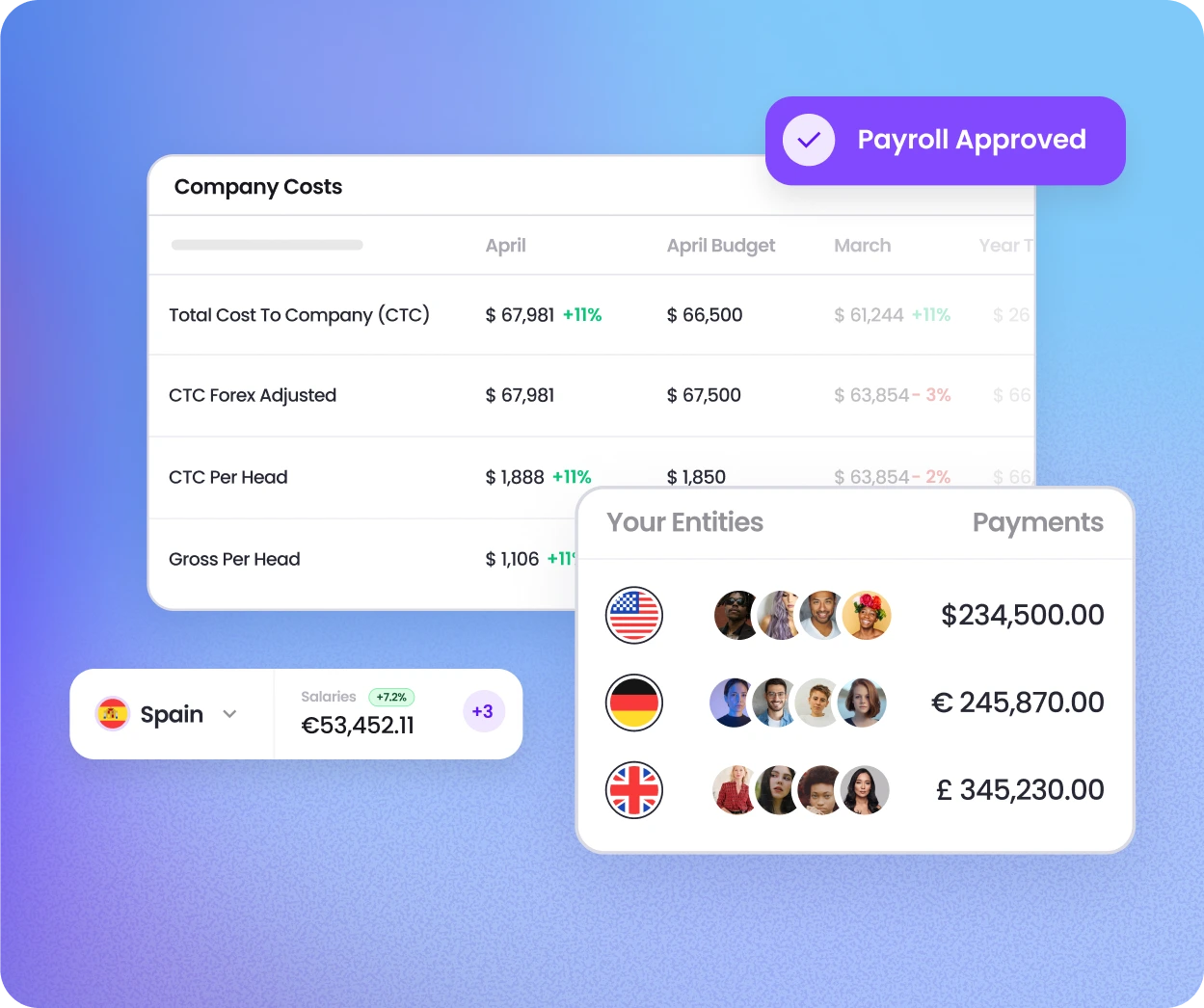
When you're paying overseas contractors, the numbers on your invoices tell only half the story. What does that $5,000 monthly payment actually mean to your contractor in Buenos Aires after currency conversion, local taxes, and payment fees eat into it? This article breaks down how global payroll analytics transforms scattered data points into clear insights, helping you understand what your international team members truly earn and how compensation decisions ripple across different markets.
Smart payroll software like Ontop gives you visibility into the complete picture of contractor compensation across borders. Instead of juggling spreadsheets and guessing at exchange rates, you can track actual take home amounts, compare costs across regions, and make informed decisions about your global workforce spending.
Summary
- Global remittance flows to low and middle-income countries exceeded $650 billion in 2023, with average transfer costs around 6.2% per transaction according to the World Bank. That percentage represents a significant reduction in take-home pay before taxes or currency effects are even considered.
- Remote workers in emerging markets can lose up to 7% of their earnings to currency conversion fees and unfavorable exchange rates. That loss represents nearly a week of work disappearing into payment infrastructure.
- Currency fluctuations alter purchasing power even when contract rates stay constant. A 5% adverse currency swing can erase an entire 4.5% median salary increase before workers adjust a single expense. Emerging-market currencies experience double-digit annual fluctuations against major currencies, making income stability unpredictable for contractors paid in dollars or euros who spend locally.
- Fragmented payment systems force contractors to manually aggregate income across multiple platforms, each with its own fee structure and reporting format. Without consolidated reporting, workers build spreadsheets to reconcile invoices against deposits, becoming their own finance departments without training.
- Research on financial well-being shows that income volatility increases stress and reduces the ability to plan for the future, even when average earnings are relatively high. The issue is not total income but the inability to see it clearly or predict it reliably.
Payroll software addresses this by consolidating contractor payments across borders into unified dashboards with transparent fee structures, real-time currency tracking, and instant fund access, removing the guesswork from budgeting.
Why Remote Workers Often Don’t Know Their True Income

Getting paid internationally is not the same as understanding what you actually earn after fees, taxes, and currency conversion. For freelancers, contractors, and digital nomads, gross payment amounts can differ significantly from usable income once real-world frictions are accounted for.
The scale of cross-border work highlights the scope of the issue. According to the World Bank, global remittance flows to low- and middle-income countries exceeded $650 billion in 2023, with average transaction costs around 6.2%. That's a meaningful reduction in take-home pay before taxes or currency effects are even considered.
Payments Arrive Through Multiple Platforms
Remote workers often receive income from multiple clients via various payment methods. International bank transfers, digital wallets, contractor platforms, or payment processors. Each system has its own fee structure, timing, and reporting format.
Without a single consolidated view, tracking total earnings requires manual aggregation across accounts. One client pays via PayPal on the 15th. Another wire funds through TransferWise on the 30th. A third uses a contractor platform that holds payments for five business days. The result is fragmented visibility into what actually landed, when, and at what cost.
Currency Fluctuations Change Real Income
Many remote contracts are denominated in major currencies such as USD or EUR, while living expenses occur in local currency. Exchange rates move constantly, meaning the same nominal payment can translate into different purchasing power each month.
A strengthening home currency effectively reduces income, while a weakening one increases it. The contract rate never changes, but your ability to cover rent, groceries, or travel does. This volatility makes budgeting feel like guesswork rather than planning.
Hidden Transfer Fees and Exchange Spreads
Beyond explicit transfer charges, providers often apply currency conversion spreads. The difference between the market exchange rate and the rate offered to customers. These costs can be difficult to detect but materially reduce the received funds.
Multiple intermediaries in cross-border payments can layer fees, compounding the impact. A $5,000 invoice might arrive as $4,650 after a 2% platform fee, a 1.5% currency spread, and a $25 wire charge. None of those deductions appear on the original contract.
Inconsistent Pay Schedules
Freelancers and contractors rarely receive income on a predictable payroll cycle. Payments may depend on:
- Project milestones
- Invoice approvals
- Platform processing times
Irregular timing complicates budgeting and cash-flow planning, especially for workers covering housing, travel, or visa costs.
When income arrives in unpredictable intervals, it's hard to distinguish between a good month and a lucky one. You can't plan savings, tax withholding, or major expenses when you don't know what's coming or when.
Lack of Consolidated Reporting
Traditional employees typically receive pay slips summarizing earnings and deductions. Remote workers paid internationally may receive only transaction confirmations, leaving them to reconstruct income records manually for:
- Taxes
- Loans
- Financial planning
Most payment platforms weren't designed for income tracking. They confirm transfers, not earnings. You're left building spreadsheets that attempt to reconcile:
- Gross contracts
- Net deposits
- Unexplained gaps
The Financial Consequences
When true net income is unclear, planning becomes guesswork. Workers may underestimate tax liabilities, overestimate disposable income, or accept projects that appear profitable but are not after fees and conversion costs.
This uncertainty can undermine long-term savings goals and financial stability, particularly for people whose lifestyle depends on geographic mobility. You can't optimize what you can't measure. And when income visibility is this fragmented, even experienced contractors struggle to answer a simple question: how much did I actually make last quarter?
Payroll software like Ontop consolidates contractor payments across borders into a single platform with transparent fee structures and real-time currency tracking. Instead of piecing together income from multiple sources, workers and employers gain unified visibility into:
- Gross payments
- Deductions
- Net deposits
Related Reading
- Paying Overseas Contractors
- Global Payroll Trends
- Benefits of Automated Payroll System
- International Payroll Compliance
- Global Payroll Best Practices
- How to Pay Overseas Employees
- Global Payroll Strategy
- Cross Border Transaction
- Payroll for Remote Workers
What Global Payroll Analytics Actually Means (for Workers)
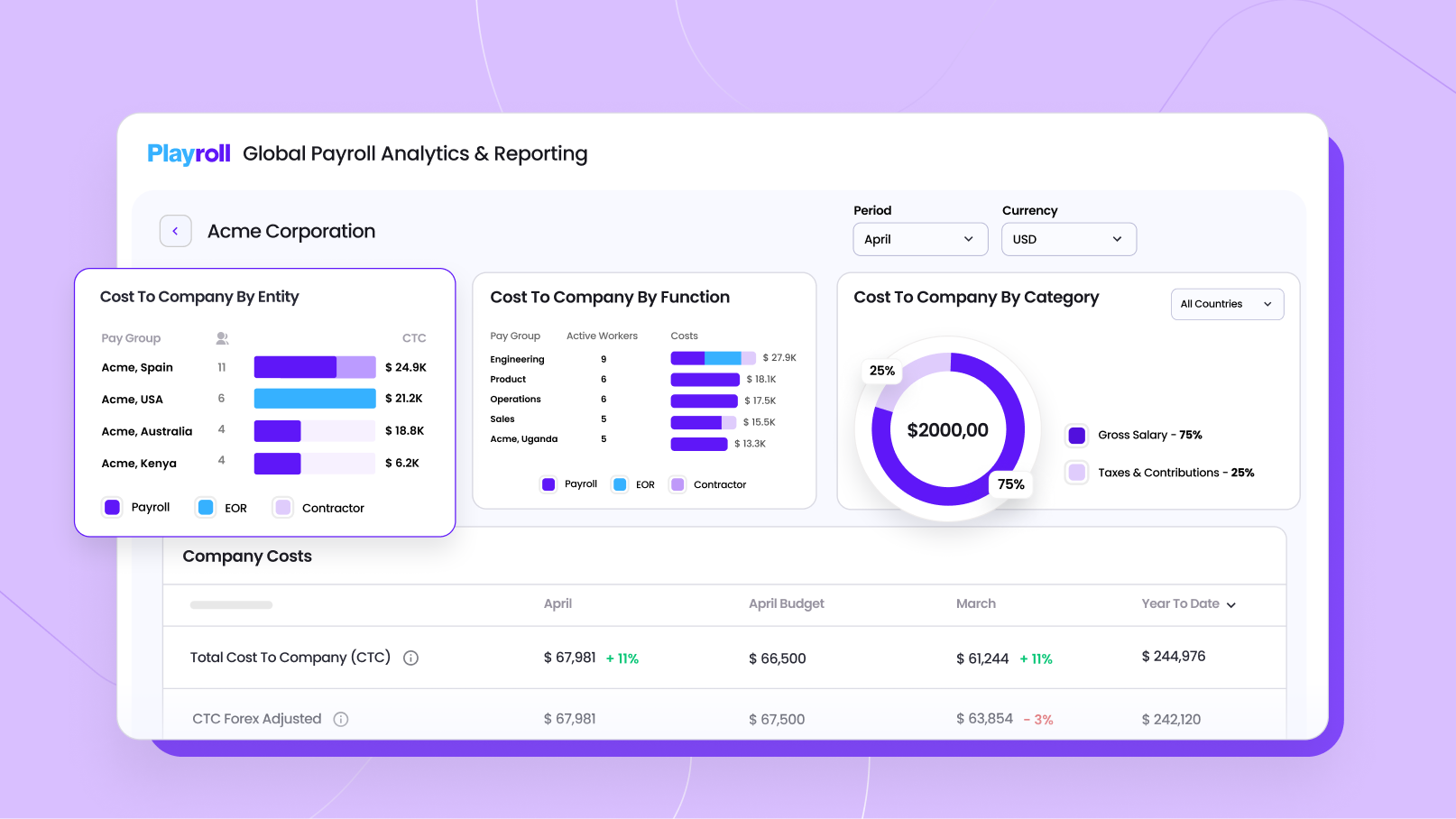
Global payroll analytics translates scattered international payments into a single, usable financial picture. For remote workers, it's not about tracking corporate labor costs. It's about understanding what you actually keep after fees, conversions, and deductions strip away portions of your contract rate. The difference between what clients promise and what lands in your account becomes visible.
Aggregating Income Across Borders
Contractors working with multiple clients often receive payments through different systems. One invoice clears via wire transfer. Another arrives through a digital wallet. A third processes through a contractor platform. Each transaction carries its own:
- Timeline
- Fee structure
- Reporting format
Analytics tools consolidate these fragmented records into a single view. Instead of logging into five accounts to reconstruct monthly earnings, you see total income regardless of payment source. That consolidation eliminates manual reconciliation and reduces the risk of overlooking smaller payments or overlooked deductions.
Surfacing Hidden Costs
Cross-border payments rarely arrive intact. Processing charges, intermediary bank fees, platform commissions, and currency conversion spreads all reduce net receipts. Many of these costs are buried in transaction details or applied silently during currency exchange. Analytics surfaces the gap between gross contract amounts and actual deposits.
You can see which payment methods cost the most and which clients generate the highest net income after fees.
According to Gloroots Blog on Global Payroll Analytics, companies using payroll analytics report a 30% reduction in payroll processing costs. Workers benefit from the same transparency, identifying inefficiencies that erode take-home pay without changing contract rates.
Tracking Exchange Rate Impact Over Time
Currency fluctuations change real income even when contract rates stay constant. A $5,000 monthly retainer buys different amounts depending on whether your home currency strengthens or weakens against the dollar. The contract never changes, but your purchasing power does.
Protecting Your Global Purchasing Power
Analytics that track exchange rates over time help workers see whether currency movements are boosting or eroding income. This insight matters most for digital nomads whose living expenses shift across countries. Understanding these patterns allows you to:
- Time major purchases
- Relocate strategically
- Renegotiate contracts when currency trends consistently reduce your effective earnings.
Building Structured Income Records
Freelancers and contractors rarely receive standardized pay slips. Most payment platforms confirm transfers without summarizing earnings or deductions. You're left with transaction notifications, not income statements.
Consolidated analytics transforms those notifications into structured records. This documentation supports:
- Tax preparation
- Loan applications
- Visa requirements
- Long-term financial planning
Having a reliable income history reduces administrative friction and eliminates the need to reconstruct earnings manually when external parties require proof of income.
Enabling Smarter Financial Decisions
With clear visibility into net earnings, budgeting shifts from guesswork to planning. You can build realistic spending plans based on actual cash flow rather than contract amounts. Tax preparation becomes less stressful when you understand true income after deductions. Evaluating new opportunities gets easier when you can compare offers in consistent terms after fees and currency effects.
Payroll software like Ontop consolidates contractor payments across borders into a single platform with transparent fee structures and real-time currency tracking. Instead of piecing together income from multiple sources, workers and employers gain unified visibility into:
- Gross payments
- Deductions
- Net deposits
The Contrast Between Employer Metrics and Worker-Focused Clarity
That clarity turns financial planning from reactive guesswork into proactive control. The difference between employer-focused and worker-focused analytics comes down to perspective. Companies track:
- Labor costs
- Productivity metrics
- Compliance risk
Workers need to understand take-home pay, purchasing power, and financial stability. Same data, opposite goals. One optimizes spending, the other maximizes clarity about what you keep.
The Hidden Variables That Change Your Pay Internationally

Currency movements, transfer fees, and tax obligations shift your real earnings in ways that never appear on a contract. These variables operate independently of your work quality or hours logged.
- They reduce purchasing power
- They create unexpected liabilities
- They make identical contracts produce vastly different outcomes, depending on where you live and how you get paid.
Exchange Rate Volatility
Currency fluctuations alter what you can actually buy with your earnings. A $4,000 monthly contract denominated in USD delivers different local purchasing power each time it converts. When your home currency strengthens against the dollar, your effective income drops even though the contract amount stays constant.
According to WTW's 2025 pay trends analysis, the median salary increase globally is expected to be 4.5%. But for contractors paid across borders, a 5% adverse currency swing can erase that entire gain before you adjust a single expense. The contract looks better on paper. Your rent, groceries, and savings contributions get harder to cover.
Navigating the Volatility of Emerging Market Currencies
Emerging market currencies experience even sharper swings. The International Monetary Fund notes that many of these currencies face double-digit annual fluctuations against major currencies, making income stability unpredictable for workers paid in dollars or euros but spending locally. You can't control exchange rates, but you absorb every percentage point of movement.
Payment Method Differences
How funds move from client to contractor determines what actually arrives. Bank wires, digital wallets, contractor platforms, and local payment systems each apply different:
- Costs
- Speeds
- Conversion rates
A wire transfer might charge lower fees but take five business days and use an unfavorable exchange rate. A digital wallet processes instantly but embeds a 3% conversion spread you won't notice until funds land.
Closing the Gap Between Gross and Net Pay
Platform payments often deduct service fees before releasing funds. You invoice $3,000. The platform takes 2.5% for processing. Currency conversion adds another 1.8%. A receiving bank charges $15 for the incoming transfer. You get $2,823. That $177 gap represents nearly 6% of your contract value, and none of it shows up in the original agreement.
Choosing the wrong method compounds over time. Twelve months of $177 monthly losses totals over $2,100 annually. That's not a rounding error. It's rent, travel, or emergency savings disappearing into infrastructure you assumed was neutral.
Local Tax and Compliance Requirements
Tax obligations shift based on residency status, local laws, and income classification. Some countries require quarterly advance payments. Others mandate social contributions or health insurance tied to earnings. Without employer withholding, you manage these obligations yourself, often facing large lump-sum payments months after income arrives.
Failure to account for these liabilities makes apparent income misleading. A contractor earning $60,000 annually might owe $18,000 in combined taxes and mandatory contributions depending on location. That's 30% of gross income that never becomes disposable. If you budget based on deposits rather than net obligations, you're spending money you'll eventually owe.
Compliance complexity increases when working across multiple jurisdictions. Different clients may trigger different reporting requirements. Miss a filing deadline or misclassify income, and penalties add another layer of unexpected cost.
Payment Delays and Cash Flow Gaps
Timing matters as much as amount. Late payments create liquidity gaps that force reliance on savings or short-term borrowing. A two-week delay might seem minor, but when rent is due and funds are stuck in processing, the gap becomes immediate and stressful.
Delays also extend currency exposure. Funds received three weeks late convert at whatever rate prevails then, not when you invoiced. If the currency weakened during that window, you lose purchasing power through no fault of your own. The client paid on time by their standards. You still absorb the cost.
Irregular payment schedules make budgeting speculative. You can't distinguish between a strong earnings month and a timing coincidence when deposits arrive unpredictably. Planning major expenses or setting aside tax reserves becomes guesswork rather than strategy.
Compounding Effects
These variables don't operate in isolation. They stack. A contractor paid $4,500 monthly might experience a 3% transfer cost ($135), a 1.5% conversion spread ($68), and a 4% currency depreciation ($180 in purchasing power). That's $383 in combined impact, reducing effective value to roughly $4,117 before taxes. Nearly 8.5% gone without any change in workload or contract terms.
Payroll software like Ontop consolidates cross-border contractor payments into a single platform with transparent fee structures, real-time currency tracking, and predictable payment schedules. Instead of reconstructing income across fragmented systems, workers and employers see unified visibility into:
- Gross payments
- Deductions
- Net deposits in minutes, not days
That clarity removes guesswork from budgeting and exposes hidden costs that erode take-home pay.
Engineering Your Global Take-Home Pay
Two contractors with identical $5,000 monthly agreements can experience $500 or more in monthly income variance solely due to these hidden variables. One optimizes payment methods and tracks currency trends. The other accepts defaults and discovers the gap too late. Same contract, different financial reality. Understanding these variables transforms how you:
- Evaluate offers
- Negotiate rates
- Choose payment methods
You stop reacting to unexplained shortfalls and start controlling the factors you can influence. The contract amount is only the starting point. What reaches your account, and what it can buy, depends on variables most workers never think to measure.
Related Reading
- Global Payroll Analytics
- Global Payroll Complexity
- Top Global Payroll Solutions for HR Teams
- ERP Payroll Software
- Multi Company Payroll Software
- International Payroll Companies
- Employer of Record Service Companies
- Best Multi-Country Payroll Softwares
Why Fragmented Payment Systems Hurt Remote Workers

The problem isn't that remote workers receive payments. It's that they receive them through five different platforms, each with its own login, currency, timeline, and reporting format. That fragmentation turns income tracking from a simple statement review into a monthly reconstruction project. You're not managing earnings anymore. You're managing accounts.
Multiple Accounts and Wallets
One client insists on PayPal. Another uses Wise. A third pays through a contractor platform that holds funds for seven business days. A fourth wire directly to your local bank. Each system:
- Operates independently
- Reports differently
- Applies its own fee structure without cross-referencing the others.
You can't log in to one place to see what you earned this month. You log into four places, export transaction histories, convert everything into a common currency, and hope you didn't miss a pending deposit or overlook a deduction buried in fine print.
According to FinTech Weekly, remote workers in emerging markets can lose up to 7% of their earnings to currency conversion fees and unfavorable exchange rates. That's not a rounding error. That's a week of work disappearing into infrastructure you thought was neutral.
Manual Tracking in Spreadsheets
Without consolidated reporting, most contractors build their own systems. Spreadsheets with tabs for each client, formulas that attempt to reconcile invoices against deposits, and notes explaining why the numbers don't match. You become your own finance department, except you're doing it after hours and without training.
Manual processes breed errors. A missed transaction. A conversion rate pulled from the wrong date. A fee you forgot to account for because the platform buried it three clicks deep in transaction details. Small mistakes compound, distorting your sense of profitability and making tax preparation feel like archeology.
Difficulty Proving Income for Visas or Loans
Traditional employees hand over pay slips. Remote workers with fragmented income streams hand over transaction confirmations, bank statements from three countries, and spreadsheets they built themselves. Institutions that evaluate financial stability want standardized documentation. What you have is a collection of PDFs that don't speak the same language.
This creates friction when applying for visas, rental agreements, mortgages, or business financing. You know you earned enough. Proving it in a format someone else accepts is a different challenge. The income exists. The documentation doesn't.
No Unified Performance View
Fragmentation hides patterns. You don't know which clients are most profitable after fees. You can't see which payment methods cost the most. You can't track whether currency movements are helping or hurting you month to month. The data exists, scattered across platforms. The insight doesn't.
This lack of visibility makes it impossible to optimize strategically. You can't negotiate better rates if you don't know your true margins. You can't choose smarter payment methods if you can't compare their real costs. You're flying blind, making decisions based on contract amounts rather than take-home reality.
Consolidating Global Payroll for Unified Visibility and Cost Transparency
Payroll software like Ontop consolidates contractor payments across borders into a single platform with transparent fee structures and real-time currency tracking. Instead of reconstructing income from fragmented sources, workers and employers see unified visibility into:
- Gross payments
- Deductions
- Net deposits in minutes
That clarity removes the guesswork from budgeting and exposes hidden costs that erode take-home pay without changing contract rates.
Lifestyle Impact of Financial Uncertainty
Irregular payments and unclear income totals undermine confidence in long-term planning. Travel decisions, housing commitments, and savings goals become harder when cash flow is unpredictable. You can probably afford the apartment. You can book the flight, maybe. The numbers say yes, but the fragmentation creates doubt.
Why Predictability Outranks Total Income
Research from PEW on financial well-being consistently shows that income volatility increases stress and reduces the ability to plan for the future, even when average earnings are relatively high. The issue isn't total income. It's the inability to see it clearly or predict it reliably. Flexibility becomes instability when you can't answer basic questions about what you're actually earning.
Fragmentation turns what should be a straightforward financial picture into a puzzle you solve monthly. Workers increasingly need tools designed for cross-border income realities, not domestic payroll assumptions. The platforms exist to move money. They weren't built to help you understand what you're keeping.
What an Ideal Global Payroll Experience Should Provide
A global payroll system built for remote workers should answer one question instantly: what did I actually keep? Not what the contract promised, not what the invoice said, but what landed after every fee, conversion, and delay. That clarity should arrive automatically, without:
- Spreadsheets
- Logging into five platforms
- Reconstructing your financial life each month
Transparent Fee Structure Before Payment
Most workers discover costs after funds arrive. The invoice says $3,000. The deposit shows $2,847. You reverse-engineer what happened, guessing at platform fees, wire charges, and conversion spreads. By then, the money is already gone.
Transparency means seeing total costs upfront. Before accepting a payment method, you should know exactly what will be deducted and why. A 2.5% platform fee. A $15 receiving charge. A 1.3% currency spread. When these numbers appear before the transaction, you can compare methods intelligently and choose the one that maximizes income.
According to G2 Learn, 49% of employees would start looking for a new job after experiencing just two issues with their paycheck. For contractors paid internationally, unclear deductions feel like issues. Repeated surprises erode trust in the entire payment relationship.
Real-Time Currency Conversion Tracking
Exchange rates shift constantly, but most workers see only the final converted amount. You don't know whether today's rate helped or hurt you. You can't track whether currency trends are steadily reducing your purchasing power or quietly boosting it.
An effective system displays both the original payment currency and its real-time value in your local currency.
You see what the client sent and what it's worth today. Over weeks and months, patterns emerge. You notice that payments arriving mid-month consistently convert better than those processed at month-end. You recognize when a strengthening home currency is eroding your effective raise. That visibility transforms currency exposure from an invisible risk into a manageable variable.
Unified Income Dashboard Across All Sources
Fragmentation forces manual aggregation. You log into PayPal, then Wise, then your contractor platform, then your bank. You export CSVs, align dates, convert currencies, and hope nothing slipped through. The process consumes hours and still leaves room for error. A consolidated dashboard pulls all payments into a single view, regardless of source. You see:
- Total monthly income
- Year-to-date earnings
- Historical trends without opening multiple tabs or building formulas
When a visa application requires proof of income, you download a single report instead of assembling documents from four countries. The data was always yours. Now it's actually usable.
Predictable Payment Schedules
Irregular timing creates cash-flow anxiety even when total income is strong. You know a $4,000 payment is coming. You don't know if it will clear by Tuesday or two weeks from now. That uncertainty makes budgeting speculative. You delay decisions, hold extra reserves, and second-guess commitments because you can't rely on when funds will actually arrive.
Consistency matters more than speed for long-term planning. A system that processes payments every Friday lets you plan rent, travel, and savings with confidence. You stop checking your account daily, hoping today is the day. Predictability removes the emotional tax of financial uncertainty.
Instant Access Without Withdrawal Penalties
Receiving money is only useful if you can spend it. Some platforms hold funds for days. Others charge fees to transfer money from their system to your bank account. You're paid, but your income is locked behind processing delays or withdrawal costs that weren't mentioned upfront.
Immediate access means funds become usable the moment they arrive. No holding periods. No transfer fees to move your own money. Whether you need to pay rent, book a flight, or cover an unexpected expense, your income is available when you need it, not when a platform's processing schedule allows it.
Built-In Compliance and Tax Reporting
Cross-border income creates reporting obligations most workers aren't trained to handle. Which forms do you file? When are they due? How do you classify income from three different countries? The answers vary by jurisdiction, and mistakes trigger penalties that compound the confusion.
An ideal system generates the documentation you need automatically. Year-end summaries formatted for local tax authorities. Quarterly earnings breakdowns. Records that satisfy visa requirements or loan applications.
Boosting Employee Loyalty Through Automated Financial Wellness and Visibility
According to G2 Learn, 82% of employees would be more loyal to employers offering financial wellness programs. For remote workers, financial wellness starts with knowing you're compliant without hiring an accountant to interpret your own income.
Platforms like payroll software consolidate contractor payments across borders into a single dashboard with:
- Transparent fee structures
- Real-time currency tracking
- Instant fund access
Instead of reconstructing income from fragmented sources, workers see unified visibility into gross payments, deductions, and net deposits. That clarity turns financial planning from reactive guesswork into proactive control, delivered in minutes rather than spreadsheets.
Why This Matters Beyond Convenience
When these elements align, the result isn't just easier bookkeeping. It's financial confidence. You accept projects knowing exactly what they'll net after costs. You relocate without worrying whether payment infrastructure will follow. You plan savings, investments, and major purchases based on reliable data rather than optimistic estimates.
The difference between knowing your contract rate and understanding your real income is the difference between hoping you're financially stable and knowing you are.
How Ontop Helps Workers Understand and Optimize Their Global Income
If fragmented payments and hidden costs make your income feel unpredictable, the solution is not necessarily earning more. It's gaining clarity and control over how you get paid. Ontop positions itself as a worker empowerment platform designed for the realities of cross-border work, not just an employer payroll tool.
Instead of juggling multiple systems, it centralizes the experience so you can see, receive, and use your earnings with confidence.
A Clear View of What You Actually Earn
Ontop helps you track payments across clients and countries in one place, making it easier to understand total income rather than piecing together transactions from separate accounts. Visibility into deductions and fees reduces the gap between headline pay and usable money. With a consolidated view, workers can evaluate which engagements or payment methods are most financially efficient.
According to Ontop, LATAM delivers the highest ROI ($1,739) for companies hiring remotely, but that value only translates to worker benefit when payment infrastructure doesn't erode take-home income through conversion spreads and transfer delays.
Reliable, Fast Payments
Irregular timing is one of the biggest stressors for freelancers and contractors. Ontop emphasizes dependable payment processing, reducing uncertainty about when funds will arrive.
Predictable timing supports budgeting, bill payments, and financial planning. It turns volatile income streams into something closer to a traditional payroll experience. The difference between hoping your payment clears before rent is due and knowing it will is the difference between financial anxiety and financial control.
Access to Your Income Wherever You Are
Digital nomads and remote professionals often move between countries, making local banking limitations a recurring challenge. Ontop provides ways to access earnings globally, so funds remain usable regardless of location.
This mobility ensures that getting paid does not depend on maintaining multiple local accounts or navigating unfamiliar financial systems in each destination. You relocate to Southeast Asia, Eastern Europe, or Latin America without wondering whether your payment infrastructure will follow. Your income does.
A Simplified Financial Life
By consolidating payments and reducing the need for multiple platforms or transfers, Ontop streamlines day-to-day money management. Workers spend less time tracking transactions and more time focusing on their work or personal goals.
The result is not just convenience but reduced financial friction. Fewer points of failure, fewer surprises, and clearer oversight. When you log in, you see what arrived, what was deducted, and what you can use. That transparency removes the mental load of constantly reconstructing your financial picture from scattered sources.
The frustrating part? Most workers don't realize how much clarity they're missing until they see what consolidated visibility actually looks like.
Related Reading
- Papaya Global Alternatives
- Rippling vs. ADP
- Global HR Systems
- Adp Alternatives
- Deel Vs Remote
- Best Multi-Company Payroll Software
- International Payroll Companies
- Oyster Hr Alternatives
- Employer Of Record Service Companies
- Best Multi-country Payroll Softwares
- Deel Alternatives
Book a Demo to See How Ontop Helps Workers Understand and Optimize Their Income
If you have ever wondered why your actual take-home income feels lower or less predictable than expected, the issue may not be your rates or workload but how payments move across borders. Ontop helps remote workers receive international payments reliably while providing clear visibility into what you truly earn after fees, timing differences, and currency effects.
Explore Ontop today and take control of your global income with fewer surprises and more financial clarity.