






Managing payroll across multiple countries is genuinely complex. Local tax laws, currency conversions, and compliance requirements shift constantly, leaving even experienced HR teams stretched thin. For companies building global workforces in 2026, choosing the right international payroll software can mean the difference between smooth operations and costly errors.
Ontop is one platform that consistently stands out among global payroll providers. Built for companies hiring remote workers across borders, it handles international contractor payments, compliance, and worker classification in a single place. Teams ranging from small distributed groups to large international operations use it to pay workers accurately without the usual administrative burden. Those ready to simplify their global operations can explore Ontop's payroll software to get started.
Table of Contents
- Why Getting Paid Internationally Is Still Hard for Many Workers
- The Hidden Cost of Choosing the Wrong Global Payroll Provider
- What Makes the Best Global Payroll Companies Stand Out?
- 10 Best Global Payroll Companies for Remote Workers and Freelancers
- What Remote Workers Should Look for Beyond Payroll
- How Ontop Helps Global Workers Get Paid Faster and Work Smarter
- Book a demo today: see how Ontop powers global teams in 150+ countries
Summary
- International payroll remains expensive and slow for millions of workers despite growing demand. The Financial Stability Board's 2024 report found that the average cost of sending a $200 international remittance was 6.4%, more than double the global 3% target, with costs reaching 7.7% in Sub-Saharan Africa. Those percentages represent direct reductions in what workers actually receive, not abstract figures on a spreadsheet.
- Payroll errors carry a measurable financial cost that most companies underestimate. According to Lano's analysis of global payroll management, each payroll error costs businesses an average of $291 to correct, including administrative time, reconciliation, and compliance review. That figure does not include the downstream effect on worker trust or retention.
- Worker retention is more fragile than most employers assume when payroll is unreliable. Research from Almas Industries found that 54% of employees would start looking for a new job after experiencing just two payroll errors. For international contractors, who have fewer legal protections and more portable skills, that threshold is often even lower.
- Compliance failures create financial exposure that lands on the company, not the payroll provider. Non-compliance penalties can reach up to 10% of unpaid taxes per month, according to Lano's global payroll research, and typically result from misclassified contractors, missed local filing deadlines, or incorrect tax treatment of cross-border payments.
- The financial complexity of international contractor work extends well beyond receiving a single monthly transfer. Vena Solutions reports that remote workers save an average of $6,000 per year by working from home, but that figure assumes earnings arrive intact, without conversion losses, platform fees, or withdrawal delays reducing the actual amount received.
- Worker priorities have shifted in ways that go beyond compensation size. StrongDM's 2024 research found that 57% of remote workers say flexible scheduling is more important than salary when evaluating a job offer, pointing to broader demand for control over working conditions, including the infrastructure that handles contracts, tax documentation, and payment timing.
- Ontop's payroll software addresses the contractor-side gap directly by combining payment processing, compliance documentation, and global accounts into one system, so workers have a financial home for their earnings rather than a patchwork of separate tools.
Why Getting Paid Internationally Is Still Hard for Many Workers

Remote work grew faster than the systems built to support it. Companies can post a job listing visible to people in 50 countries and hire someone within a week, but sending that person their first payment is where things get difficult.
Why do fees and delays still eat into international contractor pay?
The cost problem is measurable and significant. According to the Financial Stability Board's 2024 report, the average cost of sending a $200 international remittance was 6.4%, more than double the global target of 3%. In Sub-Saharan Africa, that figure climbed to 7.7%. Transfer fees, exchange-rate markups, and intermediary bank charges compound, reducing what a worker actually receives.
Speed makes the problem worse. Modern remote work happens in real time, yet many cross-border payment systems fall short of global targets for speed and accessibility. A contractor in Lagos or Manila who delivers work on Tuesday shouldn't wonder whether payment will clear by Friday or the following week. That uncertainty erodes trust between companies and their contractors.
How does a patchwork payment approach create problems at scale?
Most teams handle international contractor payments through wire transfers, third-party apps, and manual currency conversions. As contractor headcount grows, this approach creates compounding delays, inconsistent records, and compliance gaps. Payroll software built for global contractor payments, like Ontop, consolidates payments, compliance, and worker accounts into a single system, giving contractors a dedicated global account to receive and manage earnings without incurring unnecessary conversion costs.
Why does compliance make cross-border payments even harder for workers?
Following the rules adds another layer of difficulty. Worker classification rules, tax documentation requirements, and local labor regulations differ significantly by country. A contractor in Brazil faces different documentation requirements than one in Portugal or the Philippines. When companies lack systematic processes to manage these differences, workers experience delays in contract finalization, payment approval, and tax form issuance. The World Bank estimated that global remittance flows reached $856 billion in 2024, underscoring the enormous demand for cross-border payments. The infrastructure serving that demand hasn't kept pace.
The barriers aren't technical mysteries. They're the accumulated weight of financial systems designed for a different era of work, where people stayed in one country, worked for one employer, and received payment through one local bank. The global contractor workforce has moved beyond that model. The payment systems many companies rely on haven't. But choosing the wrong provider can cost you far more than the fees you were trying to avoid.
The Hidden Cost of Choosing the Wrong Global Payroll Provider
Picking the wrong global payroll provider creates a slow financial drain that worsens month after month until the numbers become impossible to ignore.
"The damage from a wrong payroll provider choice doesn't arrive all at once: it compounds silently, eroding compliance standing, employee trust, and bottom-line performance until the cost becomes undeniable."
⚠️ Warning: The danger of a poor payroll provider isn't a single catastrophic failure but the slow, invisible accumulation of errors, penalties, and inefficiencies that drain your global operations.
💡 Key Insight: By the time most companies recognise the problem, they've absorbed months of unnecessary costs from compliance penalties, administrative rework, and damaged employee relationships across borders.
What do payroll errors actually cost a business?
The most visible damage shows up in errors. According to Lano's analysis of hidden costs in global payroll management, payroll errors cost businesses an average of $291 per error to fix. But this obscures what happens to the worker: the missed rent payment, the overdraft fee, the eroding trust in a company that cannot manage the basics. Research from Almas Industries found that 54% of employees would seek a new job after experiencing two payroll errors. International contractors have an even lower tolerance: they face fewer legal protections, less company loyalty, and more portable skills. A provider that fails to deliver clean, timely payments gives them reason to leave.
Why does scale not guarantee reliability for contractors?
Most companies choose the biggest, most well-known global payroll provider, assuming size ensures reliability. But as contractor rosters grow across multiple countries, that assumption breaks down. A platform built around traditional employment infrastructure often struggles to serve contractors with the speed and flexibility it promises employers. Platforms like Ontop work differently, building payment infrastructure specifically for the contractor model, so workers get a global account to receive, spend, and manage earnings without being treated as an afterthought.
How much can compliance gaps cost when a provider falls short?
Compliance risk deserves attention. Non-compliance penalties can reach up to 10% of unpaid taxes per month, according to Lano's global payroll research, and those penalties land on the company, not the provider. When a payroll platform misclassifies a contractor, misses a local filing deadline, or applies the wrong tax treatment to a cross-border payment, the business absorbs the consequence. Choosing a provider based on brand recognition rather than the depth of compliance in your hiring countries is one of the most expensive assumptions a growing company can make.
The hidden cost isn't a single line item: it's the sum of errors corrected, contractors lost, compliance gaps closed after the fact, and hours spent managing a system that was supposed to reduce complexity. The right global payroll provider removes the friction that makes international work feel unreliable for everyone involved.
Related Reading
- Best International Payroll Software
- Pay International Employees
- How Much Does It Cost To Outsource Payroll
- Global Payroll Implementation
- Benefits Of Hiring Remote Workers
- International Payroll Management
What Makes the Best Global Payroll Companies Stand Out?

The best global payroll companies treat payment infrastructure as a product, not a process. Speed, clarity, and reliability are built directly into the system rather than added on as customer service promises.
"The best global payroll companies treat payment infrastructure as a product — where speed, clarity, and reliability are engineered into the core, not bolted on as an afterthought." — Industry Insight
🎯 Key Point: The defining difference between average and best-in-class global payroll providers is whether payment infrastructure is treated as a strategic product or merely an operational checkbox.
💡 Tip: When evaluating global payroll companies, always ask whether speed, accuracy, and transparency are built into their core platform — or simply promised by their support team.
What separates coverage from capability
Most providers list the countries they support and call it global reach. But coverage is a checkbox; capability is something else entirely. According to the TransferMate Global Payroll Payments Report 2025, businesses operating across multiple countries face payroll compliance challenges in over 140 countries. The gap between "we support that country" and "we handle what that country requires" is wide enough to cause real damage.
How does contractor support reveal the real limits of a payroll platform?
The critical difference is how a provider handles the contractor relationship. The global workforce has shifted toward independent work, but most legacy payroll systems were built around full-time employment. This mismatch creates friction: slower payment cycles, rigid contract formats, and compliance frameworks not designed for contractors. Many companies still manage this through wire transfers, third-party tools, and manual reconciliation. Platforms like Ontop address this by integrating contractor payments, compliance documentation, and global accounts into a single infrastructure, eliminating the reconciliation overhead that accumulates over time.
Why the worker-side experience matters more than most admit
The failure point is usually invisible to the company but felt immediately by the worker. A contractor in Nairobi or Bogotá who receives a payment three days late experiences more than inconvenience: they receive a signal that the system wasn't built for them. The best global payroll companies understand that the worker-side experience is part of the product, not a secondary concern. Multi-currency accounts, real-time payment visibility, and spending access aren't perks—they're the difference between a contractor who trusts the arrangement and one who starts looking elsewhere.
Workers need to know what conversion rate applies, what fees are deducted, and when funds will arrive. When that information is buried or inconsistent, trust erodes quickly. Providers that surface this clearly before payment is sent create a measurably better experience for everyone involved.
Compliance as infrastructure, not an afterthought
When compliance is treated as a feature rather than a foundation, it surfaces at the worst times. Country-specific tax documentation, worker classification rules, and contract requirements don't wait for convenient timing. Providers that handle these proactively with built-in workflows rather than manual checklists reduce administrative burden across international teams. For companies managing contractors across ten or twenty countries, this distinction separates a scalable model from one requiring a dedicated compliance team. Knowing what separates a capable provider from a reliable one is only half the equation. The harder part is identifying which companies have built to that standard.
10 Best Global Payroll Companies for Remote Workers and Freelancers
Ten companies have genuinely been built for the modern contractor workforce. The differences between them matter — a lot.
"Not all global payroll platforms are created equal — the right choice can mean the difference between seamless payments and costly compliance failures." — Industry Insight
🎯 Key Point: With 10 leading platforms competing for your business, knowing exactly what sets each apart is critical before you commit.
💡 Tip: Focus on compliance coverage, payment speed, and contractor support as your top three criteria when comparing providers.
1. Ontop
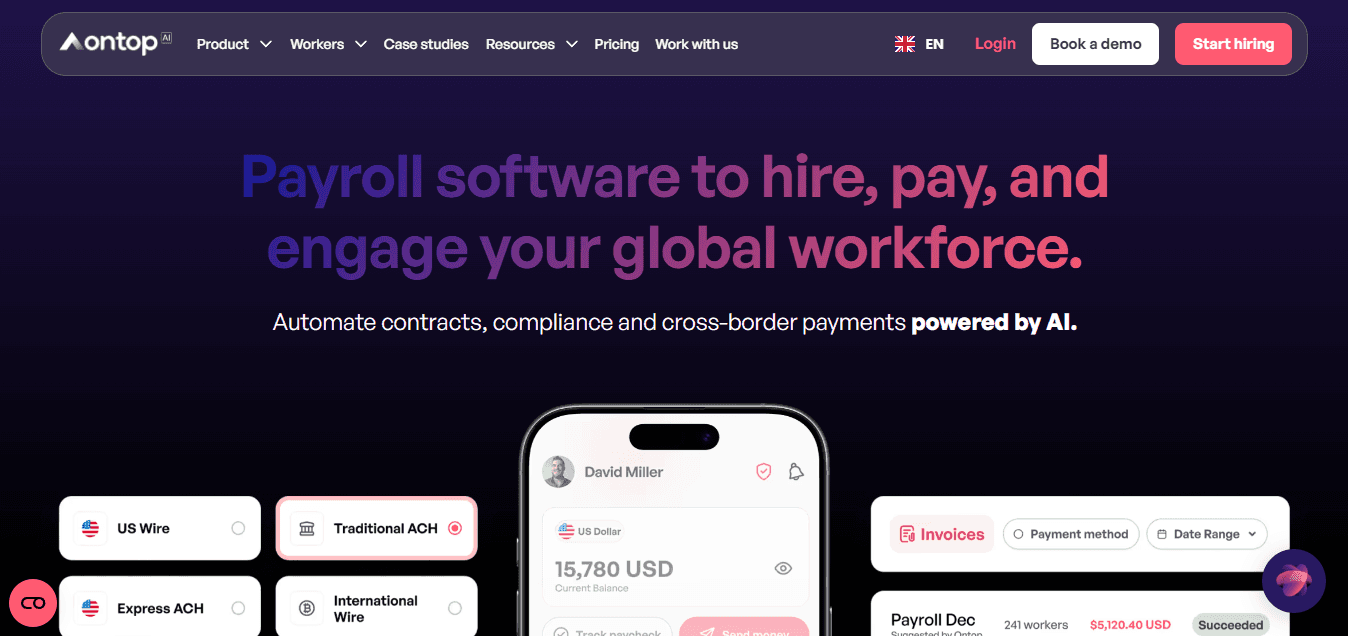
Ontop is built around a contractor-first model, which puts it structurally ahead of platforms anchored to traditional employment frameworks. Companies can hire and pay workers in more than 150 countries while contractors access USD accounts, a global Visa card, and a unified financial home for their earnings. Most payroll platforms stop at the company side of the transaction; our platform extends infrastructure to the worker, transforming the experience entirely.
How does Ontop's setup speed benefit global hiring?
How fast you can set up payroll is a competitive advantage. According to the Tarmack Blog's 2025 review of top global payroll providers, modern contractor platforms can set up global payroll in 48 hours, a timeline that would have seemed impossible with older systems five years ago. For companies that need to hire contractors in Brazil or the Philippines without a two-week wait for paperwork, that speed provides a significant operational advantage.
2. Deel

Deel built its reputation on handling large numbers of workers while maintaining compliance. The platform supports contractors and full-time employees across dozens of countries, with location-specific contracts and multiple withdrawal options that give workers flexibility in how they receive income. Deel's compliance engine was designed to handle both employment models without forcing one into the other's mold, which is critical for contractor-heavy teams with workforces spanning multiple countries and engagement types.
3. Remote

Remote's infrastructure sets it apart from other companies: it creates its own local businesses in each country rather than relying on third-party partners, reducing handoffs and ensuring consistent payroll outcomes. For companies managing remote-first teams across five or more countries, this consistency matters. Payroll errors compound across different regions, and each intermediary adds delay and risk.
4. Papaya Global

Papaya Global treats international payroll as much a data problem as a compliance one. Its platform combines payroll processing with workforce analytics, giving finance and HR teams visibility into cross-border payment flows that most providers don't offer natively. This visibility matters when managing payroll across twenty countries: Papaya reveals where friction exists, not just what occurred.
5. Oyster

Oyster's strongest feature is making international job opportunities accessible to workers in regions with historically limited access to them. The platform supports employer-of-record services, contractor management, and benefits administration, simplifying processes for both employers and workers. For freelancers transitioning to full-time international jobs, Oyster provides structure to ease the shift. Its compliance and contract frameworks protect the worker, not just the company.
6. Multiplier

Multiplier helps companies hire workers in other countries without creating local legal entities in each location. The platform handles payroll, benefits, contractor payments, and compliance through a single interface. The key advantage is speed-to-hire. When a company finds talent in a new market, Multiplier eliminates the months-long entity setup process, compressing time-to-hire into a competitive advantage for growing teams.
7. Rippling

Rippling's main strength is its deep integration of different systems. Most global payroll platforms handle compensation; Rippling also manages device management, software access, benefits, and HR workflows from a single system, reducing coordination costs between IT and HR. Most teams handle contractor onboarding through separate payroll tools, IT ticketing systems, and HR software that don't integrate well. As contractor headcount grows, this separation creates administrative drag. Payroll software that connects financial infrastructure with contractor management from day one avoids that buildup, keeping operational overhead proportional to team size rather than letting it compound.
8. Payoneer Workforce Management
Payoneer's advantage is that many international freelancers already use it for cross-border payments, making the transition to its workforce management tools seamless. For companies paying large numbers of independent contractors who already use Payoneer, this familiarity simplifies onboarding and accelerates payment processing.
9. Skuad
Skuad enables companies without dedicated legal or HR teams in each country to hire people internationally while maintaining compliance. Its employer-of-record services and contractor management tools handle the complex legal and tax issues that would normally require expert knowledge. According to Global HRIS's 2025 analysis of the largest global payroll providers, ADP handles payroll for over 1 million clients across more than 140 countries. Skuad's focused approach suits companies seeking global coverage without the complexity of large enterprise platforms.
10. Velocity Global

Velocity Global helps companies enter new markets by offering employer-of-record support, immigration assistance, and compliance management. These services address the complex rules and regulations that extend beyond basic payroll. For workers, this means they can find jobs in markets where legal and immigration barriers would normally prevent them from working. Velocity Global manages that complexity, enabling companies to hire more easily.
Choosing the right fit
No single provider works for every team. The right choice depends on your workforce composition (contractors vs. employees), operating countries, and whether workers need financial tools beyond basic payment receipts. The best providers balance both sides: companies gain compliance coverage and operational efficiency, while workers receive reliable, fast payments and financial infrastructure to build on. Platform choice, however, is not the most important decision your contractors will make.
What Remote Workers Should Look for Beyond Payroll
Getting paid on time matters. But for international contractors building careers across borders, payment receipt is the floor, not the ceiling.
💡 Tip: When evaluating a remote role or payment platform, ask how, when, and at what cost your money arrives.
"For global remote workers, the question isn't just whether you get paid — it's whether you get paid whole." — Remote Work Financial Planning Principle
The financial life of a global remote worker is far more complex than a single monthly transfer. You might earn in USD, spend in pesos, save in euros, and pay taxes in a jurisdiction that has no idea what a W-8BEN form is. Vena Solutions reports that remote workers save an average of $6,000 per year by working from home — but that figure assumes your earnings actually reach you intact, without conversion losses, platform fees, or withdrawal delays eating into the margin.
⚠️ Warning: A payment setup that looks seamless on paper can quietly drain hundreds or thousands of dollars annually through fees and unfavorable exchange rates — always audit the full cost of getting paid.
🔑 Takeaway: For international remote workers, the real measure of a payment solution isn't speed alone — it's how much of your hard-earned income survives the journey from client to wallet.
What actually moves the needle for global contractors
Contractors who succeed internationally choose payment tools that eliminate friction. Multi-currency wallets, local receiving accounts, and global spending cards are essential: they determine whether a global career builds value or bleeds money at every currency conversion. A contractor in Nairobi who receives USD, holds it, and spends strategically occupies a fundamentally different financial position than one forced to convert immediately at whatever rate the platform offers.
Why does stitching together separate tools create problems?
Most contractors use three or four separate tools: one to receive payment, another to change currency, a third to send money locally, and a bank account that charges fees at each step. This breaks down when volume grows, clients multiply, or delayed transfers create cash-flow gaps that affect rent, software subscriptions, and tax obligations. Payroll software built for contractors consolidates these layers into a single account: receiving earnings, holding multiple currencies, and connecting to a spending card, all without requiring separate banking relationships in every country.
How do compliance and contract management shape a global career?
Managing contracts and handling taxes consume significant time for people who work internationally. Different countries have distinct contractor agreements, tax withholding rules, and worker classification requirements—a single contract error can create problems for both worker and company. According to StrongDM's 2024 research, 57% of remote workers say flexible scheduling is more important than salary when evaluating a job offer. Platforms that handle compliance paperwork, generate appropriate tax forms, and maintain legally sound contracts across multiple jurisdictions give contractors control over their working lives.
What financial ecosystem do the best global payroll platforms offer?
Accessing benefits is the next big challenge. Traditional jobs include health coverage, retirement contributions, and professional development budgets as part of the pay package. Contractors must cover all of that themselves. The best global payroll platforms now compete by offering a financial ecosystem: access to healthcare options, educational resources, and financial planning tools has become standard rather than a differentiator. The real question is not which platform pays fastest, but which platform makes your global career structurally sustainable.
Related Reading
- How To Pay a Foreign Contractor
- How to Hire Overseas Contractors
- How to Hire a Remote Team
- How to Calculate Time for Payroll
- How to Hire International Employees
- Best Way To Pay International Contractors
How Ontop Helps Global Workers Get Paid Faster and Work Smarter
Most global payroll platforms focus on what employers need—hiring, following the rules, handling payroll, and managing workers. But workers need different things: fast onboarding, quick payments, easy access to their earnings, and smooth money management across borders.
"Workers need different things: fast onboarding, quick payments, easy access to their earnings, and smooth money management across borders." — A critical gap in today's global payroll landscape
💡 Tip: If you're a global worker, look for platforms built specifically around your needs—not just your employer's compliance checklist.
🎯 Key Point: The real difference between a good and a great payroll platform is whether it treats workers as first-class users, prioritizing speed, accessibility, and cross-border financial flexibility.
How does Ontop simplify onboarding and payments for global workers?
Ontop takes a worker-focused approach by consolidating contracts, compliance, and payroll into one platform. The payroll software helps workers complete onboarding and start working with international companies without having to navigate multiple systems or lengthy workflows. The platform supports payments in more than 150 countries, removing barriers for remote workers, freelancers, and digital nomads working with companies worldwide.
How does Ontop help workers manage and spend their international earnings?
Ontop provides USD accounts for receiving and managing income in a widely used business currency, simplifying financial management for professionals working with international clients. A global Visa card lets users spend and access earnings directly without moving funds between multiple services. Compliance and contract support simplify legal documentation and country-specific requirements, reducing administrative work so professionals can focus on their core responsibilities.
What makes Ontop's approach different from other payroll platforms?
The platform offers special benefits for remote workers and digital nomads, supporting the realities of international work. Rather than focusing solely on employer payroll operations, Ontop prioritizes the worker experience: making it easier for professionals to earn, access, manage, and use their income wherever they work.
Book a demo today: see how Ontop powers global teams in 150+ countries
Building a structurally sustainable global career requires infrastructure designed for you, not retrofitted around you. When evaluating payroll software options, the right question isn't who has the longest country list, but who gets you onboarded fast, pays without friction, and gives you a financial home for your earnings.
"The right global payroll platform doesn't just process payments: it gives independent professionals a legitimate financial home built around how they actually work." — OnTop
🎯 Key Point: The best payroll software is measured by speed, simplicity, and contractor-first design, not country count.
Teams in 150+ countries trust Ontop to power their global teams because the platform was built contractor-first, not as an afterthought to traditional employment models. Book a demo today to see how Ontop gives international professionals immediate access to a USD account, global payment tools, and worker benefits that treat independent work as a legitimate, long-term career choice.
💡 Tip: When comparing platforms, ask specifically about onboarding speed and contractor benefits — these are the features that separate purpose-built tools from retrofitted ones.
✅ Best Practice: Choose a platform like Ontop that was designed with the independent professional in mind from day one — not adapted from a legacy employment model.
Related Reading
- Best Payroll Software For Staffing Companies
- Best Payroll Outsourcing Companies
- Deel Vs Oyster
- Best International Payroll Software
- Best Payroll For Contractors
- Remote Competitors