






Hiring across borders is harder than it looks. Finding the right candidate is only the first step; navigating contracts, compliance rules, and cross-border payments can stall the entire process. For companies building global teams, the right recruiting, onboarding, and payment tools make the difference between a smooth hire and a costly delay.
Choosing the best international payroll software and hiring tools comes down to understanding what each platform does and how it fits into a global workflow. Ontop is one option built specifically for international teams, consolidating worker payments, contracts, and compliance into a single platform. Teams ready to hire and pay global talent without the usual friction can explore what payroll software from Ontop brings to the table.
Table of Contents
- Why Hiring Great Talent Has Become Harder Than Ever
- The Hidden Cost of Using the Wrong Hiring Tools
- What Makes the Best Hiring Tools Stand Out?
- 10 Best Hiring Tools for Modern Teams
- Why Hiring Tools Alone Don't Solve Global Hiring Challenges
- How Ontop Helps Companies Turn Great Hires Into Successful Global Team Members
- Book a demo today: see how Ontop powers global teams in 150+ countries
Summary
- Global hiring bottlenecks rarely come from a shortage of candidates. ManpowerGroup's 2025 research found that 76% of employers report difficulty filling roles despite having access to larger talent pools than ever before. The real problem is process speed. Top candidates typically accept offers within 10 days of entering the market, while the average company takes more than 44 days to complete a hire, creating a 34-day window where strong candidates move on.
- The financial cost of slow or broken hiring processes is significant and often underestimated. SHRM data puts the average cost of a bad hire at $17,000, with some estimates reaching $240,000 when legal exposure, training investment, and lost productivity are factored in. CareerBuilder research finds that 74% of companies have made a bad hire, with costs averaging over $14,900 per incident, and many of those decisions trace back to pressure from losing better candidates earlier in the process.
- Automation yields measurable gains when applied at the right stage in the recruiting process. Unilever cut hiring time from four months to four weeks after using AI to screen more than 250,000 applications, and broader research from SHRM, LinkedIn, Gartner, and McKinsey shows that teams using AI in recruiting report 20 to 40% lower cost per hire. These gains matter because they reflect time returned to recruiters for actual evaluation rather than administrative processing.
- The post-offer stage is where most global hiring stacks quietly fall apart. Recruiting software is designed to find and track candidates, not to handle contract generation, worker classification requirements, or cross-border payment infrastructure. SHRM's 2025 Talent Trends report found that 75% of HR professionals report difficulty recruiting for full-time positions, with a significant share of that difficulty tied to operational friction rather than a shortage of willing candidates.
- Technology alone does not resolve the complexity of hiring across borders. Alpha Apex Group reports that 85% of HR leaders say technology alone cannot solve global hiring challenges. The gap appears not in sourcing or tracking but in the legal, financial, and compliance infrastructure that sits between an accepted offer and an onboarded, paid contractor. As hiring scales across multiple countries, disconnected tools for contracts, compliance, and payments create compounding delays and risk at exactly the moment candidates are deciding whether the company is ready for them.
- Candidate experience after the offer stage directly affects retention. ManpowerGroup reported that 80% of employers struggled to fill roles in 2024, a record high, making the post-offer experience a competitive variable rather than an administrative afterthought. Contractors who face delayed payments, currency friction, or unclear contract terms during onboarding begin evaluating other options, regardless of how strong the recruiting process felt before the offer.
- Ontop's payroll software addresses the post-offer gap directly by consolidating contractor agreements, compliance across 150+ countries, and cross-border payments into a single workflow, so the operational lag that typically follows a verbal offer no longer costs companies their best candidates.
Why Hiring Great Talent Has Become Harder Than Ever

Hiring has never been faster to start and slower to finish. Tools exist to find talent around the world and reach thousands of candidates overnight, but finding someone and actually hiring them are two completely different problems. Most organizations lose the race at the second step.
"Most organizations lose the race not at the sourcing stage — but at the hiring stage, where speed, process, and decision-making break down." — Hiring Reality Check
🚨 Warning: Don't confuse access to candidates with the ability to hire them — most teams fail at the second step, not the first.
🎯 Key Point: The real hiring challenge isn't finding talent — it's converting interest into a signed offer before your competition does.
Where does the hiring process actually break down?
The failure point is the gap between candidate availability and company decision speed. According to ManpowerGroup's 2025 research, 76% of employers report difficulty filling roles despite access to larger talent pools than ever before. The bottleneck is not supply: it is the process between "we found someone great" and "they said yes." Top candidates accept offers within 10 days of entering the market, while the average company takes more than 44 days to complete a hire. That 34-day gap is where great hires disappear. Multiple rounds of internal approvals, disconnected applicant tracking systems, and manual scheduling across time zones create structural barriers to speed.
How does operational friction compound across global hiring?
Most teams handle global hiring by layering incompatible tools: a job board, a spreadsheet, a compliance checklist in someone's inbox. As candidate volume grows and hiring crosses borders, friction compounds. Payroll software built for global contractor hiring, like Ontop, addresses a critical delay: what happens after a candidate accepts the offer. Our platform resolves contracts, compliance across 150+ countries, and cross-border payments in one place, eliminating operational lag that costs companies their best candidates.
Classification requirements, local contract standards, and payment infrastructure add time and risk to international hiring. SHRM's 2025 Talent Trends report found that 75% of HR professionals report difficulty recruiting for full-time positions, with operational friction rather than candidate shortage as the primary cause. The hiring process itself is the obstacle.
What separates companies that consistently win top talent?
Companies that consistently win the best talent are not those with the biggest recruiting budgets, but those whose hiring workflows move fast enough to match how quickly great candidates make decisions. Talent acquisition today is less about reach and more about responsiveness. Candidate experience, communication speed, and the ability to move from offer to onboarding without administrative delays separate teams that hire well from teams that almost hired well.
The Hidden Cost of Using the Wrong Hiring Tools
Figuring out the cost of a bad hire is uncomfortable, but it's necessary. According to SHRM, cited by INOP, the average cost of a bad hire is $17,000, with some estimates reaching $240,000 when you include legal exposure, training investment, and lost productivity. That number doesn't even include what happens before that — in the hiring process itself, before a single offer is made.
"The average cost of a bad hire is $17,000 — and can climb to $240,000 when factoring in legal exposure, training investment, and lost productivity." — SHRM, via INOP
⚠️ Warning: Most companies focus on the visible costs of a bad hire — but the hidden costs buried in the hiring process itself (wasted interviews, poor screening tools, lost manager hours) are never counted.
🔑 Takeaway: A $17,000 floor and a $240,000 ceiling mean there is no such thing as a low-stakes hire. Every broken step in your hiring workflow compounds that risk before a single offer letter is signed.
💡 Tip: Before evaluating the outcome of a bad hire, audit your hiring tools first — the real damage often starts long before an offer is made.
Where do disconnected recruiting tools actually break down?
The failure point remains invisible until it worsens. When recruiting tools don't connect, every handoff between sourcing, screening, scheduling, and offer management creates a gap where time leaks out. Recruiters spend hours reconciling data across platforms never designed to work together. Hiring managers wait for updates, trapped in someone else's inbox. Candidates wait for feedback that arrives too slowly to maintain engagement.
Most teams handle global contractor hiring through a patchwork of tools: one platform for job postings, another for contracts, a third for payments, and often a spreadsheet holding everything together. Platforms like payroll software consolidate contracts, compliance, and cross-border payments into a single workflow, eliminating administrative gaps that slow hiring and reducing friction for contractors being onboarded and paid across borders.
How do slow hiring tools push teams toward the wrong candidates?
CareerBuilder, cited by INOP, reports that 74% of companies have made a bad hire, with costs averaging over $14,900 per incident. Many of these bad hires stem not from poor judgment, but from rushed decisions made under pressure after better candidates have left. Slow tools push teams toward whoever remains available, not toward whoever is most qualified.
What does a broken hiring process signal to global talent?
Global talent considers more than the job itself: compensation structure, payment reliability, and whether the company's financial practices align with its professional image. A hiring process that concludes with late payments, currency conversion issues, or unclear contract terms signals disorganization, regardless of how polished the company appears on paper. Using the wrong tools does not merely slow hiring. They quietly change which candidates you hire, how confident those candidates feel about accepting the job, and whether the person you finally hire was the one you wanted most.
Related Reading
- Best International Payroll Software
- Pay International Employees
- How Much Does It Cost To Outsource Payroll
- Global Payroll Implementation
- Benefits Of Hiring Remote Workers
- International Payroll Management
What Makes the Best Hiring Tools Stand Out?

The best hiring tools make it faster and easier to find a great candidate and get them working. Speed, structure, and clear signals separate platforms that move hiring forward from ones that keep records of it.
"The best hiring tools don't just store candidate data: they deliver speed, structure, and clear signals that drive real hiring decisions forward."
🎯 Key Point: The difference between a great hiring platform and a mediocre one comes down to three factors: speed, structure, and signal clarity. If your tool isn't accelerating decisions, it's digital paperwork.
💡 Tip: When evaluating any hiring tool, ask yourself: does this platform move candidates forward faster, or does it simply record where they are? The best platforms do both and make the path to a great hire unmistakably clear.
How does automation separate high-performing hiring platforms from the rest?
Automation makes this separation most visible. Recruiting teams lose hours each week to tasks that require no judgment: parsing applications, logging status updates, and chasing interview confirmations. Unilever screened 250,000+ applications using AI, cutting hiring time from four months to four weeks. Recruiters can focus on evaluating people rather than processing paperwork. According to Truffle, citing research from SHRM, LinkedIn, Gartner, and McKinsey, teams using AI in recruiting report 20 to 40% lower cost-per-hire. The best hiring tools aren't overhead; they're a profit decision that grows with every hire.
How do consolidated platforms reduce friction in global hiring workflows?
Most companies handle global hiring through a mix of sourcing platforms, contract systems, separate payment processors, and manual follow-up. Platforms like payroll software consolidate these layers, managing contractor agreements, compliance across 150+ countries, and cross-border payments in a single workflow, reducing time from offer to onboarding. A slow, fragmented hiring process signals weakness to desirable candidates. The best tools create a clean experience for both parties. For global contractors, this means reliable, frictionless payment. A platform solving only the employer's workflow while leaving contractors to navigate currency conversion hasn't solved the hiring problem.
Why do reporting and integration make hiring smarter over time?
Reporting and integration close the loop. Hiring visibility—knowing where candidates get stuck, which sources produce quality talent, and how long each stage takes—transforms recruiting from reactive to strategic. Tools that don't connect to HR and payroll infrastructure create information gaps. The best platforms generate data that helps organizations hire smarter next time.
10 Best Hiring Tools for Modern Teams
Ten hiring tools stand out for modern teams, each solving a different part of the recruiting puzzle. The right choice depends on whether your priority is finding candidates, tracking applicants, working together with your team, or managing the whole process from offer to paycheck across borders.
"The best hiring tool isn't the most popular one — it's the one that solves your specific recruiting bottleneck at the stage where your team struggles most." — Recruiting Best Practices
🎯 Key Point: No single tool does everything well — matching the tool to your hiring stage is the essential first step before investing in any platform.
💡 Tip: Before evaluating any hiring tool, identify your biggest recruiting pain point — whether that's sourcing, applicant tracking, team collaboration, or cross-border payroll — so you can prioritize the solution that delivers the highest immediate impact.
1. Ontop
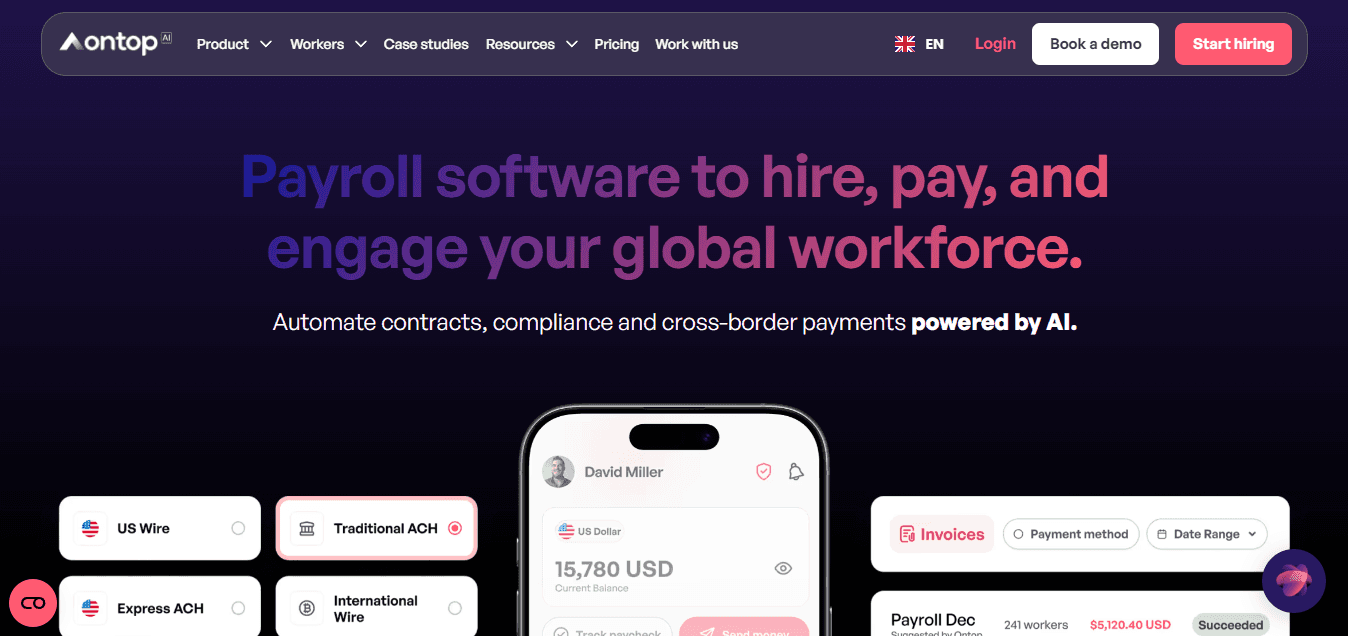
The failure point in most global hiring workflows isn't finding talent—it's everything after a candidate says yes. Contracts need to be created, compliance rules vary by country, and payment systems lag behind the needs of distributed teams. Ontop consolidates contractor hiring, compliance, and cross-border payroll into a single platform that covers 150+ countries, without the traditional employment overhead. Contractors gain access to a global financial account, benefiting both employer and worker.
2. LinkedIn Recruiter
LinkedIn Recruiter remains the best way to find passive candidates. Recruiters can filter by skills, location, and experience to identify candidates open to discussing the right opportunity without actively job searching. Few tools match its effectiveness for proactive sourcing.
3. Greenhouse
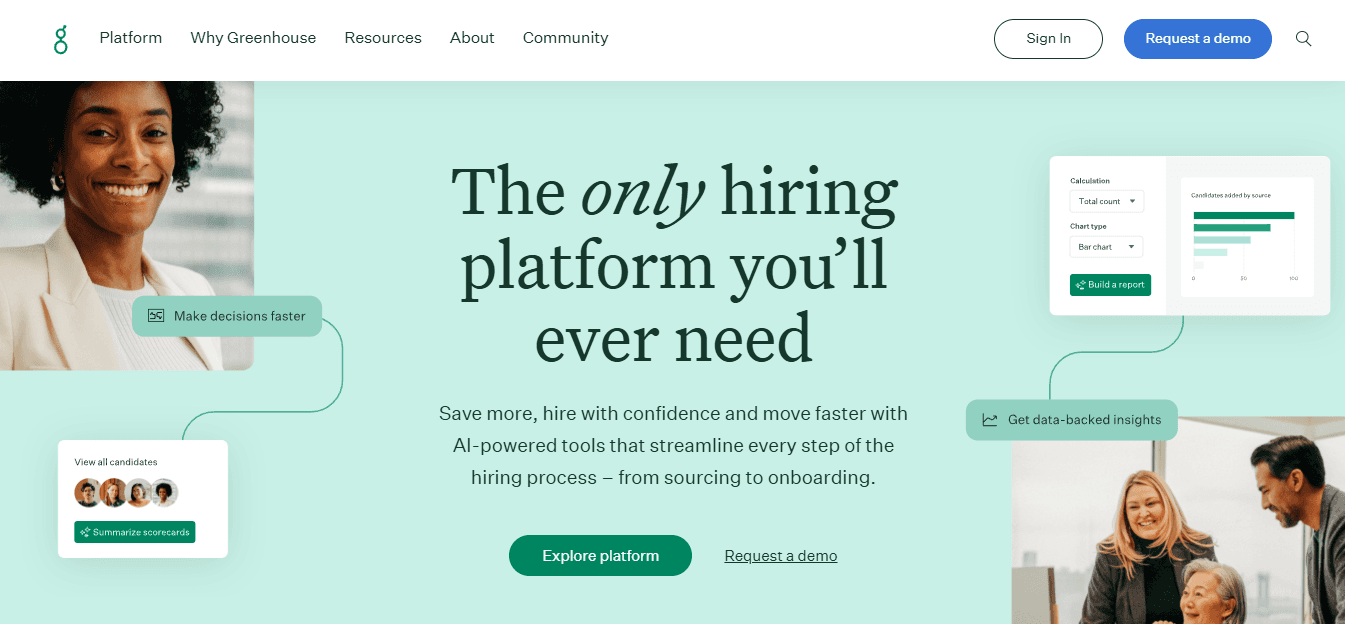
Inconsistent hiring decisions across departments typically stem from process gaps, not people. Greenhouse standardizes interview structure, feedback collection, and manager alignment, making collaborative decision-making repeatable rather than dependent on whoever speaks loudest.
4. Lever

Lever combines applicant tracking with candidate relationship management, enabling recruiters to build talent pipelines while managing active roles simultaneously. Its automation tools reduce manual coordination that typically consumes recruiting time and resources.
5. Ashby

According to LinkedIn's 2025 Future of Recruiting report, AI saves recruiters about 20% of their working week. Ashby combines this efficiency with strong analytics, displaying recruiting performance data clearly enough to inform hiring decisions in real time rather than after the fact.
6. Workable

Most small and mid-sized businesses need a single platform that handles job postings, candidate sourcing, interview scheduling, and applicant tracking without requiring a dedicated implementation team. Workable was designed for that reality, prioritizing speed of adoption over depth of configuration.
7. BambooHR

BambooHR connects applicant tracking directly to employee records and HR administration, so information captured during hiring persists after someone accepts an offer, eliminating the data re-entry and context loss that occur with separate recruiting and HR tools. Payroll software like Ontop handles global contractor hiring in a single workflow, moving from offer to compliant contract to payment without switching systems. This replaces the fragmented approach of combining an ATS, contract tool, compliance checklist, and payment platform: a gap that creates risk as headcount grows across multiple countries.
8. Teamtailor
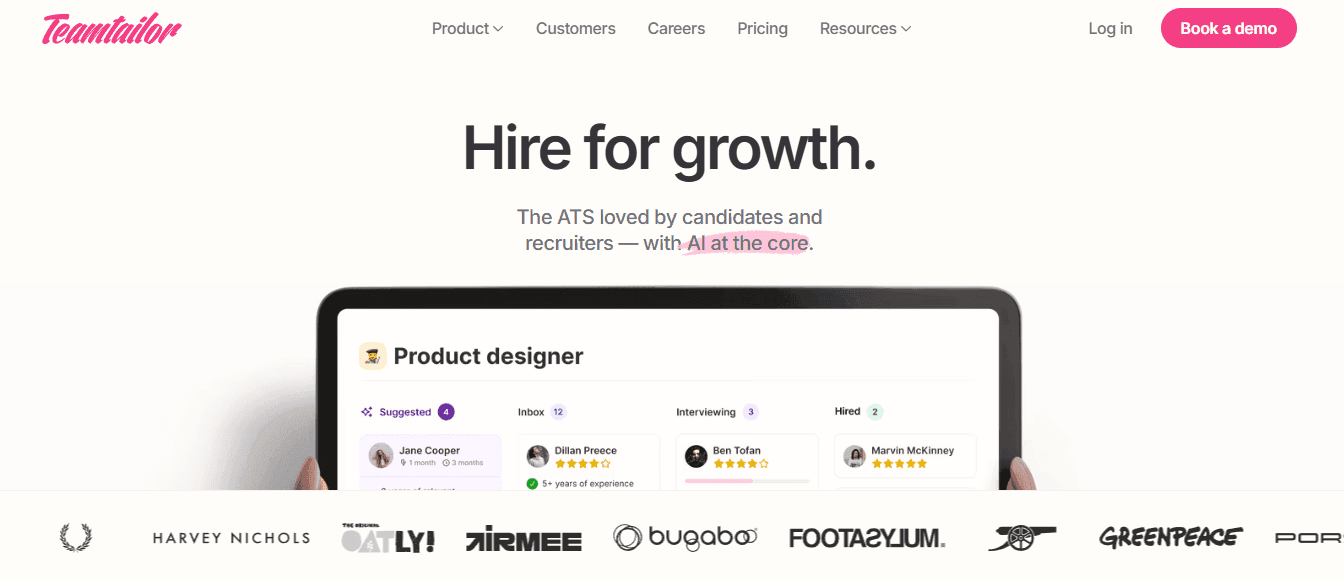
Candidate experience is a recruiting advantage most companies neglect until they start losing job offers. Teamtailor focuses on employer branding and communication quality throughout the hiring process, helping organizations build career pages that convert and automate touchpoints that typically fall through the cracks. In competitive talent markets, how a company treats candidates during recruitment often predicts how it'll treat employees afterward.
9. JazzHR

JazzHR helps small businesses organize their hiring process without enterprise costs. It tracks applicants, manages interviews, posts jobs, and automates workflows. While it lacks some advanced features of larger systems, it offers consistency and simplicity for organizations seeking straightforward solutions.
10. Recruitee
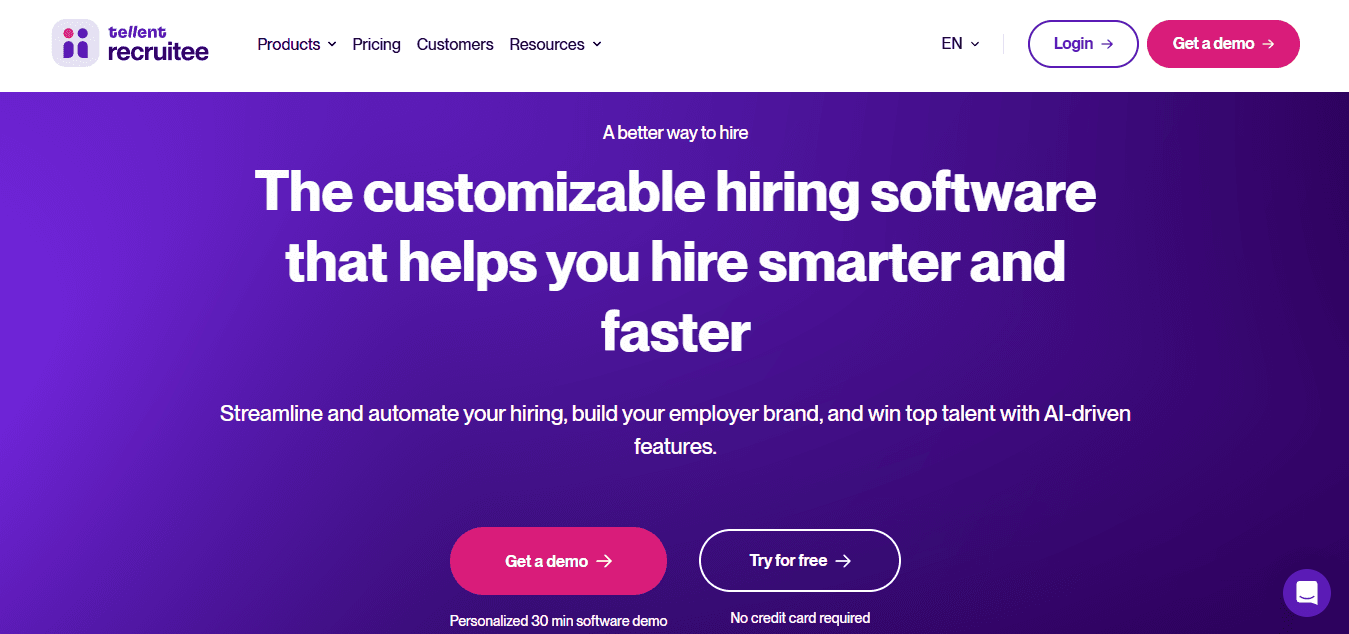
Constraint-based hiring, where multiple people need to see candidate progress without duplicating work, is where Recruitee excels. The platform is built around collaborative pipelines, giving recruiters, hiring managers, and interviewers a shared view of each candidate's status.
Why does faster hiring matter for competitive offers?
According to althire.ai, companies using recruiting tools see up to a 40% reduction in time-to-hire, which is critical when top candidates move quickly through competing offer processes.
How do you choose the right combination of hiring tools?
The right combination of these tools depends on your team's size, geography, and hiring volume. Companies that hire well use fewer, better-connected tools rather than more. But even the best stack of hiring tools encounters challenges that no feature list fully prepares you for.
Why Hiring Tools Alone Don't Solve Global Hiring Challenges

Recruiting software closes the gap between "we need someone" and "we found someone." What it rarely closes is the gap between "we found someone" and "that person is working, paid, and compliant in their country." Those are two entirely different problems, and most hiring stacks are only built for the first one.
"Most hiring stacks are built to find talent — not to legally employ, pay, or remain compliant with them across borders." — Core Global Hiring Challenge
🚨 Warning: Assuming your ATS or recruiting platform handles post-hire compliance is one of the most costly mistakes a global hiring team can make — exposing your company to serious legal and financial risk.
🎯 Key Point: The real gap in global hiring isn't finding talent — it's everything that happens after the offer is signed. Working, paid, and compliant are three separate challenges that demand a dedicated global employment solution.
Where does the global hiring process actually break down?
The failure point is usually invisible until it isn't. A company identifies the right candidate in two weeks, extends an offer, and then spends the next month navigating how to employ that person across a border: different contract requirements, tax documentation, and worker classification rules.
According to Alpha Apex Group, 85% of HR leaders say technology alone cannot solve global hiring challenges. The complexity lies in the underlying legal, financial, and operational infrastructure that software must connect to. A great applicant tracking system cannot determine whether your new contractor in Portugal needs a specific services agreement or how payment routes through local banking systems.
Why do disconnected systems slow down global hiring?
Most teams connect separate systems together: recruiting, contracts, payroll, and compliance. As hiring expands to more locations, the connections between those systems become the slowest part of the process. Delays pile up, errors emerge, and candidates question whether the company is ready for them. Payroll software built for global contractor teams addresses this directly: our platform connects compliance, contracts, and cross-border payments into a single workflow.
What happens when the post-offer experience falls short?
ManpowerGroup, via SocialTalent, reports that 80% of employers struggled to fill roles in 2024, a record high. In this environment, companies that retain talent after the offer stage are those that make the first 30 days seamless. A contractor who waits three weeks for their first payment or receives it in an inaccessible currency won't remain quietly frustrated—they'll start taking other calls. The critical difference between companies that hire well globally and those that don't isn't the quality of their sourcing tools or interview process—it's whether they've built the infrastructure to employ the people they find.
Related Reading
- How To Pay a Foreign Contractor
- How to Hire Overseas Contractors
- How to Hire a Remote Team
- How to Calculate Time for Payroll
- How to Hire International Employees
- Best Way To Pay International Contractors
How Ontop Helps Companies Turn Great Hires Into Successful Global Team Members
Finding great talent is a big achievement. But for companies building international teams, the real work often starts after a candidate accepts an offer. International onboarding, contracts, compliance requirements, and payroll processes can become obstacles that slow growth and create a frustrating experience for employers and workers.
"For companies building international teams, the real work often starts after a candidate accepts an offer: turning a great hire into a successful team member requires the right infrastructure."
⚠️ Warning: Without a streamlined onboarding process, even the best international hires face delays, confusion, and disengagement before contributing to your team.
Ontop bridges that gap by helping companies move smoothly from hiring to workforce management, providing the infrastructure needed to onboard, manage, and pay international talent without the typical complexity of global employment.
🎯 Key Point: Ontop removes the friction between hiring internationally and actually getting people working — so your team can focus on growth, not paperwork.
💡 Tip: Companies that invest in seamless global onboarding infrastructure retain international talent longer and see faster time-to-productivity across their distributed teams.
How does Ontop simplify international onboarding and contracts?
Traditional international hiring involves extensive paperwork, multiple systems, and country-specific requirements that delay new hires' start dates. Ontop simplifies this process, helping companies bring new team members on board more quickly. Every country has its own employment requirements, and managing contracts across multiple jurisdictions can become overwhelming. Ontop helps businesses create and manage compliant contracts, reducing administrative work and maintaining consistency as they expand globally.
How does Ontop help companies stay compliant across global markets?
Worker classification rules, local labor regulations, and country-specific employment requirements vary by location. Ontop helps companies navigate these complex rules, enabling them to build global teams while reducing compliance risks.
How does Ontop handle global payroll and worker payments?
Paying workers across multiple countries requires managing different currencies, payment systems, banking requirements, and local regulations. Ontop simplifies global payroll across more than 150 countries, enabling companies to pay international contractors and employees through one central platform. Fast payments reduce one of the most common frustrations in international work. Ontop also supports workers by providing access to USD accounts and global financial tools that simplify the receipt, management, and use of earnings across borders.
How does Ontop unify contractor and employee management at scale?
The platform enables companies to manage both contractors and employees through a single solution. Rather than juggling multiple vendors and disconnected systems, companies gain visibility into operations and reduce complexity as teams scale. Hiring talent and successfully employing talent are not the same thing. Many hiring tools help companies find candidates, but once a candidate accepts an offer, businesses need a reliable way to onboard them, manage compliance, process payments, and support them throughout their employment journey. Ontop helps you successfully hire, onboard, pay, and retain talent globally.
Book a demo today: see how Ontop powers global teams in 150+ countries
When companies solve both hiring and reliable cross-border payments, friction disappears. Contractors stay engaged knowing they'll be paid on time in their currency. Compliance and contracts integrate seamlessly rather than creating separate obstacles.
"When hiring and payments work together, contractors stay engaged, teams accelerate, and compliance stops being a bottleneck." — OnTop
🎯 Key Point: Eliminating payment friction is the difference between retaining top global talent and losing them to competitors who pay faster.
That's what our payroll software is built around. Companies use Ontop to hire contractors across 150+ countries, handling cross-border payments, compliance, and onboarding in a single workflow. Book a demo to see how it works.
💡 Tip: Don't manage hiring, payments, and compliance across three separate tools — OnTop consolidates everything into one seamless workflow trusted by teams in 150+ countries.
✅ Best Practice: Book a demo to see how Ontop's single workflow eliminates the hidden costs of fragmented global hiring.
Related Reading
- Best Payroll Software For Staffing Companies
- Best Payroll Outsourcing Companies
- Deel Vs Oyster
- Best International Payroll Software
- Best Payroll For Contractors
- Remote Competitors