






Managing payroll across multiple countries is genuinely complex. Tax obligations, currency conversions, and compliance requirements vary by jurisdiction, and even seasoned HR teams can struggle to keep up. For companies already using ADP and questioning whether it still fits their needs, particularly when paying remote or international workers, there are stronger alternatives worth evaluating.
Ontop is one platform built specifically for cross-border hiring and contractor payments, offering compliance support across multiple countries and reliable, on-time payments in local currencies. Unlike legacy systems designed for traditional setups, it addresses the specific friction points of managing a globally distributed workforce. Companies ready to simplify how they pay international talent can explore payroll software that was purpose-built for exactly that challenge.
Table of Contents
- Why Traditional Payroll Platforms Often Frustrate Global Workers
- What Global Workers Actually Need Instead
- 10 Best ADP Alternatives for Freelancers, Contractors, and Digital Nomads
- Why Most Alternatives Still Focus on the Employer Experience
- How Ontop Helps Global Workers Get Paid and Work Across Borders More Easily
- Book a demo today: see how Ontop powers global teams in 150+ countries
Summary
- Global payroll systems were built to serve employers, not the workers receiving payment. The gap shows up in timing, transparency, and access: a contractor finishing a project on Friday may have no reliable way to know when their payment will clear, what exchange rate will apply, or how much will disappear in transfer fees. That uncertainty is not a minor inconvenience for someone managing rent and expenses in a different currency.
- Fragmentation is the hidden cost of international payroll. Most global workers end up stitching together separate tools for contracts, payments, currency conversion, and local spending access. Each tool solves one piece of the problem, but as contractor rosters expand across multiple countries, this patchwork creates delays, inconsistencies, and compliance blind spots that nobody planned for.
- Fair pay in a global context means more than the number on an invoice. According to PwC's Global Workforce Hopes and Fears Survey, 67% of workers rank fair pay as their top priority, and for international workers, fair pay includes transparent exchange rates, predictable transfer timelines, and financial tools that work the same whether someone is based in Lisbon or Lagos. Earning fairly but losing unpredictably to fees and delays is not the same as being paid fairly.
- Most payroll platforms were designed with employers as the primary users and workers as a downstream output of that system. Zoom's 2025 employee experience research found that 58% of employees say their organization's experience programs are designed primarily to benefit the company rather than the employee. That design logic shapes everything from onboarding speed to how currency conversion is presented to whether a contractor can spend their earnings the same day they arrive.
- Worker restlessness reflects something more specific than dissatisfaction with salary or culture. Gallup's 2025 Workplace Survey reports that 51% of currently employed workers are watching for or actively seeking a new job, a number that reflects broader exhaustion with systems that treat workers as variables in an employer's operational equation rather than as people with their own financial lives to manage.
- Payment speed is a structural condition for participation in international work, not a convenience feature. Some platforms now settle payments within a few business days, and for a contractor covering rent in a city where they have no local credit history, the difference between a one-day and a five-day transfer shapes how much financial risk they can realistically absorb.
- Ontop's payroll software addresses this by combining contract management, cross-border payments across 150+ countries, USD accounts, and a global Visa card into a single workflow, so workers spend less time administering their income across disconnected systems and more time earning it.
Why Traditional Payroll Platforms Often Frustrate Global Workers
Traditional payroll platforms frustrate global workers because they were built to serve employers, not workers. The architecture, workflows, and compliance tools all prioritize the HR department's needs — leaving global workers to navigate systems that were never designed with them in mind.
"The architecture, workflows, and compliance tools all prioritize the HR department's needs — not the workers who depend on them." — Core Platform Design Problem
⚠️ Warning: When payroll systems are built around employer convenience, global workers face delayed payments, confusing interfaces, and a complete lack of visibility into their own compensation.
💡 Key Insight: The real frustration isn't just a UX problem — it's a fundamental design philosophy that treats workers as an afterthought rather than the primary end-users of the system.

Where does the payment experience break down for contractors?
The failure point is timing and transparency. A contractor in Southeast Asia finishing work on Friday has no reliable way to know when payment will clear, what exchange rate applies, or how much is lost to transfer fees. For someone managing rent and bills in a different currency, this uncertainty creates genuine financial stress. The same pattern surfaces in onboarding and payment access. A worker can sign a contract digitally in minutes, but then spend days navigating banking verification, currency conversion limits, and platform registration to receive their first payment. The hiring experience has modernized; the payment experience has not.
Why does layering multiple services create problems for global teams?
Most teams use multiple services together: one for contracts, another for payroll, a third for international transfers, and sometimes a fourth for local spending. As the contractor roster grows across countries, this patchwork creates inconsistency, delays, and compliance blind spots. Our payroll software, built for cross-border hiring, consolidates these layers, giving workers a single path from signed contract to received payment without handoff failures.
What separates employer-first platforms from worker-first platforms?
The critical difference between employer-first and worker-first platforms is where the experience ends. Employer-first platforms end at "payment sent." Worker-first platforms end at "money received, accessible, and usable." For a freelancer in Lagos who needs to convert USD to naira quickly for an urgent expense, this distinction matters. According to an HR Executive, global payroll compliance involves complex rules that, when handled poorly, erode worker trust—erosion rarely visible to employers until someone quits or declines renewal. The fundamental mismatch is between how work has globalized and how payment infrastructure has responded. Work crossed borders years ago; payroll systems are still catching up.
What Global Workers Actually Need Instead
Workers around the world need fewer barriers between completing work and accessing money. This fundamental difference shapes every choice a platform should make.
"The gap between completing work and accessing money is the defining friction point for global workers — and the platforms that eliminate it win." — Financial Access Research
🎯 Key Point: The core need for global workers isn't more features but removing friction between earning and spending.
💡 Tip: Every platform decision — from payment timing to withdrawal options — should be evaluated through one lens: does this get workers closer to their money, faster?

Why does fragmentation make global pay feel broken?
The failure point is usually fragmentation. A contractor in Accra finishes a project, waits three days for a wire to clear, loses 4% to conversion fees, then opens a separate app to manage spending. Each step works independently, but together they create a workflow designed for someone else's convenience. According to SHRM, over 50% of global workers rank flexibility as a key factor in job satisfaction, and payment flexibility is inseparable from that. If earnings are locked behind slow rails and geography-dependent banking, the freedom of global work becomes theoretical rather than real.
Why should compliance run quietly in the background?
Workers want compliance handled quietly in the background, not as extra work. A founder operating across two jurisdictions does not want to become an expert in dual-jurisdiction tax law. They want assurance that contracts, filings, and documentation are correct without having to decipher confusing guidance from multiple sources. That exhaustion—the kind that prompts someone to close a business structure simply to reduce paperwork—stems directly from platforms that treat compliance as the worker's problem rather than their own.
What is the real cost of stitching together separate tools?
Most teams use separate tools: contracts, payments, banking, and tax documentation. The hidden cost isn't subscription fees but the mental effort of managing disconnected systems, each with its own setup process, identity verification, and support lines. Our payroll software, built for global contractors, consolidates these layers, so workers spend less time managing income and more time earning it.
What does fair pay actually mean for a global workforce?
The PwC Global Workforce Hopes and Fears Survey found that 67% of workers prioritize fair pay. In a global context, fair pay requires transparent exchange rates, predictable transfer timelines, and financial tools that work consistently whether someone is based in Lisbon or Lagos. A worker who earns fairly but loses unpredictably to fees and delays experiences fair invoicing, not fair pay.
The critical difference between a payroll platform and a genuine ADP alternative for global workers comes down to one question: does the platform treat international work as its core use case or as an edge case bolted onto a domestic system? Workers feel that distinction immediately during onboarding, in how currency conversion is presented, and in whether benefits and spending tools are integrated or absent.
Related Reading
- Best International Payroll Software
- Pay International Employees
- How Much Does It Cost To Outsource Payroll
- Global Payroll Implementation
- Benefits Of Hiring Remote Workers
- International Payroll Management
10 Best ADP Alternatives for Freelancers, Contractors, and Digital Nomads
Ten platforms stand out as real ADP alternatives for freelancers, contractors, and digital nomads, each solving different problems in international work—from complete employment solutions to focused payment and banking tools.
"The right ADP alternative doesn't just process payments—it solves the specific international work challenge standing between you and seamless global income." — Industry Insight
💡 Tip: Not every platform is built the same—identifying your specific pain point (compliance, payments, or banking) is the critical first step before choosing an alternative.
⚠️ Warning: Choosing an ADP alternative based on price alone can leave you exposed to compliance risks and hidden international fees that cost far more in the long run.

1. Ontop
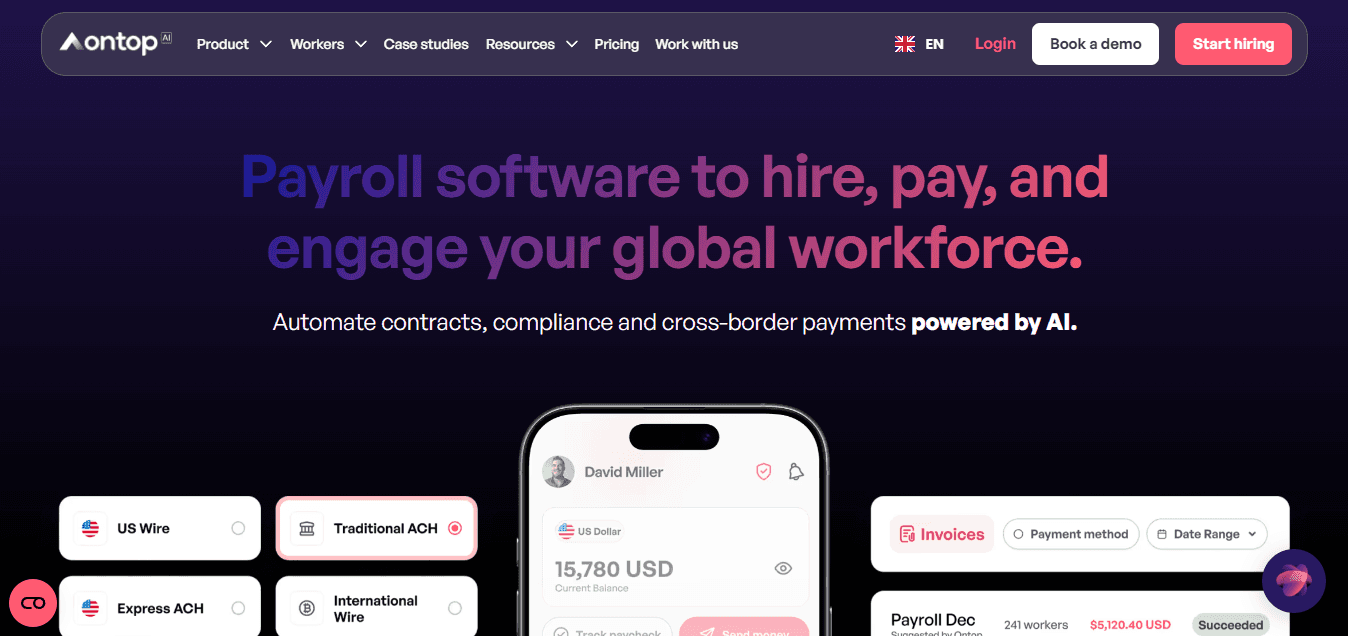
Ontop treats the worker as the product's main user, not someone who receives decisions from employers. Contractors get started quickly, receive payments in 150+ countries, and access USD accounts with a global Visa card, making earnings immediately usable. For a freelancer in Lagos or a digital nomad, that combination of speed, compliance, and financial access is essential.
How does Ontop simplify cross-border contractor payments into one workflow?
Most contractors juggle wire transfers, local bank accounts, and separate card solutions, resulting in delays, fees, and multiple logins. Payroll software like Ontop consolidates this stack by combining contract management, cross-border payments, and a spendable card into one workflow. This shortens the time from invoice to accessible funds.
2. Deel

Deel built its reputation on international compliance infrastructure. Companies use it to manage contractor agreements, payments, and local regulatory requirements across multiple countries without maintaining legal teams in every jurisdiction. For contractors, this means reliable, multi-method payouts and a platform their clients already trust.
3. Remote

Remote enables global employment through an Employer of Record model, allowing companies to hire workers in countries where they lack a legal presence. Workers receive localized contracts, benefits compliant with local regulations, and streamlined onboarding. The platform's strength lies in its deep local market knowledge rather than extensive financial tools.
4. Oyster

According to Oyster HR, ADP processes payroll for more than 40 million workers worldwide. Oyster competes by focusing on hiring distributed teams, ensuring compliance, and managing benefits across multiple countries rather than handling comprehensive payroll services. For workers joining companies with global teams, this focus provides a smoother employment experience than general platforms.
5. Multiplier

The failure point in most international payroll setups is jurisdictional complexity at scale. Managing separate compliance requirements, tax rules, and payment cycles across five or ten countries becomes unworkable. Multiplier consolidates multi-country payroll and contractor management into a single system, making it particularly useful for companies expanding rapidly across borders.
6. Papaya Global

Papaya Global serves large companies managing payroll across multiple countries. It excels at automating payments at scale rather than offering extensive worker customization. For contractors working with large organizations, it delivers reliable, consistent payments backed by robust compliance infrastructure and strong payroll systems.
7. Rippling

Rippling takes a different approach by building a unified workforce management system in which payroll, benefits, device management, and compliance live on a single platform. Workers benefit from a modern self-service experience, while employers gain a significant advantage: administrative tasks that normally span multiple tools are handled in one place.
8. Gusto

Gusto serves U.S.-based small and mid-sized businesses with a clean, easy-to-use payment and onboarding experience. For contractors working with American companies, it removes administrative friction without enterprise-level complexity. Its international capabilities lag behind those of platforms built for cross-border work, but it serves U.S. client relationships well.
9. Payoneer
Payoneer lets independent professionals receive payments in multiple currencies, hold funds in accounts across major markets, and withdraw money locally. Its deep integration with freelance marketplaces makes it a natural fit for workers who earn income through platforms rather than direct client relationships.
10. Wise

Wise is not a payroll platform; it's a financial infrastructure tool for managing money across currencies. For digital nomads, this distinction matters. According to Teamed, platforms in this category now cover 180+ countries. Wise's value lies in transparent exchange rates and local banking details across multiple countries, making it a complement to a primary payroll solution rather than a standalone replacement.
How these ten platforms actually differ
The critical difference across these ten options is orientation. Some platforms address the employer's compliance problem with workers as a secondary concern; others prioritize workers' financial realities, adding employer tools later. This distinction shapes everything from onboarding speed to currency conversion presentation to whether a contractor can spend earnings the same day they arrive.
Which platform fits your specific situation?
If you work with U.S.-based clients who need simple payments, Gusto or Payoneer will work fine. For work spanning multiple countries with complex compliance, Deel, Remote, or Multiplier offers the legal structure you need. If you want payments, compliance, banking access, and a spendable card on a single platform rather than as separate pieces, Ontop fills that gap. The best ADP alternative for any worker is one that treats their specific problem as the main focus, not an afterthought to employer needs.
Related Reading
- How To Pay a Foreign Contractor
- How to Hire Overseas Contractors
- How to Hire a Remote Team
- How to Calculate Time for Payroll
- How to Hire International Employees
- Best Way To Pay International Contractors
Why Most Alternatives Still Focus on the Employer Experience
The platforms built to replace ADP solve real problems: faster international hiring, cleaner compliance workflows, smoother contractor onboarding. Employers pay for this relief because it works. Yet the design logic underneath most platforms follows the same pattern: build for the buyer, optimize for the person signing the contract, not the person fulfilling it.
🎯 Key Point: The entire architecture of most HR platforms is optimized for the employer experience — the people paying the bill — not the workers doing the work.

"58% of employees say their organization's experience programs are designed primarily to benefit the company rather than the employee." — Zoom's 2025 Employee Experience Research
According to Zoom's 2025 employee experience research, 58% of employees say their organization's experience programs are designed primarily to benefit the company rather than the employee. The gap is not accidental. It is built into how the system works.
⚠️ Warning: This isn't a minor oversight — it's a structural flaw. When platform design starts with the buyer's needs, worker experience becomes an afterthought by default.
🔑 Takeaway: A majority of workers already feel the system isn't built for them — and the data backs them up. Any platform that truly wants to differentiate must flip the design priority from employer-first to worker-first.
What gets prioritized when employers hold the budget
The critical difference between a payroll platform and a worker financial platform is who defines success. For a finance team, success means clean reporting, audit-ready records, and zero compliance flags. Worker satisfaction, by contrast, is harder to measure in dollars and rarely appears in ROI decks, so it gets deprioritized—not out of malice, but because it was never the primary design constraint.
What happens when workers build their own financial workarounds?
Most global workers cobble together their own solutions: a payment account here, a currency wallet there, a separate card for local spending. It works until it breaks, usually costing time or money. Payroll software built with the worker as the primary user integrates payments, multi-currency management, and financial access into a single experience rather than treating them as secondary features bolted onto a compliance engine.
Why does worker restlessness signal a deeper design problem?
Gallup's 2025 Workplace Survey reports that 51% of employed workers are seeking or actively pursuing a new job. This restlessness reflects worker fatigue with systems that treat them as numbers rather than individuals with personal financial needs. Platforms that bridge this gap by prioritizing worker concerns will matter most to the next generation of workers globally. And that change proves harder than it sounds.
How Ontop Helps Global Workers Get Paid and Work Across Borders More Easily
Changing what comes first is one thing. Building the systems to support those changes is another thing entirely: most solutions fall short here.

The main problem for most global workers isn't one broken thing. It's all the small problems that add up: a contract in one system, a payment in another, a compliance question that gets passed around in three different email threads. Together, they make international work feel like a second job.
"The friction in global work isn't one big wall — it's a hundred small ones, each one slowing you down just enough to cost you time, money, and momentum."
💡 Tip: If your global workforce tools aren't talking to each other, you're not solving the problem — you're managing it.
⚠️ Warning: When compliance, contracts, and payments live in different systems, the gaps between them become your responsibility — and your risk.
🔑 Takeaway: International work should feel like an opportunity, not an operational burden. The right platform eliminates the friction before it compounds.
Why does a fragmented payments setup cost global workers more than they realize?
Most workers assemble whatever tools they can find. A freelancer in Lagos might use one platform for contracts, a separate service for getting USD, and a third app to convert and spend. That patchwork approach fails when a payment is delayed, a currency conversion costs more than expected, or a contract renewal falls through a gap between systems. The hidden cost isn't the fee on any single transaction—it's the time, attention, and trust lost across all of them. Payroll software built around the worker's full experience brings these layers together, eliminating the need to manage three separate relationships for international payments.
How does payment speed shape who can actually participate in international work?
For a contractor waiting on payment to cover rent in a city where they have no local credit history, a five-day transfer isn't a minor inconvenience—it's a structural problem that shapes how much risk they can afford to take on international work. Speed is not a convenience feature; it's a condition for participation.
What broad coverage actually unlocks
Ontop supports payments in 150+ countries, removing the geography filter from talent decisions. A developer in Nairobi and a designer in Medellín can work with the same client without either party needing to engineer a workaround. This is what "global work" means in practice.
Why do global workers need fewer, better financial tools?
Professionals don't want more platforms; they want fewer, better ones. A USD account connected to a global Visa card within the same ecosystem that handles contracts and compliance makes international income spendable without losing a percentage to conversion friction at every step. When financial tools match how global work flows, workers spend less mental energy managing money and more time doing the work that earns it.
What are companies really betting on when they choose this infrastructure?
The companies trusting this infrastructure to pay their teams are betting on something far more specific than software.
Book a demo today: see how Ontop powers global teams in 150+ countries
When a company picks a global payroll platform, it's deciding how workers experience getting paid — which shapes whether they stay, how they perform, and whether they trust the company. That decision carries real weight.
"The choice of a global payroll platform isn't an operational decision — it's a workforce experience decision that directly impacts retention, performance, and trust." — OnTop
🎯 Key Point: Your payroll infrastructure is a direct signal to every worker about how much the company values them.

If you're building or managing a global team, book a demo with Ontop to see how our consolidated payroll infrastructure works in practice. If you're a freelancer, contractor, or digital nomad, open your Ontop Global Account to onboard quickly, receive payments across 150+ countries, and access financial tools built for global work.
💡 Tip: Whether you're a multinational company or an independent global worker, OnTop offers a solution tailored to your exact needs, from enterprise payroll consolidation to fast cross-border payments.
✅ Best Practice: Join the teams in 150+ countries that already trust Ontop to power their global teams, and experience the difference that purpose-built global payroll makes.
Related Reading
- Best Payroll Software For Staffing Companies
- Best Payroll Outsourcing Companies
- Deel Vs Oyster
- Best International Payroll Software
- Best Payroll For Contractors
- Remote Competitors