





Managing a global workforce means facing one unavoidable challenge: paying overseas contractors accurately, on time, and in compliance with local regulations. When your team spans multiple countries, each with different tax laws, currencies, and employment rules, the complexity multiplies fast. This article cuts through the confusion by examining the best international payroll companies for global workers, helping you identify providers that handle cross-border payments, contractor management, and compliance requirements without the usual headaches.
That's where platforms like Ontop come in. Instead of juggling multiple systems or wrestling with currency conversions and local tax codes yourself, payroll software designed for distributed teams automates payments in local currencies, manages compliance documentation, and keeps your contractor relationships running smoothly.
Summary
- Cross-border payments pass through multiple intermediaries before reaching a worker's account, with traditional bank transfers taking up to seven days to settle, depending on how many correspondent banks handle the transaction. Currency conversion happens at unpredictable moments in that chain, and workers lose value not just to conversion fees but to timing they cannot control.
- Companies using traditional payroll systems face compliance penalties averaging $845,000 per year, often triggered by undisclosed fee structures that create tax reporting gaps or misclassified payments. Workers absorb most of this cost without realizing it, agreeing to a $5,000 payment and receiving $4,650.
- Payment timing affects more than convenience. Delayed payments create cascading financial stress that extends beyond individual transactions into broader financial planning and career decisions. Workers who wait seven days for a transfer cannot commit to rent, book travel, or make time-sensitive purchases.
- Receiving payment in a stable currency changes how workers preserve earnings over time. Local currencies fluctuate, sometimes dramatically, and workers paid in volatile currencies lose purchasing power between the time they invoice and the time they spend.
- Companies with global operations face 40% higher payroll complexity, yet most payment platforms still treat cross-border work as an exception rather than the default. LATAM delivers the highest ROI at $1,739 per hire, while Asia leads for tech roles at $1,502, but workers in these regions often navigate fragmented systems that were never designed for the scale and consistency global work now requires.
Payroll software addresses this by centralizing compliance, currency management, and payout routing into a single system, reducing settlement time from days to hours while giving workers direct access to USD and EUR balances with instant transfers and multi-currency spending.
Most Global Workers Trust the Wrong Payment Setup

Most global workers assume any platform that sends money internationally will work reliably. They sign up, submit an invoice, and expect the funds to arrive quickly and intact. That assumption breaks down the moment cross-border infrastructure enters the picture.
What Breaks Between Sending and Receiving
Cross-border payments pass through multiple intermediaries before reaching a worker's account. Each handoff introduces delay. Traditional bank transfers can take up to 7 days to settle, depending on the number of correspondent banks involved in the transaction. Workers see processing for days, with no visibility into where their money sits or when it will clear.
Why Familiar Platforms Fail at Scale
Payment platforms built for domestic transfers struggle when compliance layers multiply. According to the 2025 AFP Payments Fraud Control Survey Report, 200 statistics extracted from payment fraud control surveys reveal how fragmented systems create friction at every compliance checkpoint. Workers in certain countries face restricted access, delayed withdrawals, or forced conversions into local currencies with poor liquidity.
The Shift From Familiar Payment Tools to Integrated Payroll Infrastructure
The common approach is to use whatever tool the employer suggests or whatever platform already holds their funds. As payment volume grows and currency needs diversify, those familiar tools reveal their limits. Transfers that worked fine for occasional payments become unreliable when workers depend on them for a monthly income.
Platforms like payroll software centralize compliance, currency management, and payout routing into a single system, reducing settlement time from days to hours while maintaining full transparency across every transaction.
The Cost of Choosing Wrong
Workers discover the mismatch when they need their earnings most. A delayed transfer means missed rent payments. A poor exchange rate means less purchasing power than expected.
Restricted withdrawal options mean money sits inaccessible, earning nothing, while bills pile up. The platform worked fine for getting paid once or twice, but it was never designed to support someone building a career across borders.
The Fundamental Mismatch Between Modern Cross-Border Work and Legacy Infrastructure
The problem is not that workers made a bad choice. The problem is that most payment infrastructure was built for a world where cross-border work was rare, not the default. Workers trust setups that look modern but run on outdated rails. And they do not realize it until the system fails them when it matters most.
Related Reading
- Paying Overseas Contractors
- Global Payroll Trends
- Benefits of Automated Payroll System
- International Payroll Compliance
- Global Payroll Best Practices
- How to Pay Overseas Employees
- Global Payroll Strategy
- Cross Border Transaction
- Payroll for Remote Workers
The Hidden Problems With Traditional International Payroll

What seems like a simple payment flow is actually fragmented. A company initiates a transfer. That transfer moves through correspondent banks, each applying its own processing timeline. Then it hits a foreign exchange provider.
Then it routes to a local clearing system. It reaches the worker's account. Each step adds opacity. Workers see “pending” for days with no explanation of where their money sits or why it takes so long to clear.
The Cost Structure Nobody Explains Upfront
Fees appear manageable until you trace them across the entire payment chain. A platform might advertise a 1% transaction fee:
- Then the correspondent bank takes its cut.
- Then the FX provider applies a markup to the exchange rate.
- Then the receiving bank charges a deposit fee.
Companies using traditional payroll systems face compliance penalties averaging $845,000 per year, often triggered by undisclosed fee structures that create tax reporting gaps or misclassified payments. Workers absorb most of this cost without realizing it. They agree to a $5,000 payment and receive $4,650. The difference vanishes into a structure they never agreed to and cannot audit.
When Access Becomes a Barrier
Traditional payroll systems treat withdrawals as an afterthought. Workers receive funds into an account that they cannot easily move, convert, or spend without triggering additional fees. Some platforms impose holding periods before transfers become available.
The Evolution of Global Payroll Into Worker-Centric Financial Infrastructure
Others restrict withdrawal methods to specific banks or regions, forcing workers to open accounts they would not otherwise need. Platforms like payroll software eliminate these friction points by giving workers direct access to USD and EUR balances with instant transfers, multi-currency spending, and no forced conversions, turning payroll into financial infrastructure rather than just a compliance task.
The real issue is control
Workers cannot choose when to convert currency, so they lose value during volatile periods. They cannot access their earnings immediately, so they miss time-sensitive payments. They cannot route funds efficiently, so they pay extra fees to move money into accounts they actually use.
The system works for the institutions processing payments. It does not work for people who depend on those payments to sustain their lives across borders.
Top 10 International Payroll Companies to Know
Not all international payroll companies are built the same, and more importantly, not all of them are built for workers. Most platforms are designed for companies first (with compliance, cost control, and scalability in mind). The worker experience (how fast you get paid, how much you actually receive, and how easily you can use your money) is often secondary.
That distinction is where the real differences show up.
1. Ontop
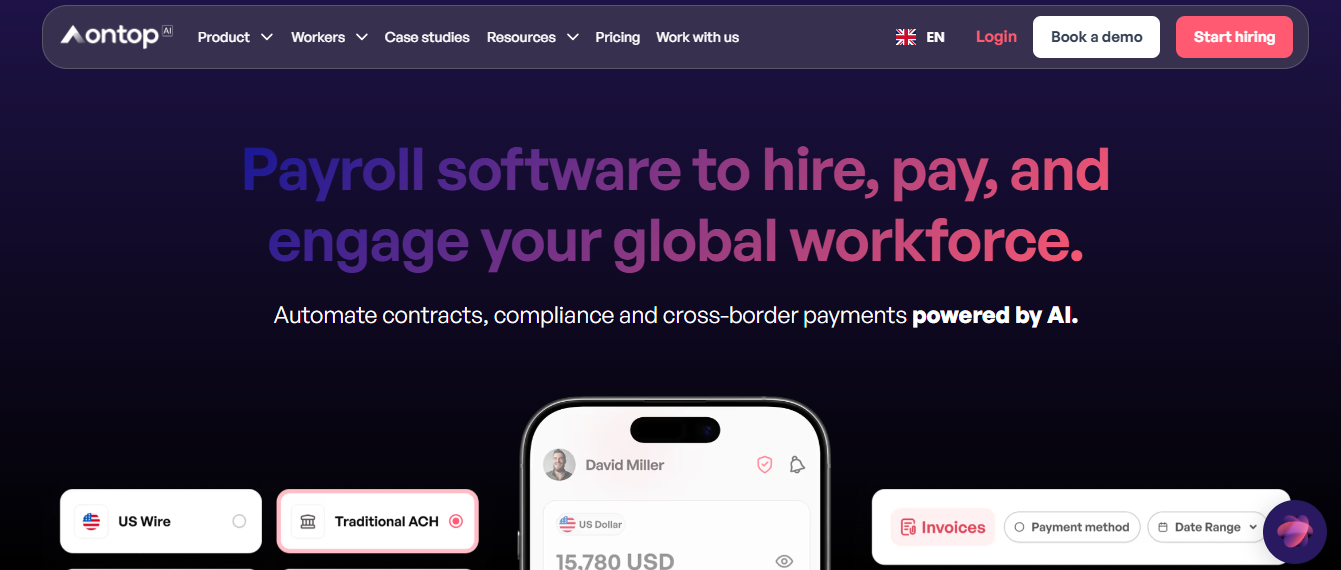
Ontop is built with the worker experience at the center, not just compliance. It enables onboarding in minutes and supports payments across 150+ countries, which removes one of the biggest frictions in global work (slow setup and delayed payouts). According to the Bolto Global Payroll Solutions Guide, companies with global operations face 40% higher payroll complexity, yet Ontop streamlines this by collapsing what used to take weeks into minutes.
Where Ontop stands out is what happens after you get paid. Workers get access to USD accounts, which helps reduce currency instability, and a global Visa card, making it easier to spend earnings without complex transfers or conversions. It performs well in onboarding speed and payments, access to a stable currency, and the real-world usability of earnings.
2. Deel
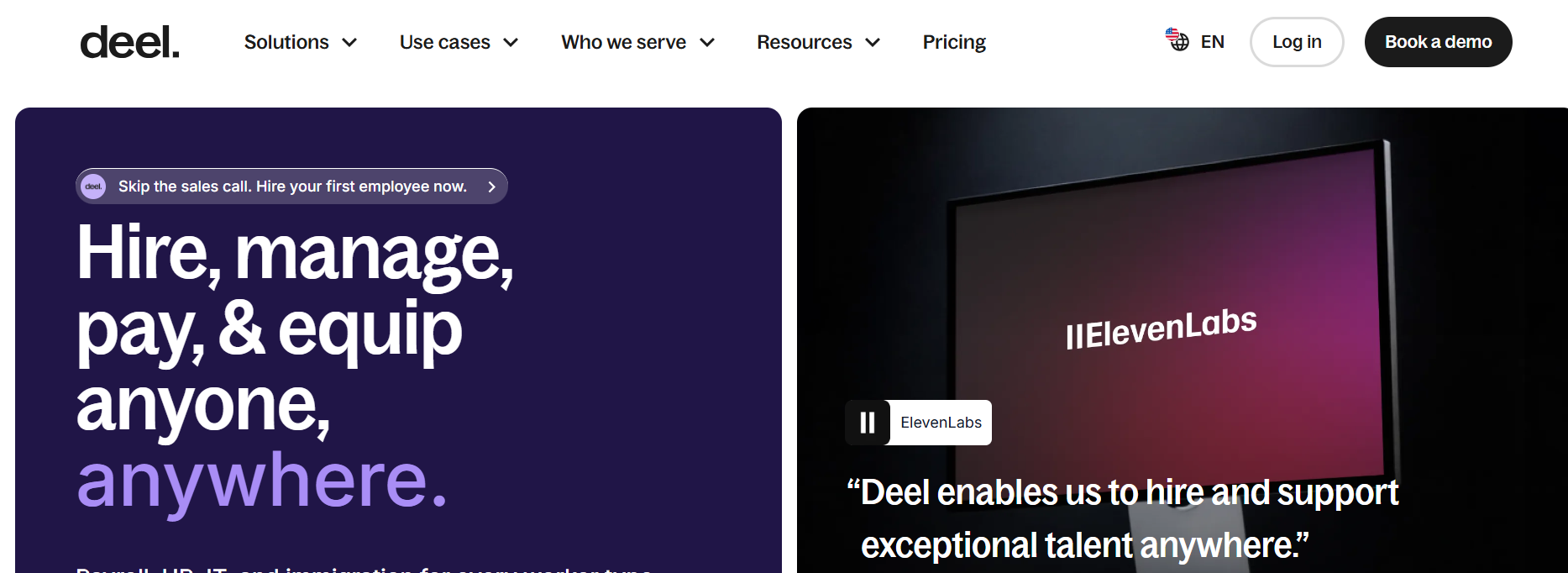
Deel is one of the most widely adopted platforms for global contractor payments, supporting workers in over 150 countries, according to Gloroots Blog. It offers fast onboarding through localized contracts and flexible withdrawal options. It performs well in contractor payments and compliance, fast onboarding, and broad global coverage.
Where it can fall short for workers is in fees and currency conversion, which vary by payout method. While flexible, the experience can feel fragmented when managing multiple withdrawals.
3. Rippling
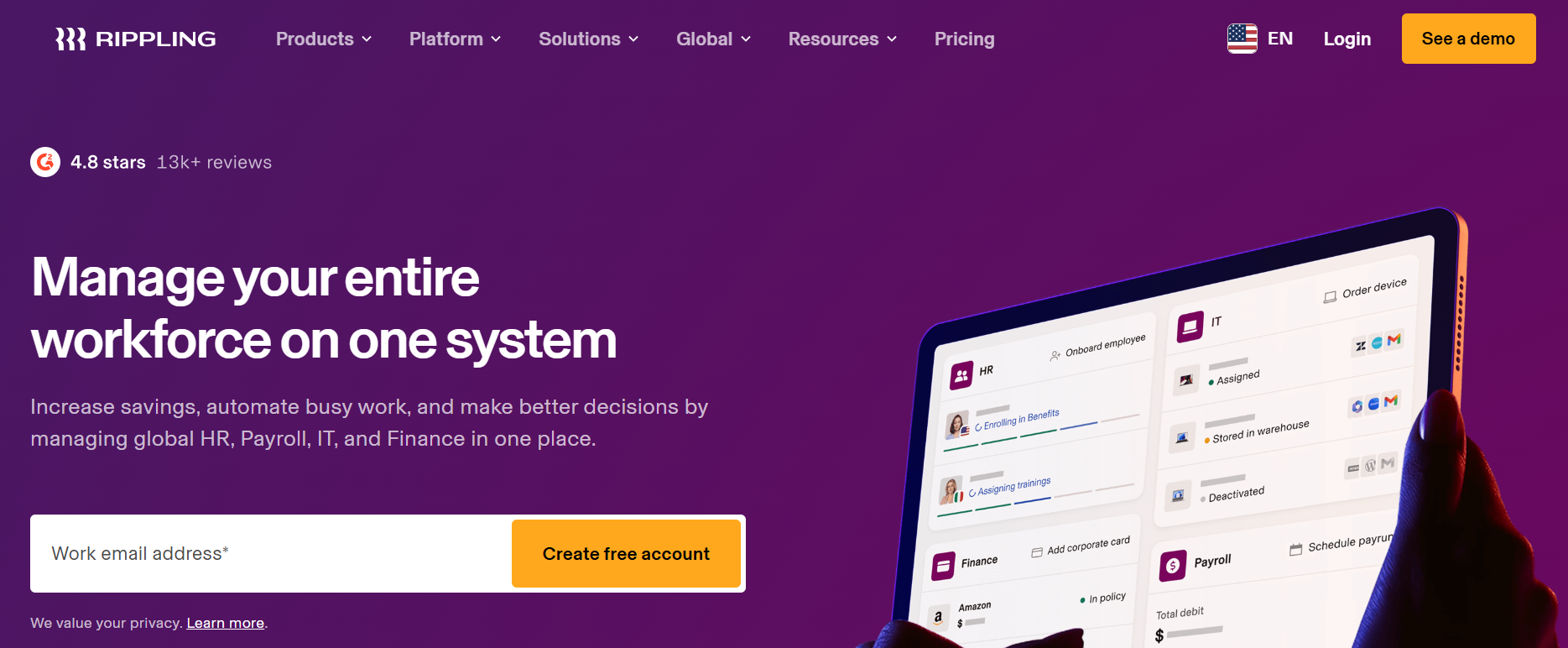
Rippling combines payroll with HR and IT systems, making it a strong choice for companies scaling globally. For workers, this means a more structured employment experience tied to a broader system. It performs well in seamless integration with HR tools, automation, and payroll accuracy, and provides a consistent employee experience.
However, Rippling is company-centric, not worker-centric. Workers have less flexibility in how they receive or use their earnings compared to more specialized platforms.
4. Papaya Global

Papaya Global operates in 160+ countries and focuses on enterprise-grade payroll infrastructure, including compliance and analytics. It performs well in handling complex, multi-country payroll, compliance, and reporting, and provides stability for large organizations.
For workers, the downside is that the experience can feel rigid and slower, with less emphasis on payment flexibility or financial tools.
5. Remote
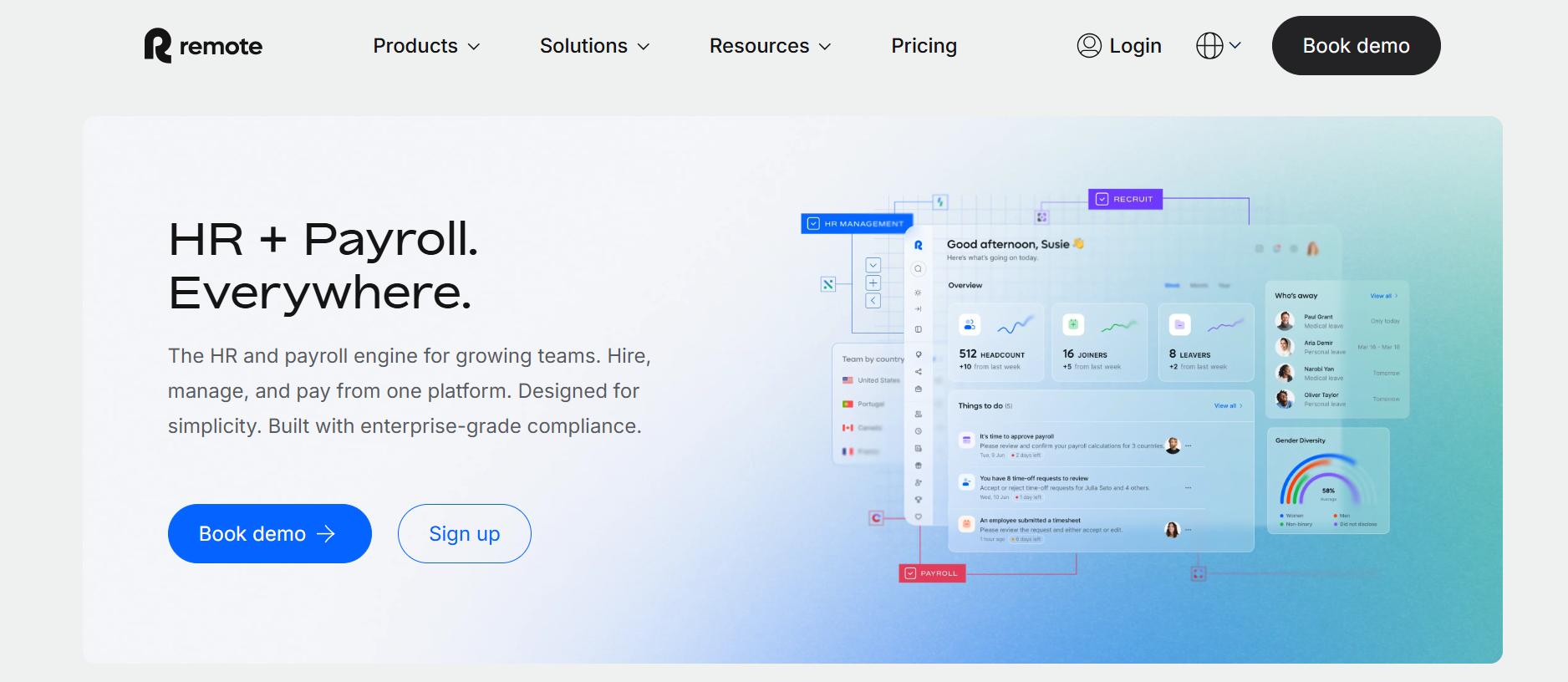
Remote focuses heavily on compliance, benefits, and intellectual property protection, making it popular with companies hiring full-time international employees. It performs well in strong legal and compliance frameworks, employer-of-record (EOR) services, and clear employment structures.
For workers, this can mean less flexibility and slower onboarding compared to contractor-focused platforms. It is optimized for stability, not speed.
6. ADP Global Payroll

ADP is one of the most established payroll providers globally, trusted by large enterprises and Fortune 500 companies. It performs well in reliability and scale, deep tax and regulatory expertise, and consistency across large organizations.
However, the experience is often legacy and slow-moving, with limited flexibility for modern remote workers or freelancers.
7. Oyster

Oyster helps companies hire and pay talent globally without setting up local entities. It includes features like bonuses and global analytics. It performs well in remote-first employment structures, global compliance, and transparent contracts.
Where it falls short is in financial flexibility for workers, particularly around how earnings are accessed and used after payment.
8. Cloudpay
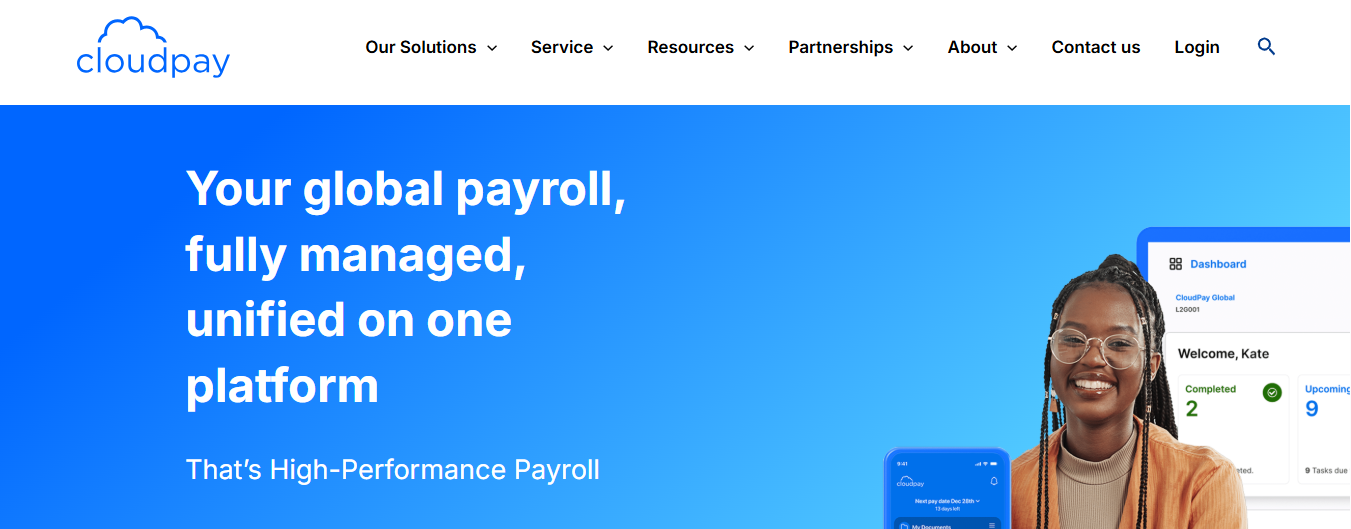
CloudPay supports payroll and payments in over 140 countries, with strong reporting and centralized systems. It performs well in payroll accuracy, multi-country coordination, and enterprise-level reporting.
For workers, it is not designed for flexibility or speed, and the experience is often tied closely to internal company processes.
9. Velocity Global
Velocity Global focuses on helping companies enter new countries through employer-of-record services and payroll support. It performs well in market expansion support, compliance in new regions, and structured employment.
The trade-off is a less-optimized worker experience, particularly in payment speed and usability
10. G-P (Globalization Partners)
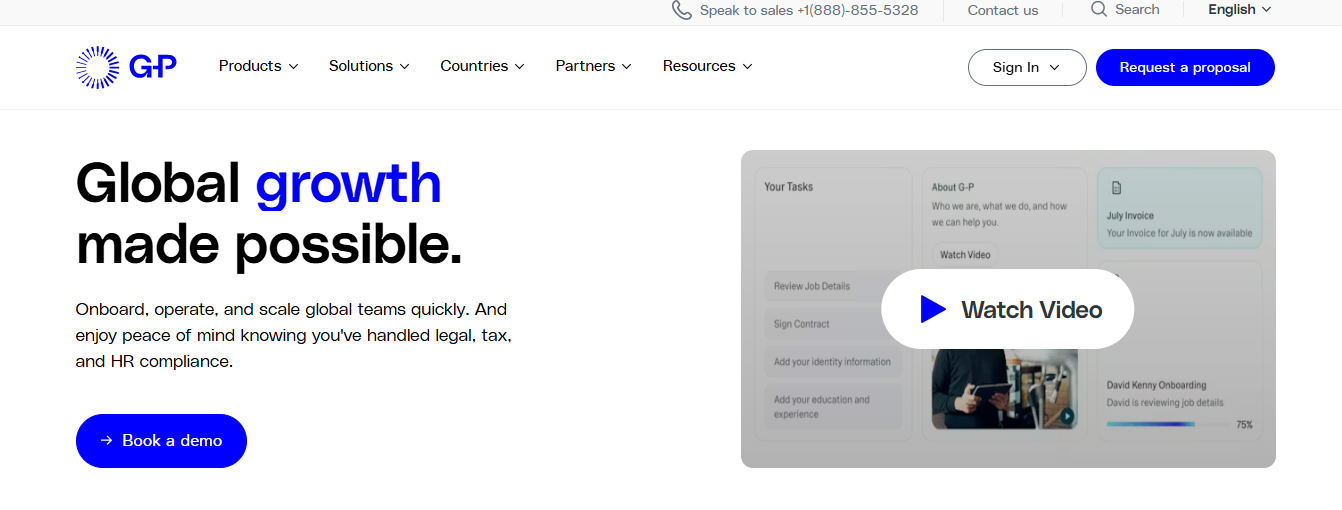
G-P is a major player in global employment infrastructure, helping companies manage hiring and payroll across multiple jurisdictions. It performs well in global compliance coverage, employer-of-record services, and enterprise scalability.
For workers, the experience is often standardized and less flexible, with limited focus on financial tools or immediate access to earnings.
What Separates Infrastructure From Interface
All of these platforms solve the same core problem (paying people across borders). But they do it for different priorities. Some optimize for compliance and enterprise control. Others focus on speed and contractor flexibility.
The Transition From Brand Recognition to Scalable Global Payroll Infrastructure
Most teams handle international payments by choosing platforms based on brand recognition or on what their payroll departments already use. As payment volume grows and workers span more currencies and regions, those familiar tools reveal their limits. Transfers that worked fine for occasional payments become unreliable when workers depend on them for a monthly income.
Platforms like payroll software:
- Centralize compliance
- Currency management
- Payout routing into a single system
It reduces settlement time from days to hours while giving workers direct access to USD and EUR balances with instant transfers and multi-currency spending.
What Actually Matters for Global Workers

The platforms that improve your life are the ones that reduce friction after the payment clears. Speed matters, but only if the money you receive is accessible, stable, and usable without triggering another round of fees or conversions. Most workers evaluate platforms based on how fast they get paid. The better measure is how much control they have once the funds arrive.
Speed Determines Financial Stability
Payment timing affects more than convenience. According to the PwC Global Workforce Hopes and Fears Survey 2025, which surveyed 56,000 workers across multiple regions, delayed payments create cascading financial stress that extends beyond individual transactions into broader financial planning and career decisions.
Workers who wait seven days for a transfer cannot commit to rent, book travel, or make time-sensitive purchases. The delay compounds when multiple payments stack up in processing limbo, turning predictable income into guesswork.
Currency Access Protects Value Over Time
Receiving payment in a stable currency changes how workers preserve earnings. Local currencies fluctuate, sometimes dramatically. Workers paid in volatile currencies lose purchasing power between the time they invoice and the time they spend.
Holding earnings in USD or EUR provides a buffer against that erosion, especially for workers in regions where inflation outpaces wage growth.
Transparency Eliminates Hidden Losses
Fees buried in exchange rates or multi-step transfers drain value without explanation. Workers agree to a $3,000 payment and receive $2,820. The $180 difference disappears into markups they never consented to and cannot audit. Platforms that show exactly what gets deducted, when, and why give workers the information they need to price their work accurately and choose payout methods that preserve the most value.
Predictability matters as much as transparency. When workers know the exact amount they will receive before initiating a transfer, they can budget with confidence. Surprises, such as:
- Unexpected fees or poor exchange rates
- Disrupt planning
- Force workers to absorb losses they did not anticipate
Clear, upfront information turns payroll from a source of uncertainty into a reliable system.
Usability Extends Financial Flexibility
Access to funds means more than seeing a balance in an account. It means being able to spend, transfer, and manage money without friction. Workers who can pay bills directly from their:
- Earnings account
- Withdraw cash when needed
- Move funds instantly to other accounts
Operate with more autonomy than those forced to navigate multi-step processes every time they need liquidity.
The Efficiency of Centralized Payroll Platforms Over Traditional International Payments
Most teams manage international payments by choosing platforms based on brand recognition or what their payroll department already uses. As payment volume grows and workers span more currencies and regions, those familiar tools reveal their limits.
Platforms like payroll software:
- Centralize compliance
- Currency management
- Payout routing into a single system
It reduces settlement time from days to hours while giving workers direct access to USD and EUR balances with instant transfers and multi-currency spending.
Related Reading
- Global Payroll Analytics
- Global Payroll Challenges
- Global Payroll Complexity
- ERP Payroll Software
- Multi Company Payroll Software
- International Payroll Companies
- Employer of Record Service Companies
- Best Multi-Country Payroll Softwares
Why the Old Way of Getting Paid is Breaking

The traditional model was built for a different kind of work, such as:
- Send an invoice
- Wait for payment
- Withdraw funds
It assumed you were operating locally:
- Getting paid in a single currency
- Through a single system
- With predictable timelines
That model starts to break the moment work becomes global. As more people work across borders, the cracks become obvious. Delays that were once tolerable become disruptive when income depends on multiple clients in different countries. What used to be a minor inconvenience becomes an inconsistent cash flow.
According to MSN Money Markets, wage growth is behaving oddly in 2025, mirroring patterns last seen around the Great Recession, which means more workers are now exposed to payment systems that were never designed for that scale.
Currency Loss Compounds Faster Than You Realize
When you are paid occasionally, small conversion differences are easy to ignore. When you are paid frequently, across currencies, those differences compound. A few percentage points lost on each transaction adds up over months of work.
You invoice for $4,000 and receive $3,820 after conversion fees, intermediary markups, and exchange rate timing you cannot control. The loss is not dramatic enough to dispute, but it is consistent enough to erode your actual earnings.
Access Becomes the Real Bottleneck
The old model assumes that once money arrives, it is usable. In reality, workers often have to move funds between platforms, wait through holding periods, or convert currencies just to spend what they have earned.
You see the balance in your account, but accessing it requires another step, another fee, another delay. The money is technically yours, but functionally inaccessible when you need it most.
Structured Payroll Platforms Change the Experience Entirely
Most teams handle international payments by choosing platforms based on brand recognition or on what their payroll departments already use. As payment volume grows and workers span more currencies and regions, those familiar tools reveal their limits.
Platforms like payroll software:
- Centralize compliance
- Currency management
- Payout routing into a single system
It reduces settlement time from days to hours while giving workers direct access to USD and EUR balances with instant transfers and multi-currency spending.
How Ontop Helps Global Workers Get Paid Without Friction

By this point, the pattern is clear. The problem is not earning globally. It deals with everything that happens after:
- Slow onboarding
- Delayed payments
- Currency loss
- Limited access to your own money
Ontop is built around solving those exact friction points from the worker's perspective.
Onboarding Happens in Minutes, Not Weeks
Instead of long setup processes that delay your first payment, Ontop allows you to onboard in minutes. That matters more than it seems. The faster you are set up, the faster you can start getting paid, especially when moving between clients or projects.
No multi-step verification loops. No waiting for manual approvals. You submit your information, and the system handles the rest while you focus on the work itself.
Payments Reach 150+ Countries Without Platform Fragmentation
Once you are onboarded, the experience shifts from fragmented to structured. Payments can be made in more than 150 countries, removing the need to juggle different platforms depending on your client's location. You are no longer adapting to the system.
The system adapts to global work. LATAM delivers the highest ROI ($1,739), while Asia leads for tech roles ($1,502), yet most payment platforms still treat cross-border work as an exception rather than the default.
Currency Control Protects Earnings From Volatility
Rather than being forced into immediate conversions, you get access to a USD account. That gives you control over when and how you convert your earnings, helping you avoid unnecessary losses tied to timing or volatility.
You decide the conversion moment based on your needs, not on when a platform processes your transaction. The difference between holding funds in a stable currency and being forced into local conversion at an unfavorable rate compounds over months of consistent work.
Spending Happens Directly, Without Additional Transfers
Ontop does not stop at helping you receive money. It focuses on making that money usable. With a global Visa card, you can spend your earnings directly, without needing to move funds across multiple platforms or wait through additional processing steps. The gap between getting paid and using your money disappears. You can pay for:
- Subscriptions
- Book travel
- Cover expenses
All from the same account where your earnings land.
Related Reading
- Papaya Global Alternatives
- Rippling vs. ADP
- Global HR Systems
- Adp Alternatives
- Deel Vs Remote
- Best Multi-Company Payroll Software
- International Payroll Companies
- Oyster Hr Alternatives
- Employer Of Record Service Companies
- Best Multi-country Payroll Softwares
- Deel Alternatives
Book a Demo Today - See why 950+ Companies Trust OnTop to Power their Global Teams
Getting paid is only half the problem. Accessing and using your money is what actually defines the experience.
Ontop is built for that. Start with Quick Start and get set up in minutes, with immediate access to a USD account and a global card, so you can receive, hold, and spend your earnings without delays or conversion friction. Over 950 companies already use Ontop to power their global teams because the infrastructure works from both sides:
- Employers get compliance and speed
- Workers get financial control and stability
Book a demo today to see how the platform eliminates the gap between getting paid and using your money. The difference shows up in your first payment cycle, when funds arrive on time, in the currency you choose, ready to spend without extra steps or hidden fees.