





Managing a global team means dealing with the reality of paying overseas contractors across different countries, currencies, and compliance requirements. When Oyster HR doesn't quite fit your budget or workflow needs, you're left searching for platforms that can handle international payments, contractor management, and local labor laws without creating more headaches. This article breaks down the top Oyster HR alternatives that actually work for businesses hiring global workers and freelancers, comparing their features, pricing, and what makes each one stand out.
Finding the right global payroll software shouldn't feel like solving a puzzle with missing pieces. Ontop offers a straightforward payroll platform designed specifically for companies that need to efficiently pay and manage international contractors. Whether you're scaling your remote team or working with freelancers across multiple time zones, Ontop handles contractor payments, tax compliance, and invoicing in one place, letting you focus on building your business instead of wrestling with payment logistics.
Summary
- Payment delays are a systemic problem in global work, not an occasional inconvenience. The Freelancers Union found that 71% of freelancers have experienced late payments, and 58% have dealt with non-payment at some point. More recent data shows 65% of freelancers wait over 30 days to get paid, and 33% wait more than 60 days.
- The cost of sending money internationally remains far above target benchmarks. The World Bank reports that the global average cost of sending remittances was about 6.2% in 2023, well above the UN's 3% target. Currency conversions, intermediary banks, and processing fees chip away at earnings before they reach your account.
- Late payments create cascading financial consequences that extend beyond missed deadlines. Data cited by Jobber found that 42% of freelancers have missed bill payments, 38% have incurred late fees or interest charges, and 31% have had to borrow money to cover expenses.
- Chasing unpaid invoices consumes significant productive time. Freelancers spend 8 to 12 hours per month following up on unpaid invoices, totaling over 100 hours per year. That represents time not working, not earning, and not growing income. The administrative burden of managing what should be automatic payments becomes a hidden cost that reduces effective hourly rates and creates ongoing stress.
- Access to stable financial infrastructure remains uneven globally. The World Bank estimates that around 1.4 billion adults remain unbanked globally, and even for those with bank accounts, access to USD accounts or globally accepted cards is far from guaranteed.
Payroll software addresses this by giving workers a global account with USD and EUR salary options, transfers, and spending capabilities, shifting control back to the worker and reducing reliance on local banking infrastructure that may not support cross-border work effectively.
Table of Contents
- Oyster HR Sounds Good, But It’s Not Built for Workers
- The Real Frustrations Global Workers Face
- What to Look for in an Oyster HR Alternative (as a Worker)
- Top 10 Oyster HR Alternatives for Global Workers
- Why Most Alternatives Still Fall Short for Workers
- How Ontop Gives Global Workers More Control
- Book a Demo Today - See why 950+ Companies Trust OnTop to Power their Global Teams
Oyster HR Sounds Good, But It’s Not Built for Workers

Employer of Record platforms exist to solve compliance for companies. They help businesses legally hire people across different countries, manage contracts, and comply with local labor laws without setting up entities. That's where their priorities sit, not with how quickly you get paid, not with how flexible your payment options are, not with how much control you have over your earnings. As a worker, you're part of the system, but you're not the system's focus.
The Visibility Problem
You often don't have full transparency into how payments are processed, what fees are applied, or when exactly funds will arrive. You're relying on your employer and the platform's backend processes, both of which operate behind layers you can't see. When delays happen or questions arise, you're left waiting for answers from people who are waiting for the platform to respond. That distance creates uncertainty, and uncertainty around money is stressful.
Limited Control Over Your Own Earnings
Payment methods, currencies, and timelines are typically set at the employer or platform level. If there are delays or constraints, you can't do much to change them. The expertise economy is reshaping how companies access talent globally, yet the infrastructure supporting workers hasn't kept pace with this shift. You might be doing world-class work across borders, but your ability to access, convert, or move that money remains constrained by systems optimized for employer needs, not yours.
Flexibility That Doesn't Exist
Many EOR setups are optimized for standardized employment structures, not the realities of freelancers, contractors, or digital nomads who may want faster payouts, USD access, or more financial tools. The result is a gap between expectation and experience. You enter thinking the platform will make global work easier for you. Instead, you find yourself navigating delays, unclear processes, or limited options, especially when something goes wrong. That's not because the platform is broken. It's because it's solving a different problem.
Integrated Global Onboarding and Retention
While traditional EOR platforms focus on compliance infrastructure for companies, solutions like payroll software address both sides of the equation. Companies can move from hiring to first payment in minutes, and workers gain access to a global account with USD and EUR salary options, transfers, and spending capabilities. That dual focus matters because worker satisfaction directly impacts retention, and retention determines whether your global hiring strategy actually scales.
Related Reading
- Paying Overseas Contractors
- Global Payroll Trends
- Benefits of Automated Payroll System
- International Payroll Compliance
- Global Payroll Best Practices
- How to Pay Overseas Employees
- Global Payroll Strategy
- Cross Border Transaction
- Payroll for Remote Workers
The Real Frustrations Global Workers Face

The problems show up in your bank account, not in the marketing copy. Payment delays, hidden fees, forced currency conversions, and a lack of transparency turn what should be straightforward into a monthly source of stress. These aren't edge cases. They're the norm for millions of people working across borders.
Payment Delays Eat Into Cash Flow
Cross-border payments are still far from instant. The World Bank notes that international remittances can take 1 to 5 business days to settle, depending on corridors and intermediaries. When payroll approval cycles, processing windows, and banking cutoffs layer on top of that, delays become common. For a freelancer or contractor, that's not just an inconvenience. It directly affects whether you can pay rent on time or cover unexpected expenses.
Fees and Conversions Reduce What You Actually Receive
The World Bank reports that the global average cost of sending remittances was about 6.2% in 2023, well above the UN's 3% target. While payroll platforms may structure fees differently, the underlying reality is similar. Currency conversions, intermediary banks, and processing fees all chip away at your earnings. You see the contract amount, but what lands in your account is less, sometimes significantly so. Many workers are paid in local currency even when the original contract is denominated in USD or another stable currency. This exposes you to exchange rate fluctuations and hidden spreads. According to OECD research on cross-border payments, foreign exchange margins are often one of the highest hidden costs in international transactions. Even when you're paid "on time," you may still lose income in the process.
Access Remains Uneven
A large portion of the global workforce still lacks access to stable, internationally usable financial tools. The World Bank estimates that around 1.4 billion adults remain unbanked globally, highlighting the uneven access to financial infrastructure. Even for those with bank accounts, access to USD accounts or globally accepted cards is far from guaranteed. That limits how you receive, store, and use your earnings, especially if you work with clients across multiple countries or currencies. Platforms like payroll software address this by giving workers a global account with USD and EUR salary options, transfers, and spending capabilities. This shifts control back to the worker, reducing reliance on local banking infrastructure that may not effectively support cross-border work.
Transparency Gaps Create Uncertainty
Contracts, payment timelines, and deductions are often controlled by employers and platforms. Workers may not have full clarity on how payments are processed or why delays happen. This creates uncertainty, especially when working across borders with different legal and financial systems. You're left guessing whether the delay is normal, whether the fee was disclosed, or whether something went wrong. That lack of visibility erodes trust over time, even when the work itself is solid.
What to Look for in an Oyster HR Alternative (as a Worker)

If you're evaluating alternatives as a worker, your criteria should be grounded in what actually goes wrong in global work. Not theory. Not features. Real failure points backed by data.
Payment Reliability Comes First
Late payments are not occasional. They are widespread. According to the Freelancers Union, 71% of freelancers have experienced late payments, and 58% have dealt with non-payment at some point. More recent data reinforces the same pattern. A global report cited by [Jobber]() found that 65% of freelancers wait over 30 days to get paid, and 33% wait more than 60 days. For a worker, that means income is not just delayed. It becomes unpredictable. So the first filter is simple: Does this platform ensure you get paid on time, consistently, without having to chase?
Cash Flow Stability Matters More Than You Think
Payment delays are not just annoying. They have direct financial consequences. The same Jobber report found 42% of freelancers have missed bill payments due to late payments, 38% have incurred late fees or interest charges, and 31% have had to borrow money to cover expenses. This turns platform inefficiency into personal financial risk. So the question becomes: Does this platform reduce financial uncertainty, or add to it?
Time Lost Chasing Payments Adds Up
According to the same dataset, freelancers spend 8 to 12 hours per month following up on unpaid invoices, totaling over 100 hours per year. That is time you are not working, not earning, and not growing your income. You should prioritize platforms where payment is automatic and reliable, not something you have to manage manually. Most platforms still operate as if chasing invoices is just part of the job. Payroll software shifts that assumption by automating payment flows from hiring to first payout in minutes, eliminating the follow-up cycles that drain hours each month. Workers gain predictability, employers gain speed, and neither side wastes time managing what should be automatic.
Cost and Income Leakage Cannot Be Ignored
Even when payments arrive, you often receive less than what was agreed. According to the World Bank, the global average cost of sending money internationally was 6.2% in 2023. A large portion of that comes from foreign exchange spreads and hidden fees. For a worker, that means you may lose a percentage of every payment, you often do not control when conversion happens, and you cannot easily optimize for better rates. So the standard should be: Access to USD or stable currencies, and control over how and when your money is converted.
Transparency is Not Optional
According to EY, only 33% of organizations report having full visibility into payroll processes. If companies lack visibility, workers have even less. This creates uncertainty around payment timelines, fee structures, and exchange rates applied. What you need is clear contracts, visible payment breakdowns, and no hidden deductions. The decision changes from "Is this compliant for the company?" to "Does this eliminate delays, reduce income loss, and give me control over how I get paid?" Because getting hired globally is step one. Getting paid properly is what determines whether it actually works for you. But knowing what to look for is only half the answer.
Related Reading
- Global Payroll Analytics
- Global Payroll Challenges
- Global Payroll Complexity
- ERP Payroll Software
- Multi Company Payroll Software
- International Payroll Companies
- Employer of Record Service Companies
Top 10 Oyster HR Alternatives for Global Workers
1. Ontop
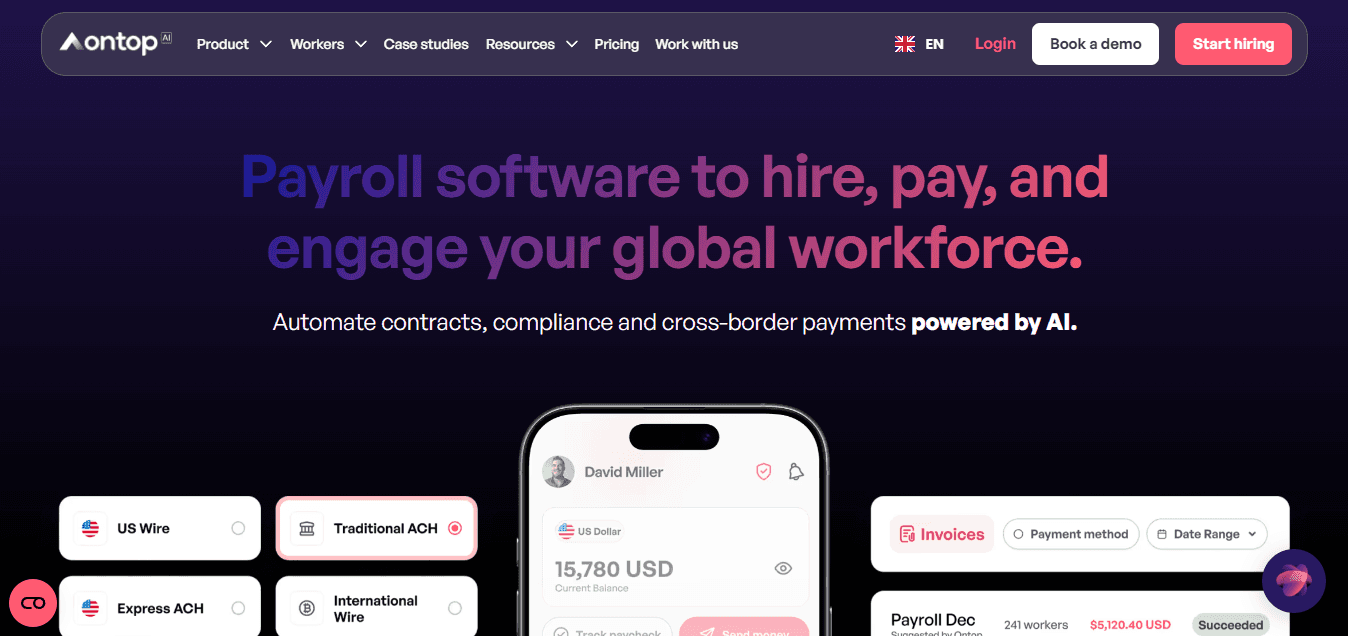
Ontop stands out because it is built with both companies and workers in mind, not just compliance. Instead of treating you as part of an employer workflow, Ontop focuses on how quickly you can get started and how smoothly you can get paid. Onboarding is faster than traditional Employer of Record setups, which often involve delays tied to legal and payroll configuration.
Flexible Access and Financial Control
Once you are set up, the experience extends beyond just receiving payments. Ontop gives you access to USD accounts, global payment infrastructure, and tools like a Visa card that let you actually use your earnings with more flexibility. That shift matters because it addresses the core issues workers face:
- Delayed payments
- Currency losses
- Lack of control
2. Deel

Deel is one of the most widely adopted platforms for global hiring and contractor payments. It offers strong global coverage and a reliable system for contracts, compliance, and payroll. Many companies choose Deel for its ability to simplify international hiring at scale. From a worker's perspective, the experience is generally stable, but still structured around employer processes. Your payment experience, timelines, and options are often determined by how the company has set things up, rather than giving you direct control.
3. Remote

Remote positions itself as a compliance-first alternative, with a strong focus on legal infrastructure and owned entities in multiple countries. This makes it a dependable option for companies that want tighter control over employment structures. For workers, that translates into predictable contracts and a consistent framework. However, the experience is still largely dependent on the employer configuration. While the backend is strong, it does not necessarily improve the worker's flexibility or financial control.
4. Papaya Global

Papaya Global is built for enterprise-level payroll and workforce management. It excels at handling complex, multi-country payroll operations and provides advanced analytics for companies managing large, distributed teams. From a worker's standpoint, the platform operates in the background. It ensures payments are processed, but it is not designed to enhance how you receive, manage, or optimize your earnings. That makes it less appealing for freelancers or digital nomads who need flexibility.
5. Multiplier

Multiplier focuses on making global hiring faster and more cost-effective for companies. Compared to traditional EOR models, onboarding can be quicker, reducing the time between hire and pay. However, the structure remains employer-centric. While it improves speed on the company side, it does not significantly change the level of visibility or control workers have over payments and financial tools.
6. Rippling

Rippling combines HR, payroll, and IT systems into a single platform. This integration makes it powerful for companies managing both employees and infrastructure across regions. According to the Rippling Blog on Oyster Competitors, platforms in this space now support operations in 200+ countries, which shows how geographically expansive these systems have become. For workers, though, Rippling is largely invisible. It supports the company's operations but does not offer features that directly improve your payment experience or financial flexibility.
7. WorkMotion

WorkMotion is designed to simplify compliance-heavy international hiring. It provides structured employment solutions across multiple regions, making it easier for companies to hire without setting up local entities. WorkMotion reports that their platform processes payroll in 144e5 milliseconds, which translates to roughly 40 hours, a timeframe that still leaves room for improvement when workers need faster access to earnings. From a worker's perspective, this creates a stable employment framework, but the focus remains on compliance rather than experience. Payment flexibility and financial tools are not central to the platform.
8. Velocity Global

Velocity Global is a long-standing provider in the Employer of Record space. It offers deep expertise in navigating complex international labor laws and supports hiring across a wide range of countries. This makes it a strong choice for companies operating in difficult markets. For workers, however, the experience is highly structured and company-driven, with limited flexibility in how payments and financial access are handled.
9. Globalization Partners

Globalization Partners, often referred to as G-P, focuses on simplifying global hiring at scale. It provides a standardized approach to employment, ensuring compliance and consistency across regions. While this benefits companies, it results in a more rigid experience for workers. Flexibility, especially for freelancers or digital nomads, is limited compared to platforms designed with worker needs in mind.
10. Skuad
Skuad is a newer entrant offering global hiring and payroll services. It aims to simplify onboarding and provide a more modern interface for managing distributed teams. For workers, it can feel more streamlined than legacy platforms, but it still follows the same core model: prioritizing employer needs over worker control and financial flexibility.
What This List Actually Shows
Looking across these platforms, a pattern becomes clear. Most alternatives are designed to do one thing: help companies hire globally. That is necessary, but it does not address the problems workers actually experience after they are hired. The real difference shows up in how platforms handle payments, access to funds, and financial control. That is why Ontop stands apart. It is not just enabling global work. It is improving how that work translates into income you can actually access, manage, and use. But even knowing which platforms exist does not explain why most still leave workers frustrated.
Why Most Alternatives Still Fall Short for Workers

Switching platforms rarely changes the underlying experience because most alternatives replicate the same employer-first architecture. They solve for compliance, legal structures, and corporate payroll cycles, not for how quickly you receive funds or how much control you have once they arrive. The interface may look different, but the constraints remain identical.
The Architecture Problem
When a platform is designed to serve the employer's operational needs first, every downstream decision reflects that priority. Your onboarding depends on when HR completes their setup. Your payment schedule aligns with corporate approval workflows, not your rent due date. Your contract terms live in a system you can view but cannot modify. Even when you switch from one provider to another, you are still operating within a framework where your access to earnings is mediated by processes optimized for someone else's timeline.
Systemic Friction and Indirect Resolution
This creates predictable friction. Payments arrive later than expected because they pass through multiple approval layers. Currency conversions happen automatically at rates you did not choose. Fees appear that were not clearly disclosed upfront. When something breaks, you cannot fix it directly. You submit a request, wait for your employer to escalate it, and hope the platform responds quickly.
Why Switching Feels Like Progress But Isn't
Most workers switch platforms expecting improvement. They assume a newer interface or better regional coverage will solve the core issues. But those are surface-level changes. The structural problem persists because the model has not changed. You are still waiting on external approval cycles. You still lack transparency into processing timelines. You still cannot choose how or when to convert your earnings into the currency you actually need. According to January 2025 data from the Bureau of Labor Statistics, the unemployment rate held steady at 4.1%, indicating a labor market with options for workers. Yet the infrastructure supporting global work has not evolved to match that leverage. Workers can choose between platforms, but most platforms still treat them as passive recipients rather than active participants in their own financial workflows.
The Control Gap
The real test is not whether a platform can process payments. It is whether you can act independently when needed.
- Can you access funds before the standard payout cycle if an emergency arises?
- Can you hold earnings in USD to avoid unfavorable exchange rates?
- Can you transfer money between accounts or spend directly without waiting for conversions to settle?
Most alternatives do not offer these capabilities because they were not designed with worker autonomy in mind.
Financial Autonomy and Direct Access
Platforms like payroll software address this by providing workers with a global account that includes USD and EUR salary options, transfers, and spending tools. This shifts control from the employer's payroll calendar to the worker's financial needs, reducing the dependency on external approval cycles that cause delays and limit flexibility. The question is not which platform has the cleanest dashboard or the widest coverage across countries. It is whether the platform actually repositions you within the system, giving you direct access and control, rather than keeping you one layer removed from your own earnings. But understanding the problem is only half the answer.
How Ontop Gives Global Workers More Control

Ontop restructures the relationship between the worker and the payment system. Instead of routing everything through employer workflows that add delays and remove transparency, Ontop gives you direct access to the infrastructure that handles your earnings. That means faster onboarding, predictable payment timing, and financial tools you control, not tools that control you. The difference starts before you receive your first payment.
Onboarding Without the Wait
Traditional EOR platforms tie your setup to corporate approval cycles. HR needs to configure the system. Legal needs to finalize contracts. Payroll needs to sync timelines. Each step depends on the one before it, and you sit in the queue waiting for someone else to move the process forward. Ontop compresses that timeline. You get set up quickly because the system is designed to operate independently of employer bottlenecks. That directly impacts when you start earning and when funds first arrive. According to ADP Research's People at Work 2025 survey of 35,000 people in 18 countries, workers increasingly expect faster, more transparent processes from their employers. Ontop meets that expectation by removing the delays caused by layered approvals.
Payments That Arrive on Schedule
Once onboarded, the next friction point is payment reliability. Ontop enables faster global payments in 150+ countries, reducing the uncertainty caused by opaque processing windows and intermediary delays. You are not left wondering when funds will clear or chasing updates through your employer. The system is built to make payment timing predictable, which directly improves cash flow stability.
Currency Control That Protects Your Earnings
Forced currency conversion is one of the highest hidden costs in global work. You earn in one currency, but your platform converts it automatically at rates you did not choose, often with spreads that reduce what you actually receive. Ontop gives you access to a USD account. You can hold your earnings in a stable currency and decide when and how to convert, rather than automatically lose value. That shift matters because it protects income from exchange rate volatility and gives you leverage over timing.
Global Spending and Currency Friction
With access to a global Visa card, you can spend your earnings internationally without waiting for conversions to settle. Whether you are paying for software, travel, or everyday expenses, your income becomes usable across borders without friction or additional fees eating into what you have left.
Financial Tools Built for Remote Work
Ontop does not stop at delivering payments. It includes perks designed for long-term remote work, supporting not just how you get paid, but how you sustain and grow your work globally. According to PwC's Global Workforce Hopes and Fears Survey of 56,000 workers, workers increasingly prioritize flexibility and control over their financial tools. Ontop addresses that by providing infrastructure that adapts to how you actually work, not how payroll departments prefer to operate. The mechanism becomes clear when compared with traditional EOR platforms. Where those systems limit your control by routing everything through employer-driven processes, Ontop gives you direct access to your earnings and the tools around them. That reduces delays, minimizes income loss, and gives you flexibility in managing your money. It shifts you from being dependent on the system to actually operating within it.
Book a Demo Today - See why 950+ Companies Trust OnTop to Power their Global Teams
Start with Ontop's Quick Start and get set up in minutes, rather than waiting through employer-driven delays. You receive your first global payment faster, access your USD account immediately, and control when and how your money moves. That difference matters because it shifts you from waiting on external systems to managing your earnings directly. The setup process removes the dependency on corporate approval cycles that stretch onboarding across weeks. You gain access to payment infrastructure, currency options, and financial tools without needing your employer to configure multiple backend systems first. For workers who need income stability and flexibility, that compression of the timeline translates directly into faster cash flow and fewer points at which delays can occur.
Mutual Value and Global Alignment
Over 950 companies use Ontop to power their global teams because it solves both sides of the equation. Companies move from hiring to the first payment in minutes, helping them secure top talent before competitors do. Workers gain access to a global account with USD and EUR salary options, transfers, spending capabilities, and perks to support long-term remote work. That dual focus creates alignment instead of friction, where your ability to get paid quickly reinforces the company's ability to hire effectively.
Active Participation and Financial Control
The alternative is staying within systems designed for compliance first and worker experience second. Those platforms will continue processing payments, but they will not give you the control, visibility, or financial flexibility that makes global work sustainable. Ontop changes that by treating you as an active participant in your financial infrastructure, not just a recipient at the end of a payroll cycle. The question is whether that level of control matters enough to make the switch.
Related Reading
- Papaya Global Alternatives
- Rippling vs. ADP
- Global HR Systems
- Adp Alternatives
- Deel Vs Remote
- Best Multi-Company Payroll Software
- International Payroll Companies
- Oyster Hr Alternatives
- Employer Of Record Service Companies
- Best Multi-country Payroll Softwares
- Deel Alternatives