






Managing a global workforce means dealing with different currencies, tax regulations, compliance requirements, and payment methods across multiple countries. Paying overseas contractors becomes particularly complex when you're juggling various labor laws, banking systems, and reporting standards for each region where your team members work. Whether you're scaling your international operations or hiring your first remote worker abroad, finding the right multi-country payroll solution can transform a monthly headache into a streamlined process. This article examines the best multi-country payroll software that simplifies global workforce management, comparing features like automated tax calculations, currency conversions, contractor classification tools, and compliance tracking.
One standout solution worth considering is Ontop, a payroll software designed specifically for companies managing international teams. Ontop handles contractor payments, employee onboarding, and local compliance requirements across numerous countries, letting you focus on growing your business instead of wrestling with spreadsheets and international wire transfers.
Summary
- Global payroll platforms primarily optimize for employer compliance rather than worker experience, creating systems where payments arrive but remain difficult to use. Workers absorb the friction through delayed access, opaque fees, and fragmented tools that treat disbursement as the endpoint rather than the beginning of financial utility.
- Cross-border payments still cost significantly more than policy targets. The World Bank reports the global average cost for sending remittances remains at approximately 6.49% of the transaction amount, well above the UN Sustainable Development Goal target of 3%.
- Payment speed determines financial stability for distributed workers more than salary amount. According to the Bank for International Settlements, cross-border payments can take 1 to 5 business days, depending on the corridor and the intermediaries involved. For contractors managing irregular income streams without salaried employment buffers, this lag creates liquidity gaps that force borrowing, late fees, or missed obligations when expenses arrive before cleared funds are available.
- Currency volatility creates invisible income erosion that workers manage alone. Earning globally while being paid in depreciating local currencies means income loses value between payment and use, with workers bearing exchange rate risk that compounds through multiple conversions.
- Worker expectations for payroll have fundamentally shifted beyond transactional reliability. Native Teams reports that 73% of employees expect to be paid on time, but for global contractors and remote workers, expectations extend to immediate access to funds, transparent fee structures, and integrated financial tools that function across borders.
Payroll software addresses this by combining compliance infrastructure with worker financial access, providing global accounts where funds can be received, held in stable currencies, and spent immediately through integrated cards, rather than treating disbursements as completed transactions.
Getting Paid Across Borders is Still Broken for Workers
.jpg)
Most freelancers and remote workers assume global payroll tools are built with their needs in mind. They're not. These systems are designed around employer requirements, not the worker experience. That gap shows up immediately once payments cross borders.
The Three Hidden Costs Workers Absorb
Delays are common. Payments can take several days to arrive, depending on:
- Country
- Banking rails
- Intermediaries involved
During that time, workers have no access to the funds they've already earned. For someone managing rent, childcare, or business expenses across time zones, that wait isn't just inconvenient. It's destabilizing.
The Hidden Tax of Transfers and Conversions
Costs are another issue. Currency conversion and transfer fees are often layered and not fully transparent. The World Bank reports the global average cost for sending remittances remains well above the UN Sustainable Development Goal target of 3%, at approximately 6.49% of the transaction amount. On a $2,000 payment, that means losing $130 before the money even reaches your account. Those fees compound over time, quietly eroding annual income by thousands of dollars.
Access is also limited. Many workers are paid in local currencies that are volatile or harder to use internationally, while access to stable currencies like USD is restricted or comes with additional steps and fees. The irony is sharp: you're earning globally, but the payment system treats you like a local risk.
What Happens After the Payment Lands
Beyond the payment itself, there's little support. Most platforms don't provide financial tools, benefits, or protections that reflect how global workers actually operate. Once the money is sent, the system stops. No savings options. No currency flexibility. No benefits to infrastructure. Just a transaction that arrived late and cost more than it should have.
The result is a fragmented experience. Workers earn globally, but the way they get paid is slow, expensive, and difficult to manage. Over time, that erodes both income and financial stability. The tools exist to move money across 200 countries and territories, but the infrastructure still isn't built for the people doing the work.
Related Reading
- Paying Overseas Contractors
- Global Payroll Trends
- Benefits of Automated Payroll System
- International Payroll Compliance
- Global Payroll Best Practices
- How to Pay Overseas Employees
- Global Payroll Strategy
- Cross Border Transaction
- Payroll for Remote Workers
Why Most Global Payroll Tools Don’t Solve Worker Problems

Most global payroll platforms prioritize compliance and operational efficiency over worker experience. They were built to help companies navigate tax codes, labor laws, and bulk payment processing across jurisdictions. That focus makes sense from an HR perspective. It collapses when you're the person waiting for the money.
The first breakdown happens at the point of transfer. Even after payroll runs, funds move through correspondent banking networks, adding layers and time. According to the Bank for International Settlements, cross-border payments can take 1 to 5 business days, depending on the corridor and the intermediaries involved.
For workers managing rent, childcare, or vendor payments in real time, that lag creates liquidity gaps that compound stress and limit financial flexibility.
Hidden Fees and Opacity
Fee structures are the second point of failure. Costs rarely appear as a single, transparent line item. Instead, they're distributed across:
- Exchange rate markups
- Intermediary charges
- Withdrawal fees
Opaque Exchange Rate Markups Hurt Senders
The Consumer Financial Protection Bureau has flagged exchange rate markups as one of the least transparent costs in international money movement, making it nearly impossible for workers to calculate what they're actually paying. A $3,000 payment might arrive as $2,820 after conversions and fees, with no clear breakdown of where the $180 went.
The third gap is what happens after the payment lands. Most platforms stop at disbursement. There's no infrastructure to help workers manage the funds once received, no tools for currency flexibility, savings, or benefits that reflect how distributed teams actually operate. You earn globally, but the system treats your financial life as purely local.
The Infrastructure Inheritance Problem
This isn't just poor UX. It reflects deeper structural issues. McKinsey's global payments research shows that cross-border payments remain one of the most fragmented and intermediary-heavy segments in financial services. Payroll tools built on top of that infrastructure inherit the same inefficiencies, pass-through delays, and opacity for the end user.
The Worker-Centric Payroll Shift
Some platforms address this by offering multi-country payroll software that consolidates compliance and payment rails into a single interface. Solutions like payroll software go further, providing workers with global accounts that enable faster access to funds, transparent currency conversion, and integrated financial tools that extend beyond the payroll moment itself. The shift moves payroll from a transactional event to a continuous financial relationship.
The result is a system that works for the company but fractures for the worker. Payments arrive late, cost more than expected, and leave recipients managing the aftermath alone. It's a partial solution that treats workers as endpoints rather than participants.
What Global Workers Actually Need From Payroll Software: Fast, Predictable Access to Funds
.jpg)
For global workers, payroll isn't complete when the payment is sent. It's complete when the money can actually be used. Speed determines whether earnings cover this week's expenses or arrive too late to matter. Freelancers managing irregular income streams across multiple clients can't afford to wait five business days for funds to clear, especially when rent, utilities, or vendor payments are due.
According to Native Teams, 73% of employees expect to be paid on time. That expectation rises sharply for contractors and remote workers who lack the financial buffer of salaried employment. Same-day or instant payouts aren't a luxury. They're the baseline for financial stability when income arrives unpredictably, and expenses don't wait.
Transparent, Low-Cost Transfers
Cost matters, but opacity matters more. Workers can plan around a known fee structure. They can't plan around hidden deductions that shift with every payment. Exchange rate markups, intermediary charges, and withdrawal fees often appear as separate line items, if they appear at all. A $2,500 payment that lands as $2,340 without explanation creates confusion and erodes trust.
The issue compounds over time. Losing 6% per payment means forfeiting thousands annually. For workers in countries with volatile currencies, those losses can accelerate if funds sit in local accounts before conversion. Transparency allows workers to calculate real income, compare options, and make informed decisions about where and how they receive payments.
Access to Stable Currencies and Financial Tools
Earning globally while being paid in a depreciating local currency creates a risk that workers absorb alone. Many prefer holding funds in stable currencies like USD to preserve purchasing power between payment and use. Without that option, income loses value before it can be spent, saved, or transferred.
Beyond currency flexibility, workers need tools that reflect how distributed teams operate. That includes cards that work internationally, accounts that don't require multiple conversions, and an integrated benefits infrastructure that extends beyond the payroll moment.
Platforms like payroll software address this by providing global accounts that let workers receive, hold, and move money across borders with transparent fees and immediate access, turning payroll into a continuous financial relationship rather than a transactional event.
Control Without Complexity
Managing income across countries often means juggling platforms, accounts, and currencies. Workers shouldn't need three tools to do what one should handle. Simplicity isn't about dumbing down features. It's about connecting earning, holding, and spending into a single, coherent system where money flows without friction.
The best payroll solution doesn't just send money. It makes that money usable the moment it arrives. That's the difference between getting paid and actually being able to use your income. But knowing what workers need is only half the equation. The harder part is finding platforms that actually deliver it.
Related Reading
- Global Payroll Analytics
- Global Payroll Challenges
- Global Payroll Complexity
- ERP Payroll Software
- Multi Company Payroll Software
- International Payroll Companies
- Employer of Record Service Companies
10 Best Multi-Country Payroll Software for Global Workers
1. Ontop

Best for: Fast payments plus financial access for global workers
Instant or fast payouts across 150+ countries, USD accounts allowing global workers to earn and hold funds in stable currency, and a global Visa card for direct spending without conversion delays. The platform combines payroll with financial tools designed specifically for workers, not just employers.
Dual-Sided Financial Utility
What sets it apart is the dual-sided value proposition. Companies get compliance and payment infrastructure, but workers gain immediate access to earnings through accounts that function like global banking. The stability of the USD account matters particularly for workers in countries with volatile local currencies, and the integrated spending card eliminates the traditional delay between receiving payment and accessing funds.
Worker experience focuses on making earnings accessible and usable quickly, addressing the reality that global workers often need immediate access to funds and face challenges with traditional banking infrastructure. It's payroll infrastructure that extends beyond the transaction moment into ongoing financial utility.
2. Deel

Best for: Structured global contracts with strong compliance
Robust compliance infrastructure covers employment law across 150+ countries, according to Bolto's 2026 guide; reliable payment processing with established banking relationships; and contract templates with legal frameworks for international hiring. The platform includes Employer of Record (EOR) services for full-time employment relationships.
The Compliance-First Tradeoff
Companies trust Deel for compliance and risk management when hiring internationally. Payments are dependable, and contracts are legally sound, which matters when navigating complex labor regulations across jurisdictions.
The tradeoff is clear. Strong on compliance, less focused on worker experience. The platform prioritizes employer needs (contract management, compliance, reporting) over worker-side financial tools or flexibility. Workers receive payments reliably, but without additional financial services such as integrated spending cards or instant access features.
3. Remote
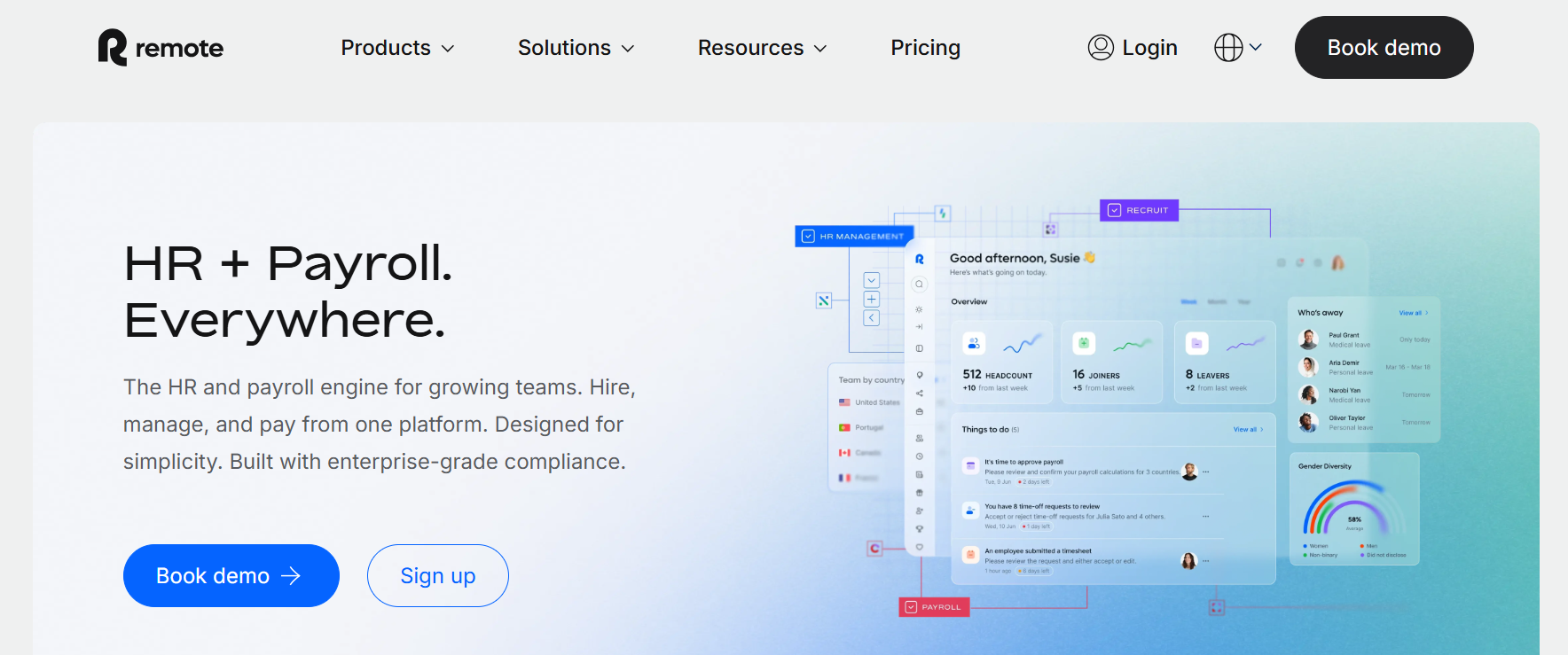
Best for: Full-time global employment relationships
Employer of Record services allow companies to hire employees in countries where they lack entities, provide stable payroll processing and local compliance, benefits administration in supported countries, and employment contracts that comply with local labor laws.
The Full-Time Employment Bias
Remote enables hiring full-time employees internationally without establishing local subsidiaries. It handles complex employment regulations, tax withholding, and benefits administration that larger organizations require when building distributed teams. The limitations surface quickly for contractors.
Remote is designed more for companies hiring employees than independent workers. Freelancers and contractors find limited utility here because the platform focuses on formal employment relationships with benefits, local employment contracts, and regulatory compliance, which they don't require.
4. Payoneer
Best for: Cross-border payments and multi-currency receiving
Multi-currency receiving accounts allow workers to collect payments in USD, EUR, GBP, and other major currencies. Local receiving accounts (US, UK, EU bank details) make it easier for clients to pay you. The platform has global acceptance on freelance platforms and with international clients, plus a prepaid debit card for withdrawing or spending funds.
The Payment Rail Structural Gap
Payoneer is widely accepted globally, with particular strength in developing markets with limited banking infrastructure. Many freelance platforms integrate Payoneer for international payments, which creates network effects that benefit users.
The gap is structural. More of a payment platform than a full payroll solution. Payoneer facilitates receiving and moving money but doesn't handle employment contracts, compliance, or formal payroll processing. Additional fees for transfers and withdrawals can accumulate:
- Currency conversion fees
- Withdrawal fees to local banks
- In some cases, monthly maintenance fees.
5. Wise (Formerly TransferWise)

Best for: Low-cost international transfers with transparent fees
Multi-currency accounts hold 50+ currencies, use mid-market exchange rates without markup (transparent 0.4-1% fees depending on currency), include local account details in multiple countries for receiving payments, and offer a debit card for spending in any currency held in the account.
Efficient Money Movement, Not Payroll
Wise has exceptionally transparent pricing and genuinely low fees compared to traditional banks or other platforms. Holding multiple currencies allows receiving payment in the client's currency without immediate conversion, which preserves value when exchange rates are unfavorable. Wise is not a full payroll or employment platform. It moves money efficiently, but doesn't handle:
- Contracts
- Compliance
- Invoicing
- Employment relationships
It's a tool for receiving and converting funds, not managing work arrangements. Workers must handle all employment documentation, tax obligations, and client relationships separately.
6. Oyster HR
Best for: Distributed teams with employment and contractor payments
Combined platform handles both employees (via EOR) and contractors, payroll processing in 180+ countries, compliance management and local tax handling, and benefits administration in supported markets.
Oyster HR serves companies with mixed workforce types (some employees, some contractors) through a single platform. It handles the complexity of different employment relationships across countries, which reduces administrative overhead for HR teams managing diverse global teams.
Like Deel and Remote, it primarily serves employer needs. Workers benefit from reliable payments and proper contracts, but don't gain additional financial tools or flexibility beyond standard payroll processing. The platform solves for company efficiency, not worker financial experience.
7. Papaya Global

Best for: Enterprise-scale global payroll with deep compliance
Enterprise payroll infrastructure across 160+ countries, automated compliance and tax calculations, multi-entity payroll consolidation for large organizations, and real-time payroll analytics and reporting.
Enterprises choose Papaya Global because it handles complex scenarios:
- Multiple legal entities
- Diverse workforce types
- Consolidated reporting requirements that smaller platforms struggle with.
The depth matters when managing thousands of workers across dozens of countries.
Papaya is built for enterprise employers, not individual workers or small companies. Its complexity, pricing, and features are designed for HR departments managing hundreds or thousands of global workers, making it impractical for freelancers or small distributed teams. You need enterprise-scale problems to justify enterprise-scale solutions.
8. Multiplier

Best for: Growing companies scaling internationally
Employer of Record services in 150+ countries, contractor payment processing, compliance automation for employment and tax regulations, and onboarding and offboarding workflows. It appeals to scale-ups because it balances comprehensive features with more accessible pricing than enterprise platforms. Serves companies in growth phases expanding internationally, which means the feature set scales with organizational complexity.
A middle-market focus makes it less suitable for very small teams or individual contractors. Like competitors, it emphasizes employer compliance and administration over worker financial experience. The platform optimizes for companies hiring their 10th through 500th international worker, not their first or their thousandth.
9. Velocity Global

Best for: Established companies with complex international workforce needs
Global Employer of Record and contractor management, payroll processing with local compliance expertise, immigration and visa support services, and risk management and employment law guidance.
The Enterprise Consulting Model
Velocity Global has deep expertise in employment law and international HR compliance. It provides consulting alongside platform services, which matters when navigating unique regulatory situations or complex multi-country employment scenarios.
The platform serves established companies with budgets for premium services and consulting. Individual workers don't interact with Velocity directly because their employers use it to manage employment relationships. Higher pricing reflects a comprehensive service-and-consulting model that makes sense for enterprises, not for startups or freelancers.
10. Globalization Partners

Best for: Rapid international expansion without entity establishment
The Employer of Record platform enables hiring in 187+ countries. It provides full-service HR, including:
- Payroll
- Benefits
- Compliance
- Legal entity infrastructure in each country
- Dedicated service teams to support hiring and HR processes
Speed to market matters here. Can hire employees in new countries within days rather than the months needed to establish legal entities. Comprehensive service model reduces internal HR burden for companies expanding quickly into new markets.
Premium pricing reflects a full-service model. Designed exclusively for employers hiring internationally, with no relevance to freelancers, contractors, or individual workers seeking payment solutions. Workers employed through Globalization Partners receive standard local employment arrangements (reliable but without innovative financial tools).
What the Comparison Reveals
Most platforms in the multi-country payroll space optimize for one of two outcomes: employer compliance or payment efficiency. Few address what happens after the payment lands. The worker still needs to convert, withdraw, spend, or save those funds, often through separate tools that add friction and cost.
Payroll Platforms as Financial Infrastructure for Workers
Platforms that combine payroll infrastructure with worker financial tools, such as payroll software, shift the value proposition from transactional to relational. Instead of just processing payments, they provide accounts, cards, and currency flexibility that make earnings immediately usable. That dual focus (employer compliance plus worker financial access) addresses both sides of the employment relationship rather than treating workers as passive recipients.
Choosing the right platform means understanding which problem you're solving. If it's pure compliance and contract management, Deel or Remote make sense. If it's low-cost transfers, Wise works. If it's making money instantly accessible and usable for workers while handling compliance for employers, platforms with integrated financial infrastructure deliver more complete solutions.
The Real Difference: Getting Paid vs Actually Using Your Money

Most platforms solve the payment step. Very few solve what happens after. On paper, getting paid means the transaction is complete. In practice, that is only the beginning of the worker experience. Once the money arrives, the real questions start:
- Can you hold your income in a stable currency like USD, or are you forced to hold it in a local currency that may lose value?
- Can you spend it immediately?
- Do you need to transfer it again, wait for settlement, and pay another round of fees?
- Can you access it globally, or is it locked into a local banking system?
This is where friction compounds.
The Usability Gap After Payment
According to research from McKinsey & Company, digital financial tools that combine payments with spending capabilities significantly reduce user friction and improve financial access. When income can be held, managed, and spent in one place, the need for multiple transactions disappears.
The difference shows up in everyday life. Instead of waiting days and paying multiple fees, income becomes immediately available. Instead of losing value through repeated currency conversions, workers can hold funds in stable currencies. Instead of juggling platforms, they operate within a single system.
When Payment Doesn't Equal Access
Traditional payroll ends at disbursement. The platform sends money, marks the transaction complete, and moves on. What happens next (conversion, withdrawal, spending, saving) becomes the worker's problem to solve through separate tools.
That fragmentation creates real costs. Each additional step means another fee, another delay, another conversion that erodes the payment's value. For workers in markets with limited banking infrastructure or volatile currencies, these barriers can make the difference between financial stability and constant stress.
According to the Bank of America Institute, 8 in 10 Americans live paycheck to paycheck. For global workers facing currency volatility and cross-border payment friction, that pressure intensifies. Getting paid on time matters less if the money isn't accessible when bills come due.
The Infrastructure That Makes Money Usable
Without integrated financial tools, income loses value through delays, conversions, and friction. With them, getting paid becomes usable income, not just a completed transaction.
Platforms like payroll software address this by providing workers with global accounts where funds can be received, held in stable currencies like USD, and spent immediately through integrated cards. Instead of treating payroll as a single transaction, they create a continuous financial infrastructure that serves workers beyond the payment moment.
The shift matters because it changes the meaning of payroll. Not just money sent, but money that's immediately accessible, stable, and usable across borders without additional friction or cost.
Related Reading
- Papaya Global Alternatives
- Rippling vs. ADP
- Global HR Systems
- Adp Alternatives
- Deel Vs Remote
- Best Multi-Company Payroll Software
- International Payroll Companies
- Oyster Hr Alternatives
- Employer Of Record Service Companies
- Best Multi-country Payroll Softwares
- Deel Alternatives
How Ontop Helps You Get Paid and Actually Use Your Income

Getting paid quickly across 150+ countries reduces the waiting time typically associated with cross-border payments. Once the funds arrive, you're not forced through another layer of transfers or conversions. You can access your earnings in USD, which helps preserve value and avoids unnecessary foreign exchange losses.
From there, the experience continues. With a global Visa card, you can spend your income directly, without moving it between platforms or accounts. The same system that delivers your income also supports how you use it day to day.
Why Currency Stability Changes the Equation
Holding earnings in a stable currency matters when local currencies fluctuate. Workers in markets with high inflation or volatile exchange rates watch their income lose purchasing power between the moment they're paid and the moment they need to spend. Access to USD accounts removes that erosion, turning income into a store of value rather than a depreciating asset.
The practical impact is immediate. Instead of converting funds multiple times (once when received, again when spent internationally, possibly again when saved), you hold and use money in the currency that maintains its value. That eliminates the compounding losses from repeated conversions over traditional banking rails.
The Unified Financial Experience
Most workers face delays because payments are processed slowly through intermediary banks. They encounter currency friction because platforms force conversions at unfavorable rates. They experience fragmentation because managing money requires switching between multiple services just to access, hold, and spend what they've earned.
The Liquidity Gap Resolution
Platforms like payroll software collapse those steps. Instead of receiving payment, transferring it to another account, converting it, and then finally spending it, you get paid and can use your funds immediately. The difference isn't just convenience. It's financial stability for people who can't afford to lose days or percentages to a broken system.
Workers living paycheck to paycheck understand this viscerally. When rent is due on Thursday, and your payment clears the following Tuesday, the system hasn't just delayed your money. It's created a gap that forces borrowing, late fees, or missed obligations. Immediate access eliminates that gap entirely.
Beyond the Transaction
Traditional payroll treats workers as endpoints. The platform's job ends when the transaction completes. What happens after (how you access it, where you hold it, whether you can actually use it) becomes your problem to solve alone.
Integrated financial infrastructure treats workers as participants. The system doesn't stop at disbursement. It provides the tools needed to manage income across borders:
- Accounts that hold stable currencies
- Cards that work globally
- Transparent fee structures that don't erode earnings through hidden deductions.
This shift turns payroll from a one-time event into continuous financial support.
Book a Demo Today - See Why 950+ Companies Trust OnTop to Power Their Global Teams
If getting paid globally still feels slow, expensive, or fragmented, the issue isn't where you work. It's how you're paid. The infrastructure exists to solve this, but most platforms have never built it with workers in mind.
Start with Ontop Quick Start, no demos or sales calls required. In your first session, you can onboard, receive payments, and access your earnings with tools designed for global workers from day one. The difference between waiting for money and using it immediately isn't a feature upgrade. It's a fundamental shift in how payroll works across borders.